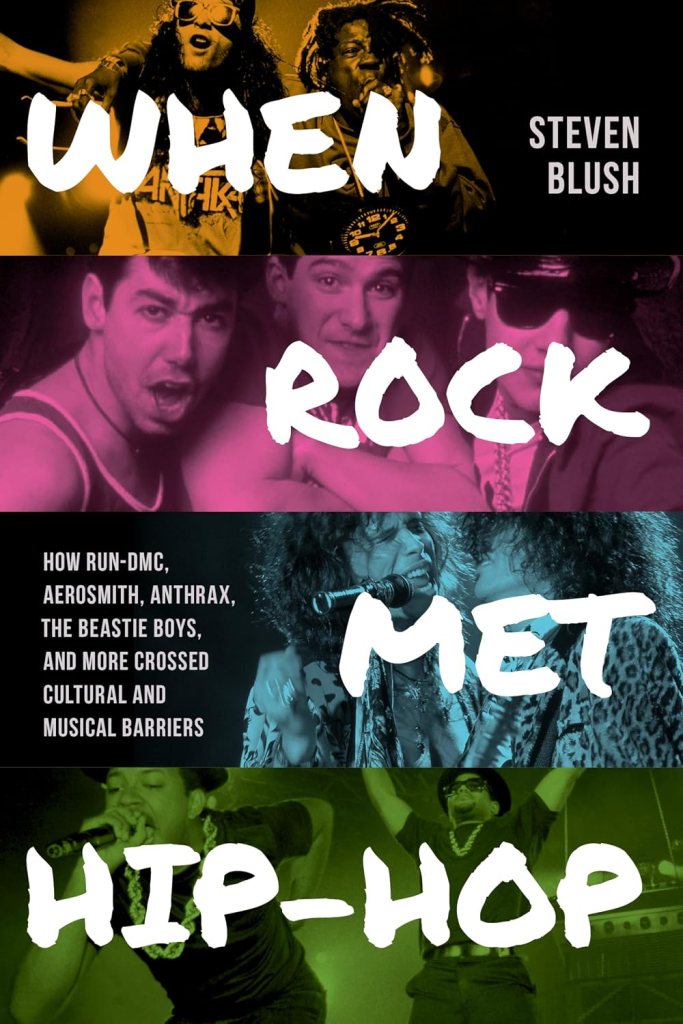
An epiphany hit early in Steven Blush’s “When Rock Met Hip-Hop” (Backbeat Books, 2026). I felt dumb for never making the connection until now.
Rap and punk, argues critic Carlo McCormick, followed a shared aesthetic command: “Rip it up, start again.” From fragmented form, rebuild. Snagged sounds resembled Jamie Reid’s cover art for the Sex Pistols’ “Never Mind the Bollocks” (1977), with its alternating typefaces and sizes — the “ransom note” look — shorn from myriad sources and patched into new contexts and new messages.
If rap and rock once kept a neighborly distance, they were destined soon to collide.
Blush employs a similar creation technique here, one in line with his “When Rock Met” series (other volumes cover reggae and disco). He spreads archival interviews — many of them his own — amid newer observations to build 255 cohesive pages about this eventful clash. He’s mined relationships between music and culture for years, most famously in his unsinkable “American Hardcore” (2001).
The author’s uniquely positioned for this assignment. After all, he tracked it firsthand. In fact, the first issue of his Seconds magazine a quarter-century ago boasted the Beastie Boys splayed near lures for the Butthole Surfers, Metallica and The Damned.
As he was present for the scene’s New York gestation, Blush begins “When” there. However, rather than skimming overly familiar historic ground, he dives into its living delivery. For instance, most people know Blondie dropped bars in 1980’s name-checking “Rapture” (a service repaid in fat-cut collage “The Adventures of Grandmaster Flash on the Wheels of Steel”), but few are aware of guitarist Chris Stein’s involvement in the public-access “TV Party” program, which featured downtown fixtures Jean-Michel Basquiat and Fab 5 Freddy. So, this wasn’t appropriative cash-in, but honest appreciation.
This section further affirms punk/rap bona fides and the comfort with which they meshed. Most books don’t explore this, too eager to beeline toward milestones. But here they come, these unbeknownst-to-themselves pioneers. Graffiti artists Futura 2000 and Dondi White collaborate with Fab 5 and The Clash (“The Escapades of Futura 2000”). Sex Pistols impresario Malcolm McLaren nails World’s Famous Supreme Team wax-whips through “Double Dutch” and “Buffalo Gals.” Afrika Bambaataa finds common ground with the ex-Johnny Rotten on the political “World of Destruction.”
In three years, rap expanded from good (“Rapper’s Delight”) to rough times (“The Message”), from the neighborhood to the universe at large.
But was the universe ready to listen? Punk was one thing, still an underground movement despite Blondie bridging new-wave gaps to No. 1. Though once pilloried equally as not-music, mainstream rock was another matter.
When hip-hop landed, it seemed to fascinate and excite the musicians themselves. Many white rock fans, however, dismissed it as talking over stolen art, the not-music of not-musicians — a strangely militant stance on “authenticity” considering rock’s not-white roots.
Yet there was no stopping what came.
“When Rock Met Hip-Hop” was published earlier this year.
Rising, surprising and often hypnotizing
Naturally, this New York peaks with Run-D.M.C., the Beastie Boys and Public Enemy, starting with the former’s 1983 application of Billy Squier’s “The Big Beat” to “Here We Go.” (Although Squier’s comically notorious for that “Rock Me Tonight” fumble, rappers value his catalog, and he jokingly calls himself “the Robert Johnson of hip-hop.”) The trio tightened this fusion on “Rock Box” the following year.
But no one could predict what happened when Def Jam rock-fiend Rick Rubin convinced D.M.C. to revive 1975 Aerosmith chestnut “Walk This Way” with the actual band. Would the then-lapsed rockers pull it off? Hollowed by burnout in ’86, they seesawed between self-immolation and explosive rebirth. When the joint video premiered on MTV, my father recognized Steven Tyler and Joe Perry. I, at 13, assumed they were actors, hired to embody some Stones/metal hybrid as satire.
It’s interesting to note that the Hollis, Queens, rappers initially wanted no part of it: “Aerosmith? Our fans are gonna tear us apart.” Yet the effect was transformative. Joey Kramer’s drum intro spoke hip-hop fluently. Perry’s guitars wove a welcoming base. And Steven Tyler’s jabber fit Run-D.M.C.’s call-and-response braggadocio. Not only that, he emoted his brains out in the $67,000 video, toppling the forms’ barriers with a literal mic stand, inviting rap into that venerated space forever.
Rubin pulled the same trick that year for the Beasties’ “Licensed to Ill,” cadging Zeppelin riffs and inviting Slayer guitarist Kerry King to punctuate the jock-strapped sendup “(You Gotta) Fight for Your Right” and “No Sleep till Brooklyn,” itself a reference to Motorhead’s “No Sleep ’til Hammersmith,” with some captured-live accompaniment. (Perhaps in response, Zep frontman Robert Plant in ’88 threaded “Tall Cool One” with clips of his own band’s work. With a catalog that divine, why not plunder yourself?)
Despite the seven-week chart topper’s classic status, the trio would soon repudiate “Licensed” and strike out on its own. First came 1989’s “Paul’s Boutique” with the Dust Brothers, a multi-layered rock/soul/random-sample masterpiece impossible today.
Unappreciated in its time — exiled to cutout bins within six months, too exotic for suburban sponges — it regained popular traction with each successive mind-blowing Beasties release: the high-as-fuck “Check Your Head” (1992), then “Ill Communication” (1994), featuring the punk-fringed “Sabotage” and named by an equally high-as-fuck Q-Tip of A Tribe Called Quest on “Get It Together.”
If Run-D.M.C. and Aerosmith comprised a forced marriage that somehow worked, Blush suggests that Public Enemy and Anthrax were a mutually appreciative statement of purpose.
P.E. played with metal from its ’88 bow, boosting emcee Chuck D’s bark with Slayer’s “Angel of Death” on “She Watch Channel Zero?!” “Bring the Noise” references Anthrax, which had wetted its own rap beak on “I’m the Man” and UTFO’s “Lethal.” The bands mirrored each other’s sonic aggression, one vocally, the other musically. Sartorially, too, as Anthrax stalwart Scott Ian frolicked in Public Enemy tees. So their 1991 union felt inevitable, yielding a thrash-bottomed “Bring the Noise,” where Ian’s band rocked bells as itself.
And the blend struck hard from coast to coast — growing in density, more advanced, at times imperceptible — the assimilation near complete.
Freedom of speech, that’s some motherfucking bullshit
Anger informs Blush’s West Coast tour. No surprise: The ’90s burned hot. Earlier, the Red Hot Chili Peppers crammed slap-bass funk up its own buzz. Faith No More sneer-raged a bouillabaisse of everything. N.W.A. needed no guitars to vent in 1988’s “Straight Outta Compton,” casting their horror through speech.
Then came Rodney King. The L.A. riots. O.J. Simpson. Revolution, a bygone phantom resummoned, scorched newscasts. Racism unveiled itself as an unwelcome guest that never truly left, carefully stuffed in America’s front pocket. But hip-hop rose to expose it. “Rap music is the invisible TV station that black America never had,” Chuck D said in 1989, a likening since truncated to “the black celebrity.land.” Five years after that pointed remark, Public Enemy waxed the decade’s most accurate deva-state of the union with “Muse Sick-n-Hour Mess Age.”
The merger turned darker, more hardcore, hope-free, furious: House of Pain, Cypress Hill. White kids schooled in the form found ways to weaponize it: Downset, Kottonmouth Kings. The racially mixed Rage Against the Machine preached and charged hard. Inspired by Suicidal Tendencies, rapper Ice-T launched Body Count, matching his fuck-you verbosity with musical abrasion. A proposed “Ghetto Metal” summit involving N.W.A.’s Dr. Dre and Eazy-E never came to fruition. Others did, however, from Audioslave to Prophets of Rage, each attached name wielding cultural power.
These communions prelude the section’s highlight: the “Judgment Night” soundtrack, which has since outpaced its parent ’93 thriller. The movie tried to capture class warfare, dropping Emilio Estevez and his manicured-lawn crew into an urban survival plot. All I’ve retained, however, is a ham-boned Denis Leary announcing, “Attention, food shoppers! We have a special over at the frozen-food department: dead meat!” over an in-store PA while methodically offing suburbanites.
Musically, the project lapped the star vehicle, connecting rock acts to hip-hop partners and letting ’em cook. Helmet punched up House of Pain. Biohazard and Onyx, already pals post-“Slam,” tackled the title track. Pearl Jam sharpened Cypress Hill’s teeth. However, the disc’s most successful pairing was accidental: When P.M. Dawn fell out, Teenage Fanclub shoegazed with De La Soul on “Falling,” dreamily marrying Steve Miller “Fly Like an Eagle” harmonies to Tom Petty declarations.
That it warrants full spins years later — I still can’t pass that Mudhoney/Sir Mix-a-Lot joint — is testament to its lasting worth. Same for a 2000 production, Loud Records’
“Loud Rocks,” which didn’t push a hackneyed film (a hard ticket to accidental novelty) but celebrated, on its own terms, integrated schools of thought — anything to get half of Black Sabbath to throw down with the Wu-Tang Clan.
Crossover crosshairs
Once friends with benefits, by 2000 rock and rap were married with kids.
Groundbreaking though “Walk This Way” was, Run-D.M.C. and Aerosmith remained separate entities. The track’s foundation — Kramer’s drums, Perry’s guitar — was old enough in ’86 for your dad’s stacks, otherwise alien to you. And it lived a high school pud-pull fantasy that felt of another time, like a drive-in flick with hairs in the gate.
Still, it and its descendants schooled another generation of musicians, who coupled these sonic elements into a seamless whole.
Let’s start with The Roots, a hip-hop mindstate powered by actual instrumentalists. The era also spawned alt-rap (De La Soul, Native Tongues, A Tribe Called Quest — Del tha Funkee Homosapien and Digable Planets, too), alt-rock rap (Luscious Jackson, Beck, Soul Coughing, Cake), trip-hop (Massive Attack, Portishead, Tricky) and the maligned nu-metal, where Limp Bizkit, Sugar Ray, Linkin Park, System of a Down and Korn faced that timeless pop culture conundrum: when music of defiance and alienation attracted aggressors. Blush even swings through Detroit for the Insane Clown Posse, Kid Rock and Eminem, the latter of whose nimble flows benefited from Dr. Dre’s hip-hop mentorship and easily eclipsed previous white throne-contenders Vanilla Ice and Snow.
Personally, what I loved most about this unputdownable book was revisiting names I hadn’t seen in years. Young Black Teenagers. The Boo-Yaa T.R.I.B.E. I exhumed my Disposable Heroes of Hiphoprisy to unspool the duo’s update of the Dead Kennedys’ “California Über Alles,” swapping Jerry Brown for Pete Wilson, “the baddest governor to ever grab a mic and go BOOM!”
Blush even includes an appendix of “lost gems,” and while I’ll agree that Adam “MCA” Yauch (Beastie Boys) and Jay “Burzootie” Burnett’s “Drum Machine” qualifies, the Fat Boys/Beach Boys’ “Wipeout” didn’t age past ’87 camp. (The author also drops The Jaggerz’s “The Rapper,” recorded in 1970 when the word was hippie slang for conversing, in this case coaxing a woman into bed.)
Still, wherever these genres mixed, audiences responded, then followed en masse. Much like the music itself, sometimes they coalesced, sometimes they fucked shit up. Par for the course in any uprising. As Def Jam’s Bill Adler — who wrote “When Rock Met Hip-Hop’s” foreword — supposed in 2014, “Punk was the revolution that failed; rap was the revolution that succeeded.”
Blush disagrees in part, declaring everyone the winner, with a discography to back his play. Keeping with the neighborhood theme, the blocks threw a party-war, and everyone came.
‘ The preceding article may include information circulated by third parties ’
‘ Some details of this article were extracted from the following source www.phoenixnewtimes.com ’