The Cap Times is an independent newsroom serving Madison and Wisconsin. Sign up for the Food & Culture newsletter for exclusive weekly insight.
If Yelena Andreyevna Serebryakova lived here and now instead of in rural Russia in the late 19th century, she would be a social media influencer. And she’d be bad at it.
Yelena, the disaffected young wife who throws the house into chaos in Anton Chekhov’s “Uncle Vanya,” has no passions. When her stepdaughter Sonya suggests she could help on the estate, teach kids or care for the sick, Yelena scoffs.
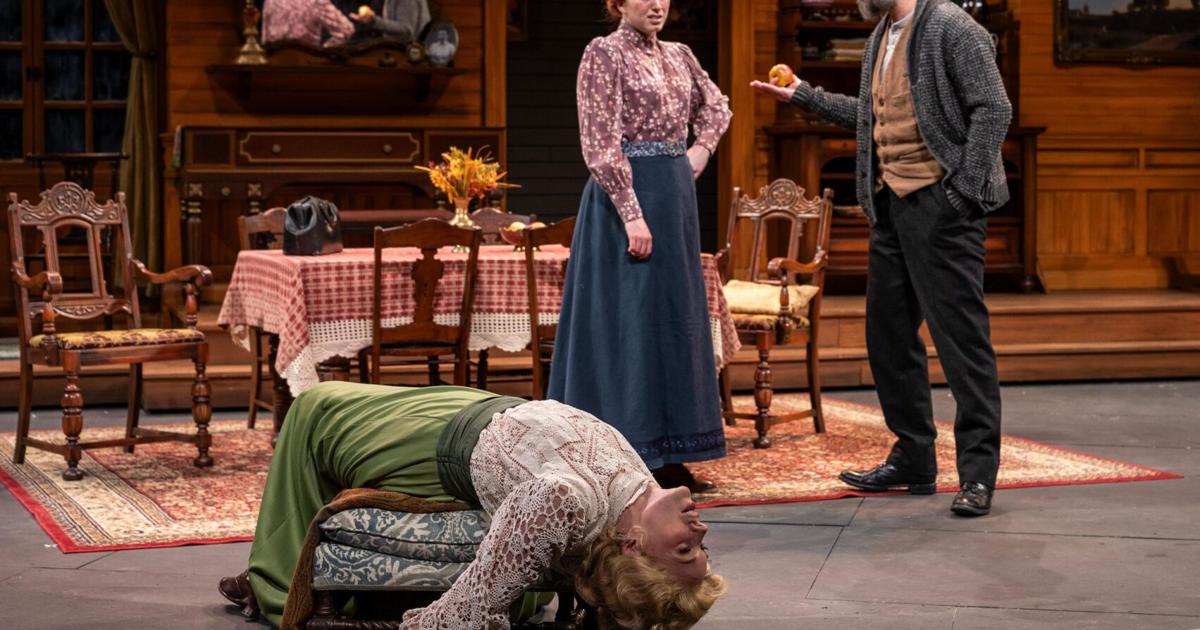
From left, Tracie Lane, Maggie Cramer and Marcus Truschinski play unhappy Russians in “Uncle Vanya,” a new adaptation by Nate Burger at American Players Theatre. Takeshi Kata designed the set.
“I’m not qualified to do any of that! Plus none of it interests me,” she sniffs. “You want me to start handing out literature to peasants?”
If Ken’s job is beach, Yelena’s job is beauty. Yelena is pretty and bored, and as Sonya points out, her unhappiness is catching.
Brenda DeVita, American Players Theatre’s artistic director for over a decade, leads this summer’s production of “Uncle Vanya,” where nihilism threatens to win the day. In her director’s notes, DeVita points to the “stagnation and disillusionment” that smothers these 19th-century Russian characters’ “quiet yearning for a better life.”
Sonya’s right. Nobody’s happy on Vanya’s estate.

Dr. Astrov (Casey Hoekstra), Waffles (David Daniel) and Vanya (Marcus Truschinski) drink and sing and bemoan their lives in “Uncle Vanya” at American Players Theatre.
Tracie Lane plays Yelena with the melodramatic air of a teenager who can’t even pretend to be interested in anything other than her own inner monologue.
Yelena’s elderly professor husband (played by Brian Mani with an impressive commitment to unlikability) feels ignored and put out to pasture. He has gout but pretends to be ailed by rheumatism. He’s sure nobody respects him anymore.
“Doesn’t age earn you the right to a little egoism?” he pouts.

Yelena (Tracie Lane) wearily comforts her retired professor husband Alexander Serebryakov (Brian Mani) in “Uncle Vanya.” Holly Payne designed the costumes.
The country doctor, Mikhail Astrov (Casey Hoekstra, with an electrifying intensity), drinks too much and resents his patients. He would rather be caring for trees.
“Because of us, forests are dying, rivers are drying up, whole species are disappearing,” he cries.
Dr. Astrov can’t stand the “dull-edged, uneducated worker bee” types in the country, but he doesn’t fit in with the educated classes either. In this new adaptation of Chekhov’s text by Nate Burger, Astrov calls himself a “weirdo.”

Yelena (Tracie Lane) attempts to bond with her stepdaughter, Sonya (Maggie Cramer) in “Uncle Vanya” at American Players Theatre.
Sonya, played with prodigious energy and extra freckles by Maggie Cramer, has been crushing on the doctor for six solid years, searching in his sloppy drunken ramblings for signs of affection he’s definitely not giving her. (Sonya, girl. If he wanted to, he would.)

Marcus Truschinski, center, plays the title character in “Uncle Vanya,” staged in a new adaptation by Nate Burger at American Players Theatre. Takeshi Kata designed the set and Dawn Chiang designed the lights.
Joyless, self-sacrificing Vanya (Marcus Truschinski, with sad eyes and a graying beard) also drinks too much. He neglects the estate, ranting instead about his wasted life and declaring his (unrequited) love for Yelena, 20 years his junior. He tries to grab her whenever they’re alone together. It’s awkward.
At the start of “Uncle Vanya,” the arrival of the professor and Yelena has thrown off everyone’s routines — even the elderly nanny (Karen Janes Woditsch) complains about the timing of dinner.
Yet new habits quickly develop, which DeVita choreographs in a wordless scene set to music, the cast retracing the same patterns like figures in a cuckoo clock. Rare moments of levity come only in late-night drunken revels, accompanied on guitar by a sad sack peasant nicknamed Waffles (David Daniel).

Burger has adapted the translated text with clarity and a sense of humor. I can’t recall ever hearing “yada yada yada” in Chekhov before.
The world of “Vanya” is equally vivid. Costume designer Holly Payne dresses Yelena in lovely things, like an intricate lace top and a long green skirt that seems to reference Vanya’s insistence that she has “mermaid blood.”
Scenic designer Takeshi Kata’s wood-paneled interior is set off by milk-glass lamps and a mirror that wants to be a metaphor for the people frustrated and stuck. Catch a glimpse of yourself amid this existential suffering and it’s enough to make a person want to seize the day, take a trip, fall in love. I want to do anything but what Sonya and Vanya do, their heads bent, waiting for death.
“Freedom!” Yelena shouts in a moment of brief resolve. “Open water!” I’d love to believe it, but sadly, she can’t even influence herself.
‘ The preceding article may include information circulated by third parties ’
‘ Some details of this article were extracted from the following source captimes.com ’