Last week marked yet another upheaval in the media and entertainment landscape, with the news that Comcast will spin off NBCUniversal’s media and entertainment assets into a separate, publicly traded company.
As my colleagues Meg James and Stephen Battaglio have reported, the breakup unwinds longtime Comcast leader Brian Roberts’ bold bet 15 years ago that merging cable television distribution with a stable of hit films and TV shows, as well as theme parks, would be a lucrative marriage.
Though Comcast was generally considered a good steward of the Universal Pictures movie studio and its theme parks business, the company’s stock flagged for years. Philadelphia-based Comcast lost thousands of broadcast customers from its primary business, and investors soured on the prospects for its legacy cable TV channels that faded with the rise of Netflix and other streamers. Something had to be done — and spinning off the cable channels into a new company called Versant wouldn’t cut it.
The Comcast-NBCUniversal downsizing comes as other Hollywood players are bulking up. Paramount Skydance, of course, is finishing its purchase of Warner Bros. Discovery, while Walt Disney Co. already had its merger era in 2019, when it bought the entertainment assets of Rupert Murdoch’s 21st Century Fox.
Where does that leave the soon-to-be Comcast-less NBCUniversal?
That depends on whom you ask. Not as an acquisition target, according to Roberts.
When asked by analysts whether the split was designed to position the two companies for a sale, he replied, “Absolutely not.”
“This is the right move to put each company in the strongest position to create value, fully monetize its assets and aggressively pursue its own organic growth strategies,” he said in a conference call last week.
Comcast co-Chief Executive Mike Cavanagh tried to hammer home that point in a memo last week to NBCUniversal and Sky employees, saying the soon-to-be separate company would have the “ambition to pursue opportunities that keep us ahead of evolving consumer behavior and audience demands” and the “freedom to explore adjacent businesses.”
That hasn’t quelled speculation about whether NBCUniversal could become the next studio on the block.
Nonetheless, none of the major Hollywood studios are likely to be buyers — after all, two of them are currently merging.
And while Netflix was previously interested in Warner Bros., the streamer is unlikely to be a bidder for NBCUniversal since the company probably wouldn’t want to own the NBC broadcast network or Universal’s theme parks, Rich Greenfield, a partner and media analyst at LightShed Partners, wrote in a note last week to clients.
Netflix declined to comment on the speculation.
Bankers and analysts have also speculated that Amazon MGM Studios could be a potential bidder for NBCUniversal, given it lacks a significant number of franchises and its expanding Prime Video streaming platform. Some analysts, however, think a deal is unlikely because the company would not want to be saddled with a broadcast network.
In any case, a deal couldn’t even take place for a few years due to the tax implications of the split. The spinoff will take at least a year, followed by a two-year buffer to avoid tax penalties.
Which leaves NBCUniversal to maintain and build its own business.
Already, Comcast’s British TV service Sky — which will spin off with NBCUniversal — said it would acquire ITV Media and Entertainment in a $2.1-billion deal. Known for hits such as “Love Island” and “Midsomer Murders,” ITV already reaches about 40 million people weekly; when combined with Sky, the new business will account for about 20% of in-home viewing in the U.K., the two companies said in a statement Sunday.
NBCUniversal already has a stable of valuable franchises, including “Fast & Furious,” “Despicable Me/Minions” and “Jurassic Park,” and its film studio is poised for a big 2026 box-office haul with the billion-dollar-grossing “The Super Mario Galaxy Movie” and Christopher Nolan’s upcoming film, “The Odyssey.”
But arguably, the most intriguing hit it has had this year is Focus Features’ “Obsession,” the $750,000 budget horror film from 26-year-old Curry Barker, who built his reputation on YouTube. The film has now grossed more than $403 million worldwide, and its success, along with that of A24’s “Backrooms,” has galvanized interest in internet-native stories.
Could the independent NBCUniversal look for more of these narratives? Robert Fishman of MoffettNathanson posed the idea in a note to clients that the company could pursue content creator acquisitions “as franchises,” which would allow it to “directly leverage engagement on YouTube, TikTok and other social media platforms as well as to drive younger demographics towards its own flywheel.”
Not a bad idea when most of Hollywood is trying to connect with Gen Z.
Stuff We Wrote
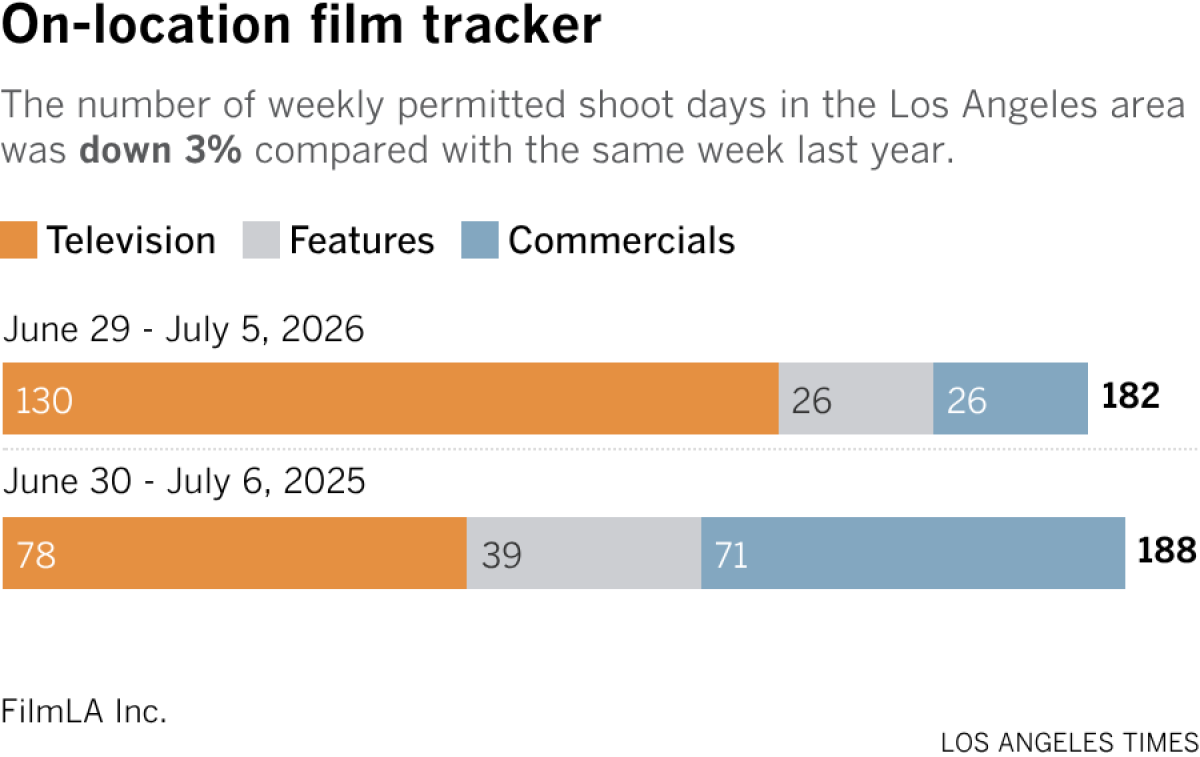
Film shoots
Number of the week

The Minions slipped at the box office over the weekend, as the seventh installment of the “Despicable Me” and “Minions” franchise opened to a lower-than-expected $62 million in the U.S. and Canada for the five-day Fourth of July holiday weekend.
The domestic haul for “Minions & Monsters” marks the lowest opening for the franchise. Part of the issue could be timing — theatrical revenue can be negatively affected when the Fourth of July lands on a Saturday, said Paul Dergarabedian, head of marketplace trends at Rentrak.
However, “Minions & Monsters” still topped the domestic box office and saw a hefty international haul of $85.1 million for a worldwide total of $160.6 million. The movie follows the Minions as they venture through the early Hollywood studio system and try to get their passion project — a monster movie — filmed.
What I’m watching
I started the “Legally Blonde” prequel series “Elle” on Prime Video over the weekend and thought it was cute. I know it’s mid-’90s Seattle, but I chuckled at the copious amounts of drab flannel worn in every scene (except by Elle, of course).
‘ The preceding article may include information circulated by third parties ’
‘ Some details of this article were extracted from the following source www.latimes.com ’