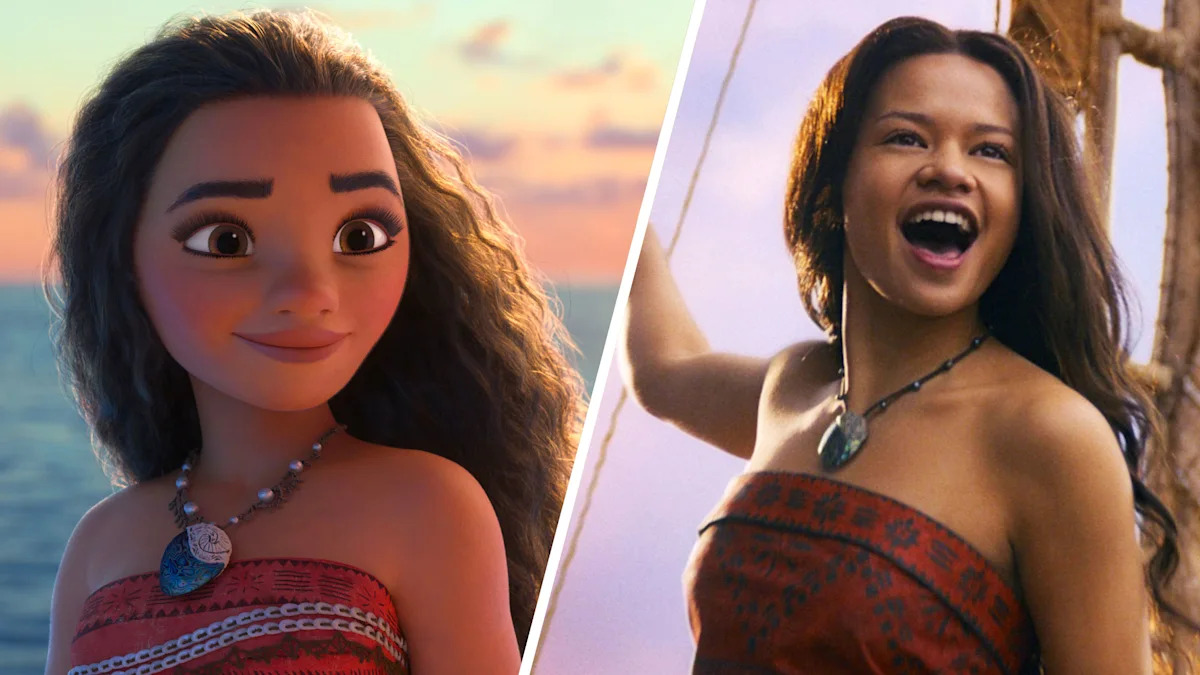
Disney’s latest live-action remake, Moana, hits theaters on Friday. It’s the most recent in a string of films that have repackaged the classic animated movies with real actors and a heavy dose of CGI.
Over the past decade, Disney has released about a dozen live-action remakes, not counting the various new original sequels, prequels and origin stories like Mufasa: The Lion King or Cruella. The studio had previously dabbled in modern remakes, like the live-action versions of The Jungle Book and 101 Dalmatians, in the 1990s, but didn’t go all-in on live action as a core part of its business strategy until recently.
When the new Moana was announced, it was met with many of the same reactions that its live-action predecessors received — many wondered why it should exist at all. That question is especially pointed for Moana, which is coming just 10 years after the animated original. That’s a much shorter turnaround time than any of the other live-action remakes Disney has released over the past 10 years.
More remakes are on the way as well. Live-action versions of Tangled and Hercules are reportedly in various stages of development.
Live action has real traction
On a purely financial front, Disney’s wave of live-action remakes has unquestionably been a success. Four of the films have earned more than $1 billion at the global box office,including the 2019 remake of The Lion King, which is currently the 12th-highest grossing movie of all time with $1.66 billion in revenue. A fifth remake, 2016’s The Jungle Book, came up just short of the $1 billion threshold.
Among the remakes that got a full theatrical release, only last year’s Snow White is widely considered a clear box office flop, losing a reported $170 million. It’s worth noting that four of the live-action redos — Mulan, Pinocchio, Peter Pan & Wendy, and Lady and the Tramp — did not have theatrical releases in the United States and instead came out on the Disney+ streaming service.
In many cases, weighing the economic success of the remakes against the originals that inspired them is challenging because of the decades that separate the films. The world of cinema today is just fundamentally different than it was a generation ago. Tickets cost more. The global box office is a much bigger factor than it used to be. Inflation has significantly reduced the buying power of the dollar. And it costs dramatically more to make a movie now than it did even a few decades ago.
All that said, the imperfect metric of inflation-adjusted box office receipts can still give a solid sense of how the remakes have performed relative to the originals — at least when box office data is available for both versions.
The numbers above reflect only the earnings from the older films’ original releases.
They don’t account for any revenue that might have been generated if they were put back in theaters. In every case but one, the remake brought in substantially more than the original. The one exception is glaring, however. Last year, Snow White pulled in just over $200 million, a paltry sum compared to the 1937 original. The classic animated version ranks as the 10th-highest-grossing film ever in Box Office Mojo’s list of adjusted gross earnings, which accounts for fluctuations in ticket prices as well as inflation.
The four remakes that didn’t receive a traditional U.S. theatrical release collectively earned about $90 million in inflation-adjusted overseas box office revenue. The original films they were based on made roughly $2.5 billion.
To match the performance of the original Moana, the live-action film will need to make close to $900 million.
Are the remakes any good?
Things get more complicated when you move beyond the money and try to judge the live-action remakes on a creative and artistic level. Like all art, movies are subjective. There’s no one metric that can quantify their quality.
Online ratings, for all of their shortcomings, can be helpful. The review site Rotten Tomatoes compiles ratings from hundreds of critics to calculate its Tomatometer score, which is the percentage of reviews deemed positive. By that measure, the original animated versions have rated higher in all but one instance.
Some of the gaps in scores are huge. Disney’s classic animated Pinocchio has a perfect Tomatometer score, while the widely-panned 2022 straight-to-streaming remake starring Tom Hanks is at just 27%. Only one remake, 2016’s The Jungle Book, enjoys a better score than its original, though both versions have overwhelmingly positive reviews.
The originals benefit from selection bias here. Disney has plenty of critical flops in its catalog, but the company is only ever going to choose its most successful and beloved films for remakes. The forgotten fare from Disney’s decades of moviemaking can remain in the dustbin of history.
The results are less lopsided when you consider the Rotten Tomatoes Popcornmeter. That score is based on reviews from moviegoers and serves as more of a measure of whether the audience thinks a movie is enjoyable, rather than whether it’s “good.”
In terms of pure watchability, the originals still come out on top in a majority of cases, sometimes by an enormous margin. But there are four remakes that rank slightly higher than the originals that inspired them. The biggest gap is between the two versions of Lilo & Stitch, where the remake comes in 13 points higher than the animated original.
The live-action Moana has a steep hill to climb if it’s going to outperform the original in the eyes of critics or the audience. The 2016 version has a Tomatometer score of 95% and a Popcornmeter score of 89%. As of Wednesday afternoon, its remake had a critics score of 33%.
‘ The preceding article may include information circulated by third parties ’
‘ Some details of this article were extracted from the following source www.yahoo.com ’