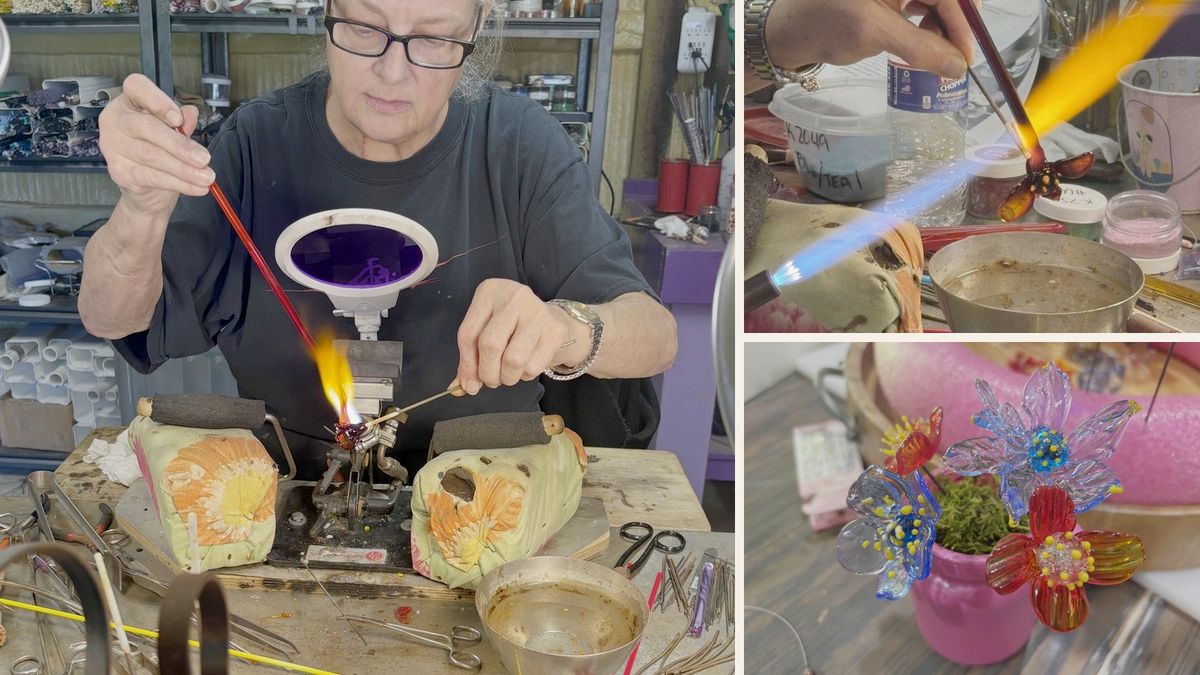
LAWSON, Mo. — As Theresa Cauley-Archuleta steps inside her home-based studio in Lawson, Mo., her world narrows to the glow of a torch, where she turns rods of glass into colorful designs and offers a glimpse into a process many never get to see up close.
Flameworking, Theresa explained, is a torch-based form of glassblowing that offers a more intimate setting and uses a bench torch and small rods of colored, soft glass known as 104-COE. Due to the nature of the glass, it cools fast and can “blow up if it doesn’t have any heat that’s continually going into it,” she said. Every piece, when complete, goes straight into a kiln, allowing it to slowly go back to room temperature to prevent cracking.
Working with the 104-COE glass, Theresa explained, is rhythmic as she “teaches the glass” to go from cold to hot at temperatures up to 968 degrees Fahrenheit. Borosilicate glass, a stiffer material used in traditional glassblowing, allows artists to pause their work and step away, in stark contrast to working with softer variants. Theresa explained that, because she uses “soft glass,” she doesn’t have that ability. Instead, she remains close to the torch and can’t even step away for a moment. Making flameworking more demanding and intimate.
The hands-on nature of her artwork comes to life as she designs flowers, brightly colored fish, wind chimes, and beads that transform into decorative pieces and jewelry. During her working process, she adds frit to give each piece its own texture and color.
Frit, she explained, are small pieces of crushed glass that can also be made into a fine colored powder to add or change the color of the designs. The crushed pieces of glass, she said, are used to add “texture or patterns” to each bead or flower, bringing each piece she creates to life.
‘ The preceding article may include information circulated by third parties ’
‘ Some details of this article were extracted from the following source www.excelsiorcitizen.com ’