After seeing Christopher Nolan’s The Odyssey for the first time early last week, I came away impressed, but somewhat conflicted about two of the film’s more fantastical set pieces. While those scenes were beautifully crafted and tremendously acted, there was something a little bit off about the way they hit my eye. I spent days wondering what, exactly, wasn’t quite working for me during that first theatrical viewing, and I thought that might have just been splitting hairs. But it wasn’t until I saw the movie again over the weekend — this time in IMAX — that the issue became crystal clear.
Though I’d heard all of the buzz about The Odyssey being the first feature shot entirely with 70mm film IMAX cameras, I thought a lot of it was clever marketing hype meant to activate Nolan’s cinephile fan base. I hadn’t considered how watching the film in larger format would make for a markedly different viewing experience. But The Odyssey really is a movie that needs to be seen in IMAX if you want to get a true sense of the story Nolan is telling.
Spoiler warning: This story contains spoilers for The Odyssey (which, to be fair, is an adaptation of Homer’s almost 3,000-year-old epic poem).
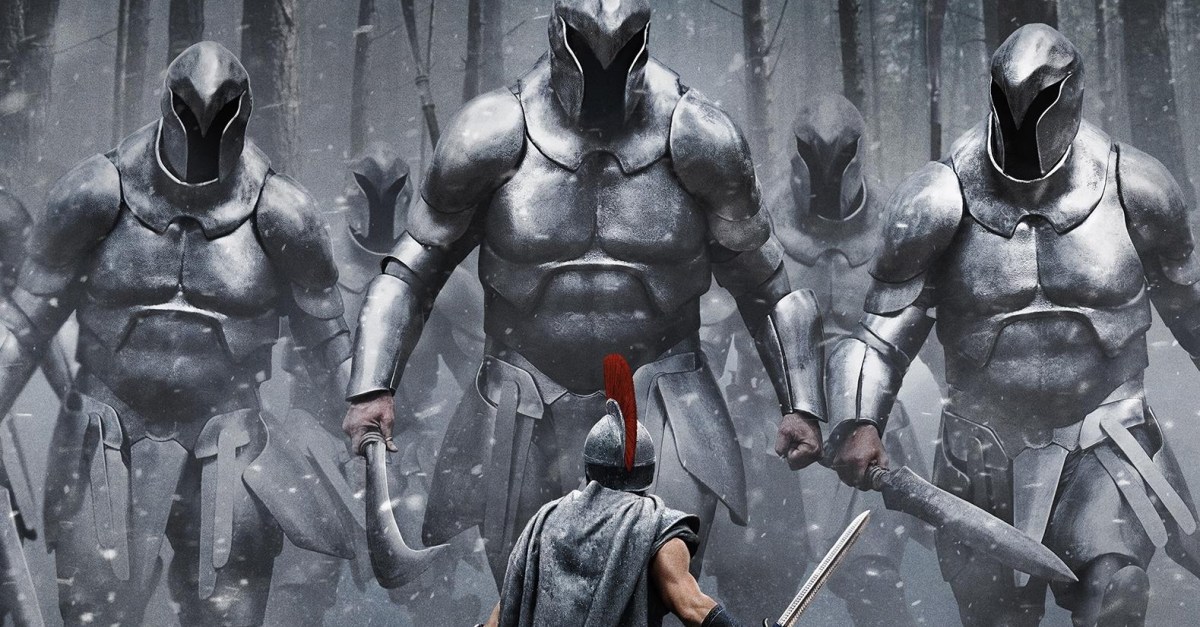
There are many scenes throughout The Odyssey that look perfectly fine when the film is displayed in the 35mm format. Majestic, wide shots of Odysseus (Matt Damon) and his men at sea make you appreciate the Mediterranean’s expansiveness, and you can feel the soldiers’ claustrophobic tension as they hide within the Trojan horse. Even though you can see that the film is cropped, Odysseus’ disastrous encounter with the Laestrygonians gives you a sense of how gigantic they are compared to the wandering Ithacans. But The Odyssey’s scenes involving some of the story’s more gargantuan monsters take on a different gravity when they’re displayed in IMAX because of how much more visual information there is to take in.
When I saw The Odyssey in 35mm — which is projected in a widescreen, 2.39:1 aspect ratio — I knew that the Cyclops Polyphemus (Bill Irwin) towered over the humans who marched into his cave searching for food. But when I saw a standard IMAX screening of the film — whose 1.90:1 aspect ratio is smaller than the 70mm’s 1.43:1 ratio — I had a much clearer understanding of the creature’s stature and the subtle nuances baked into Irwin’s physical performance. Because the IMAX screening projected a taller image, I was able to spend more time taking in details that were easy to miss the first time around, like the way Polyphemus has to hunch in order to keep his head from hitting the cave’s ceiling.
The substantive difference between the two screenings became exceedingly obvious once I saw the Cyclops chasing Odysseus and his men down a mountain for a second time. In 70mm, you can see more of the monster’s upper body as it lumbers through trees in a fitful rage, which brings an added sense of danger and urgency to the chase scene. I had a similar experience seeing the soldiers rowing past a whirlpool not knowing that they were drifting directly into the sea monster Scylla’s reach. The 35mm screening shows you that Scylla’s humongous, but the IMAX screening’s added real estate makes it easier to understand how she’s able to snatch her victims up before any of them realize that she’s lurking in the cliffs above them.
By shooting The Odyssey completely in 70mm, Nolan crafted a film whose size and visual detail could make it feel immersive in ways that most modern features aren’t. But he also chose a format that makes it difficult for most theatergoers to see the movie in its most impressive form. Because there are only about 40 theaters globally (25 in the US) that are able to screen 70mm IMAX films, the vast majority of people will probably never get a chance to take The Odyssey in as Nolan intended. This and the fact that standard IMAX screenings are more expensive than standard movies have prompted some to accuse the director of being anti-art and contributing to the culture of obsessive format purism.
One could also argue that Nolan is using The Odyssey to show IMAX and theater owners that there is a genuine public demand for films shot in 70mm. The current shortage of 70mm screenings of The Odyssey is due to the fact that IMAX hasn’t been able to produce new projectors. Speaking to Variety, IMAX CEO Richard Gelfond explained that the company has largely been focused on retrofitting old projectors, but there aren’t many movie exhibitors willing to take on the construction costs it would take to build the 1.43:1 screens necessary to display 70mm films. If IMAX and various theater chains were willing to pony up the cash for projector part development and venue expansion, 70mm screenings could become more common. But for the time being, the industry seems comfortable using the format’s scarcity as an effective marketing tool.
That marketing strategy has worked for The Odyssey — a highly anticipated project from one of the world’s most revered filmmakers. But Nolan’s star power clearly has a lot to do with the movie’s box office success. There aren’t that many other directors who could get people journeying across the country just to see one of their features. It also helps that the movie is actually worth seeing, especially in IMAX.
‘ The preceding article may include information circulated by third parties ’
‘ Some details of this article were extracted from the following source www.celebrity.land ’