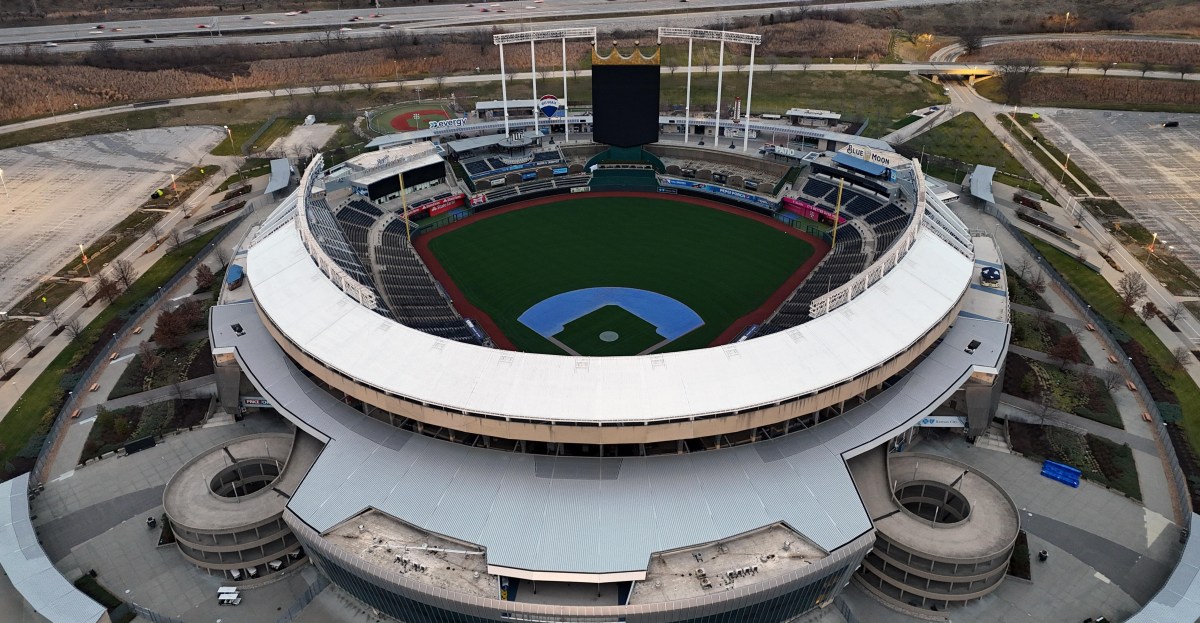
If you’re anything like me, you have seen headlines like this one: Royals stadium vote effort moves forward after signatures verified, and wondered what the heck is going on there. After all, didn’t the Kansas City City Council already approve a new deal for a development at Crown Center? Certainly Mayor Quinton Lucas, members of the council, and the team would like you to believe that it’s a done deal.
But after speaking with members of Missouri Workers Power (MWP), the 501(c)(4) organization behind the effort, I gathered information that I haven’t seen covered elsewhere.
What is this petition anyway?
The organization submitted a petition that was certified last month by the city clerk with over 4,500 signatures. The petition proposes a new ordinance that would require a public vote and approval before any kind of work can be performed on the construction of a stadium with at least 2,500 seats with “material support” from the city for a for-profit entity, including ancillary development or necessary infrastructure.
(a) Except as provided in this Section, any and all City officers, agents, and employees are prohibited from in any way implementing, advancing, furthering, or fostering any plan to design or construct, with material support from the City, a stadium, arena, or similar venue, with a seating capacity of 2,500 or more, for use by a for-profit business, or ancillary development or necessary infrastructure support for that stadium, area, or similar venue.
(b) For any city officer, agent, or employee to implement, advance, further, or foster any plan to design or construct, with material support from the City, a stadium, arena, or similar venue, with a seating capacity of 2,500 or more, for use by a for-profit business, or ancillary development or necessary infrastructure support for that stadium, arena, or similar venue, that plan must first by ordinance be submitted to the voters in an election and be approved by a majority of voters in that election. The City Council shall submit an ordinance for that purpose to the voters at the next available municipal or state election held not less than thirty (30) days after such submission by the Council for which the City can lawfully provide required notices to the election authorities without seeking a court order.
If all that legalese confuses you, it can also be described like this: “The city isn’t allowed to fund or work on a large stadium for private benefit without first putting it to a public vote.” It would also preclude doing infrastructure work to support such a stadium, meaning if this ordinance were passed into law and John Sherman suddenly decided to stop trying to get public money to pay for his stadium, the city still couldn’t pay for or do any work on infrastructure changes without passing a vote about it, either. It’s a pretty comprehensive piece of legislation.
It also, I think, makes perfect sense. As things stand, the Kansas City Government has earmarked up to $600 million for the construction of this stadium. It sure seems, this being a democracy and all, that the people should get to have a say in the allocation of such a colossal chunk of their tax dollars to a private enterprise. And, of course, in 2024, when Jackson County put to a vote the option to fund a new stadium, voters convincingly rejected the proposal. That begs the question of why Kansas City is dodging that requirement and whether it should be able to.
Whether the city should be able to avoid a vote is the question that will be answered by whether this new ordinance is enacted. However, the why is a question we can answer right now: the Royals and the stadium backers in city government don’t want to run the risk of having a plan rejected again.
When the Chiefs and Royals were rejected in 2024, I wrote that both teams needed to take a hard look at the efforts they had made to win the public’s support and do better next time. Instead, the Chiefs jumped at an offer made by politicians in Kansas (which also, notably, lacked a public vote component) and moved across the state line. The Royals chose to deal with the officials in Kansas City*, who passed an ordinance authorizing their city manager to negotiate with the Royals on the new stadium project using an accelerated effective date. Using that strategy ensured not only that the public wouldn’t vote on the initial ordinance, but that they couldn’t even force a referendum per the city’s charter. That’s what appears to have led MWP to draft this broader ordinance and work to get enough signatures to get it to the ballot.
*This is a bit tangential, and might be obvious, but I can’t let it slide that the Royals made absolutely no effort to improve the sham of a Community Benefits Agreement they proposed last time, either. Just further evidence that they do not care what the public thinks unless the public thinks they should have a lot of money with no strings attached.
Literally minutes before this article was scheduled to go live, the Royals announced a “community engagement meeting” to discuss their rezoning plan. That might be a sign they’re changing their perspective in the wake of MWP’s efforts, but I’ll hold judgment until I see how the meeting goes.
How does the petition process work?
I’m so glad you asked, because that’s what I was hugely curious about at the start of this. Anyone in Kansas City can propose a new ordinance as long as they’re a registered voter and can convince four other people to form a committee of petitioners with them. You also need a certain number of registered voters to sign a petition for it, equaling 5% of the number of voters who cast ballots in the most recent mayoral election. In this case, that number is 2,068. The signatures have to be validated by the City Clerk, as they were for this petition.
The City Council has up to 60 days to review the ordinance being proposed, a review period which has begun for this petition as of June 22. During this time, they can opt to simply enact it into law, they can add it to the next ballot, they can attempt to negotiate with the petitioning committee toward a compromise on the new law, or they can do nothing. Once the 60-day period has elapsed, the petitioner’s committee has a 10-day period where they can approve any edits, withdraw the petition, or have the city clerk send it to a citywide vote. If it passes that vote, it would be enacted into law and could only be repealed in the first year by a vote of at least nine city council members, rather than the usual seven.
The Royals don’t really have much ability to directly impact the petition process. I reached out to them for comment just in case they wanted to express an opinion, but they declined. As for the city government, it seems unlikely that the same council that just passed an ordinance in a way that precluded a public vote on this subject would approve the new ordinance without complaint. If they wait out the entire 60-day period and do nothing, the ballot measure would miss the August deadline to be included in the November ballot, which means it wouldn’t appear until the April 2027 ballot. According to Mayor Lucas, that will be the plan.
“I think the deal is likely to get done before we even have some of these discussions,” Lucas said, “if we ever get to the point of a public vote.”
Just in case you had any doubt, he is outright saying that he doesn’t want the public to have a vote on this. It’s worth noting also that if the city government continues working on the project, they do so knowing full well that they are doing an end-around against the will of their constituents.
That’s the bad news; here’s the good news: based on the phrasing of the ordinance, even if the city completes all of the necessary legislative work (including passing an ordinance for the TIF and creating and passing the lease agreement), the ordinance above stipulates not just that ordinances can be passed, but that no work on a stadium like this could be performed by City officers, agents, or workers. Even if the stadium was started when this law was enacted, the city would have to stop supporting it until a public vote approving the funding had passed or they’d be breaking the law.
The phrase that was repeated to me more than once when I spoke to Jaeda Roth, one of the members of the petitioner’s committee, was “public need before corporate greed.” As I spoke to Roth about why she thinks it’s so important for the public to have a voice on a new stadium, she told me a story about how she had been apartment hunting, found one she loved, and realized she couldn’t afford the rent on it because housing costs in Kansas City are so high. She finds that she can’t even attempt to be a Royals fan because, no matter where the team is located in the metro area, she can’t afford to go to a game.
When I asked her what her response would be to someone who attempted to point out the alleged benefit to the economy a large stadium could bring, she noted that increasing the public transportation network in Kansas City would similarly add jobs and increase revenues. But it would also be a direct improvement to the quality of life of many who rely (or would like to rely) on public transport for their day-to-day life in ways that building a stadium they can’t afford to buy tickets to never could.
I’ve often heard people argue that it’s ridiculous for ballplayers to make so much money when teachers make so little. I’ve always argued that reducing baseball player salaries will never increase a teacher’s salary by even a single penny. However, refusing to pay for a new baseball stadium and instead drafting an ordinance to spend a similar amount of money on increasing affordable housing, expanding public transit, and improving the education system would do exactly that and so much more.
Why shouldn’t the public get a say in that?
‘ The preceding article may include information circulated by third parties ’
‘ Some details of this article were extracted from the following source www.royalsreview.com ’