Guy Collins has lived a journey of colorful perspective as a juggler. He has seen the world but also interacted with many unique individuals. After many years it led him to his current home of Bennington where he now lives in between gigs that take him both around the world and close to home. Collins will be performing his show and conducting a workshop at Monument Arts Center this weekend. He sat down with the Banner at his home in Old Bennington to talk about exploration, memory and the act of balancing.
Collins spent the early part of his life in Marietta, Georgia. “My dad worked for McDonnell Douglas, and he did what they call an ‘apprenticeship’ back then, but his ‘apprenticeship’ was like seven years long. I mean, nowadays I think you’d call it something different. But he was working as an engineer.” Collins says his dad though always felt like an ‘Englishman Abroad’ so his family moved back to England when he was five. Collins actually started his adulthood as a travel agent. He always wanted to travel the world but was not as interested in school. “I was sort of asked to leave school early because I just didn’t go.” He ended up taking a travel and tourism course. “I excelled in that and became a travel agent for a year.” Collins was 18 at the time. “I had already hitchhiked when I was 14 throughout France and stuff like that. You could do that back then. It was a different age.” He fondly remembers “The Hitchhiker’s Guide to Europe,” which he says is where “The Hitchhiker’s Guide To The Galaxy” probably came from. “We all read that book. And then I met some German hippies at a campsite in Paris. You could just juggle literally and make some money doing that.”
Collins says one of his friends had discovered juggling earlier, “and I was trying to do it — and I could just do it.” The German hippies told Collins: “Oh yeah, we play music on the streets. You should come with us and do that.’ And so we did.” Collins started out playing bongos on the Paris Metro and at festivals. “We were busking with a bunch of hippies, And I got better, obviously. So we did that for a while in Paris.” Collins began to meet other sorts of street entertainers, “which I found fascinating. And then we went off to Avignon specifically for their festival. Avignon [in France] is a pretty big arts festival.” Collins says he was completely taken away by “this street performance thing.” When he went on this trip to Avignon, he met a Portuguese fire breather. “He kind of taught me how to do like the basics of a show, as opposed to standing there and juggling.” He adds there was a little bit of progression in his act. “I wouldn’t call it a story, but an easy way to collect the money at the end,” he adds laughing. “And then I got back to Britain after I had a holiday romance.” He does think back to the south of France during that time. “I was in the Pyrenees…the foothills of the Pyrenees… I ended up there, and it was really nice. That is a place that I can always go back to — and if I ever want to retire — I would like a little full room cottage up there.”
Collins has now traveled all over the world. “When I actually became a performer, it opened up several doors. I went to Australia for a season. I went to India for six months as well as to Nepal.” He smiles that “this work does allows you to travel a little bit more. I’ve been to all the places in the Middle East as well.” He says as far as India he just went there for a while to explore. “I mean, the winter is a slow time for us. I just went one winter, but we stayed for six months. That was back in 1995. I think we spent 800 pounds for that whole time, which is like $1,000 for the whole six months. And we didn’t have a bad time,” he chuckles.
When Collins came back to England, he says he had giardia (which is a intestinal infection) “and I was thin as a rake and looked quite sick.” Collins says he was dancing around on the Tube subway “and I had on all these bright colored clothes that I brought back from India. I also think I had fluorescent hair at the time.” He says he was likely very ‘buzzy’ and happy at the time. “And this guy said to me: ‘Can you sit down for a minute?’ And he starts talking, ‘Would you mind modeling for me?’ And I said, ‘Why?’ And it was Paul Smith, the famous designer. He gave me his card and everything. I never did it, but I found it quite interesting, because I really was stick thin. And I was thinking, ‘He’s going for a look there.’”
Collins laughs and says “growing up in England, you’ve got to remember, there’s no sunshine. It’s dark the whole time.” He says people started talking to him about Key West in Florida as this place that you could go to do street performing. “It was a tropical island, and this is after I’d been to Australia for a season.” This was around 1998. “I’d learned to scuba dive in the Philippines on the way over there.” Collins says as far as moving to Key West: “I just didn’t believe it would happen. That it would be a real thing.” He ended up initially going there because there was a street performer festival very briefly on the island in Mallory Square. ”It was a sunset-type celebration. It’s dying a bit now. I came to that during one November, and my friend Gazos, a magician, took me over to the Hilton, and they offered me a job straight away, working their version of the sunset celebration.” Collins was able to get paid a stipend, and tips. “I worked every single night, and I did that job for 10 years.” Before he had started that gig, he had actually bought a place in Key West. “I just went back and visited Key West with my daughter two weeks ago. We stopped there on the cruise where I was performing.” He says ironically the first place they stopped by when they were there was where she went to school. “We left Key West because I didn’t want her to [grow up to] become a stripper,” he jokes. Collins does muse that “the wall that I built around our house is still there.” When his daughter was seven or eight, he says they decided to move away from the island “because we realized that people just had different values in Key West.” For his daughter growing up there, he says it was a thrill, “because she spent the whole time on the beach, and all their parties were at the beach. All the kids could swim before they could walk. It was nice, except it was hot in the summer, because we literally lived there all year round.”
His daughter was in the gifted program and he wanted her to go to a place with better schooling. “We looked at the schools in Vermont which [at the time were considered] the best schools in the country.” They ended up moving to Warren, Vermont near Sugarbush. Collins says Warren had the second best elementary school in Vermont at the time. “We moved here there. But when we got there we told them, ‘Oh, she’s gifted and talented student.’ And they went, ‘Well we don’t have one of those schools here.’ So it turned out she was just at the same level as everybody else in Vermont.” He relates that this was around 2010.
Collins says once he moved to Vermont, he tried to book as many local gigs as possible — though he still does travel extensively, especially when working on cruises. “So I’ve got all my Vermont fairs back from three years ago. I’m doing the Champlain Valley Fair. I’m doing Tunbridge World Fair, which I love. It’s just so beautiful there. And I share a stage with the Ed Larkin dancers who’ve been there since 1946 or something. They’re really lovely, and just so very nice. They bring you cake and stuff like that. They all bring their families, and their children are the same age as me. And then they bring their grandchildren and their great grandchildren too.”
In terms of his difference in approach between a state fair, a Renaissance Festival and then the cruise lines, Collins says his show is basically the same. In terms of his bookings, he tries to keep a balance. “Lately, I’ve been doing more fair work than the other stuff because it is fairly well paid.” He says quite often on a Saturday and Sunday at the fair, “you’ll feel like a rock star. But then on Monday morning, you’re entertaining three people in a car park — and you can see that you’re entertaining three people in a car park. And that difference is kind of huge.” At the fairs, “I do kind of simplify the act because you’re dealing with a very broad range of people there and they want you to be squeaky clean.” He continues when he does his act of the cruise ships, “there’s sort of more of a [mixed] element because you are on a cruise, and on the cruise ships, you can be a little bit more fluid. You just can’t be blatant [in the humor]. It’s like the stuff you would watch in a dry bar. If you’re doing the state fairs, you want to keep it even simpler than that. And then when you’re doing the Ren fairs, then you just want to be bawdy.”
Collins reminiscences that growing up in Britain, every single juggler starts off as a jester “at some blinking medieval castle. And I was no different. I remember I did the Winchester, which was the closest of the medieval towns to us when I growing up. I did the Crusades Experience, and they literally dressed me up as a jester and sent me onto the streets to promote the thing.”
Collins says his performing and jugging career just kind of happened. “I didn’t actually even think I could be what I am.” He admits he didn’t even realize he was a performer “until quite late in the day, and I turned around, and said ‘Oh, this is what I do.’ I mean I think you focus so much on doing a proper job.” He adds, when he was 26, and five years into performing, he was making very decent money. “I’d already been on tour.” But it was also about upping the craft. “At first, you’re just trying to get a crowd, trying to do something that’s valid, trying not to suck. But then with the bigger crowds and more money, [you refine]. And then after a while, it’s like, ‘No. I want to do this my way, and it’s got to be exactly this and nobody else can have done it.’”
That evolution is a result of time, experience and practice. “I think when you start off, you’re like a sponge, and you sort of soak up everybody else’s energy.” Collins thinks back to when he would come down to Covent Garden Market in England. He did that solidly for seven years. “And there was a young performer: Nick. He just came back to perform there actually. But when he started, he was 15 years old…and we were his only influences.” Collins says Nick would literally impersonate all of them. “In his act, he would start off, and he’d do my friend, Dave, and then he’d go into me. You could tell he was literally doing me and doing my trick. Then he’d do somebody else and take on their persona as well. You could literally see that within him.”
Collins thinks that kind of mimicry “happens to all of us but it was just a bit more extreme with him. Eventually his own identity came out. But it was just really nice to watch.” He says some other performers would get frustrated that they couldn’t do his material exactly. “But it just takes a long time to learn.” Collins continues that he remembers copying people when he started. “They were my influences, and then I was trying to put my own personality on [their stuff], before coming up with my own individual tricks.”
Collins says he got hooked on the idea of walking on a rope for his act. “And nobody else was really doing that at the time.” He adds that he worked it out so that he could have people holding the rope, and he could walk on top of it. “But I needed to make that better. So I used to put somebody underneath it, to walk over them.” He adds that he would put a child from the crowd underneath the rope. “And then I would go to work, and get their father in to swap with [the kid] because ‘Really? You’re going to let your child do that?’” Collins admits that “obviously that was a bit. And I think the act developed around those things.” Collins adds that once he had that core structure, “which was basically juggling knives and then the rope and walking on the rope” then his act really developed from there. “And now that is basically my act.”
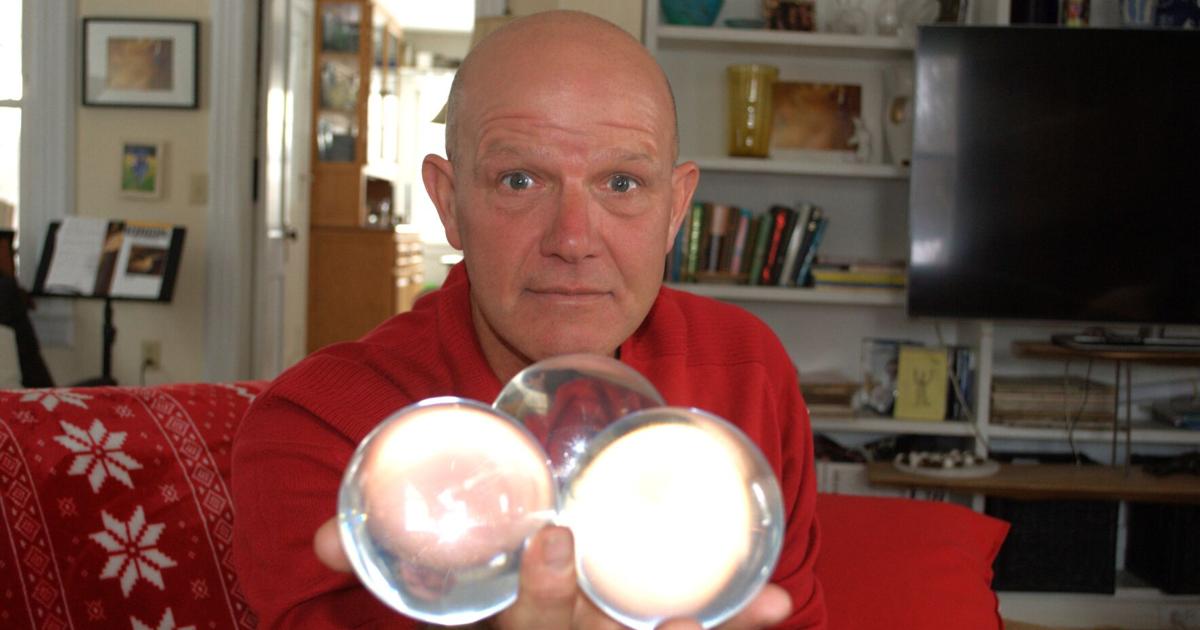
As far as mentality versus physicality, Collins says there is a lot of muscle memory. “I think it is better if I just do it and don’t think about it. If I think about [the act], you’re right…that’s when you tend to mess up.” He does admit that a lot of the tricks he does in his act, “I still have to practice doing. I mean, juggling five pins…it’s not a skill that many people can do. That took me a long time. I still have to practice.” He demonstrates a trick that is muscle memory that he does with heavy glass balls. “If I start to think about it, it can go horribly wrong. In actual fact, it’s two movements that I’m doing to look like one. That took me three months. And then to catch the ball another way and balance. That took ages to do. So that’s another three months. The trick itself took two years just to learn the actual base of it.” He says he can only practice doing the trick 15 or 20 minutes a day, “otherwise you start to really make your neck lock up,” he laughs, “But it’s not something you can just learn. And I think that’s what most people don’t understand.” He also continues that riding a unicycle is actually a really hard skill. “I ride a unicycle in my act. I used to write an eight foot one, but that’s now gone down to six foot,” he chuckles.
This weekend is the first time he will be playing the Monument Arts Center. “I’ve been in there.” Collins says, with any stage, “you’ve got to make sure your angles are good. And there has to be the space I need when I do the rope walking, because I need five people on either end, so a 30-foot space wide.” He says that is pretty much the edge of most stages. “I can do it slightly shorter.” He says he does like a challenge. “When it’s rough on the boat [during cruises], I really like it because it makes it much more fun for the audience. It’s fun to see if I can go on. I mean, the tricks are very hard, but we do them every day. You got to remember… [these skills] are ingrained into us.”
It’s not really like magic, but it is magic. Collins adds that “the fact is that we have trained for years and years and years and years and years and years to do these things. You don’t just do the stuff.” He adds he did go to Circus School in Bristol in England, “and back then there were only two circus schools in the whole of Western Europe. The one in Bristol was called Full Time back then. Now it’s called Circo Media.” He mentions how popular circus (and training) has become. “There were two circus schools in the whole of western Europe back then. Now there are three in Bristol alone. We became victims of our own success.”
Collins says he and his wife Stephanie came to Bennington three years ago. He says during COVID the profit price of his house in Warren went up massively. “Everybody wanted to move up to Warren, which was bizarre. I sold the house there at a decent amount. We did well on that one, which is good, because we did badly in the Key West sale.” At the time, his now-wife Stephanie (whom he met when she was performing as a Queen at a Renaissance fair) was living in Maryland. “She really wanted to get away from that whole DC area. Our kids are the same age, and they’ve all just kind of turned into adults.” Collins said he wanted to live somewhere else in Vermont, “and she wanted to move up to Vermont. So we looked around and we found this place [in Old Bennington], and we’re just really happy with it.”
As far as performing at the MAC, Collins said they were at a dinner party for one of their neighbors, and one of the board members mentioned they were having a gala night: “And would you come along and do some juggling, and Stephanie can sing?” Collins says they were kind of new in town, “and it seemed like a nice thing to do. ‘We’ll support the theater. Sure.’ And it is just around the corner. I wouldn’t do if it wasn’t just around the corner.”
Collins says after his performance this weekend, he will also be doing a small workshop. “I’m going to teach everybody the basics of juggling.” He usually starts the group with juggling scarves. “ And normally, pretty much everybody can juggle scarves. There will usually be a few people that can go straight onto to juggle balls as well.” Collins says he can teach everybody to juggle, “except my daughter, but I think she’s deliberately not learning, although she says she has dyspraxia.” Collins says he teaches people the basic pattern. “Everybody will be able to juggle scarves, and maybe three or four will be able to juggle balls when they leave.” He expects usually a base of 20 people who normally show up to his workshop. He says he teaches balancing as well. “I get them balancing peacock feathers. Everybody can do that, but it’s a great thing because it builds their confidence. It’s something you don’t think you can do but, in actual fact, once you’re shown the technique – and there’s a very easy technique – you can balance it on your feet, and then you can balance on your head. After that it gets harder.”
Collins says he remembers the first time he knew his act was successful. “I remember the feeling of the crowd.” He says it was in Reading, England which is a very local town. He says he also remembers a gig he did in Sweden. “We had to perform on the rooftop of a hotel for a festival, and the band: The Cause had just played before us and there were 30,000 people in the square below us. I had never had a crowd that big before. So you’re performing on the roof, and then this guy comes down from a helicopter, and everybody turned around, and they’re all watching us. There are four of us, and I’m juggling four fire torches.” Collins says the whole time he was just thinking, “Don’t drop. Don’t drop. Don’t drop.” He says the helicopter landed, “and the whole crowd goes off. That’s a massive memory. I remember that one in particular.”
Collins says as a performer, “you remember the light literally of the crowd as you’re doing something. and then sometimes, it’s just the way that people are laughing.” He says “you also remember some of the bad moments. I remember when I snapped my ACL and actually heard it pop. That was the only time I’ve ever had to stop a performance. That was in Key West.”
Collins says he just always wants to do the best show possible for people. “I want it to be original and I do want people to remember what I do. It is about creating that ‘live’ thing. So much of when you’re actually doing the show, it is very much in the moment. I guess I am thinking about creating a memory by just being there. And I like to hear people laugh. I hope that my show is is unique. I’ve worked hard at making it different. And although it’s the same, it is different.”
Tickets to Guy’s show at 7 p.m. March 1 at Monument Arts & Cultural Center [44 Gypsy Lane in Bennington] are available at monumentcentervt.org/groovyguy.
Guy’s performance coincides with the MAC Center’s annual Wellness Weekend, which takes place March 1 and 2. He will lead a special workshop in juggling, which is among a variety of activities — yoga, cardio fitness, swing dancing, sound healing, self-hypnosis, nutrition, stress, and digestion, modern dance, and more — designed to rejuvenate the mind and body. Tickets for the Wellness Weekend are available at https://www.monumentcentervt.org/wellnessweekend.
‘ The preceding article may include information circulated by third parties ’
‘ Some details of this article were extracted from the following source www.benningtonbanner.com ’
‘ O artigo anterior foi obtido e traduzido do site internacional da celebrity.land ’ Source Link