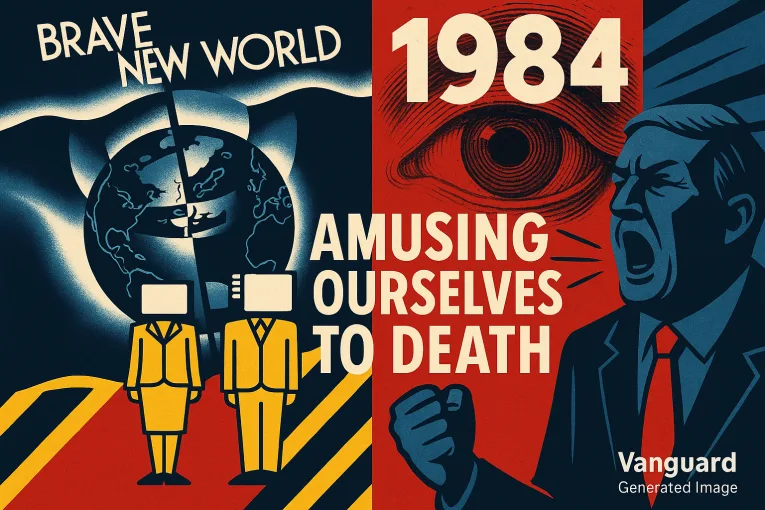
- What Orwell feared were those who would ban books. What Huxley feared was that there would be no reason to ban a book, for there would be no one who wanted to read one.
What Orwell feared were those who would ban books. What Huxley feared was that there would be no reason to ban a book, for there would be no one who wanted to read one.
That, more than any single line of dystopian prophecy, captures the crisis of 2025—a culture so numbed by spectacle, consumption, and digital distraction that it no longer needs to be censored to be controlled.
Neil Postman saw this coming forty years ago when he warned that America’s greatest danger was not Big Brother, but the citizen who willingly gives himself to entertainment.
Today, Donald Trump has simply learned to weaponize that weakness, turning Huxley’s world of pleasure into Orwell’s world of power.
Postman, in Amusing Ourselves to Death, set up Orwell and Huxley as two contrasting warnings. Orwell feared domination through pain and surveillance. Huxley feared domination through pleasure, distraction and triviality.
Postman suggested that the Huxleyan world, where people are lulled into passivity by entertainment, consumption and endless choice, was the greater danger because it would be harder to resist.
The reality, though, is that a Huxleyan world leads us to an Orwellian world.
The distractions, addictions and fragmentations of a Huxleyan society can actually pave the way to an Orwellian one. If people are numbed by entertainment, misinformation and consumerism, they’re less likely to resist creeping authoritarianism.
By the time surveillance, censorship and coercion arrive in force, democratic resistance has already atrophied.
In this line of thinking, Huxley isn’t the opposite of Orwell—he’s the precondition. The softened citizenry of Brave New World makes the rigid controls of 1984 easier to impose.
Postman’s core claim was that the medium is not just the message as Marshall McLulan once put it but rather the medium is the way a culture decides what counts as truth which in the current reality is downright frightening.
Postman saw that a society organized by print rewards patience, sequence, logic and evidence. A society organized by images rewards speed, emotion, brevity and showmanship.
Television ushered in what Postman called the Age of Show Business, in which news, religion, education and politics learned to survive by becoming entertaining. The internet and social media completed the transformation. In fact, it obliterated the concept of objective truth and more importantly the notion that anything can be objectively false.
What was once a one-way broadcast of images is now a participatory spectacle in which everyone is both a performer and an audience. The old gatekeepers are diminished, but the new ones—algorithms—are invisible systems optimized for engagement, not truth.
The result is not more freedom but a new kind of control, a Huxleyan control that rarely needs to censor because it can drown.
This is why the last decade of American politics looks at once absurd and dangerous. The absurdity is the Huxleyan part: a feed where a constitutional crisis sits next to a dance clip, a wildfire beside a meme, a policy announcement wedged between ads.
“Now … this,” as Postman put it, is the grammar of a world without continuity, where every fragment erases the last. The danger is the Orwellian part: the collapse of shared reality that follows from sustained distraction and emotional manipulation, and the easy opening that collapse creates for the leader who thrives on confusion and fatigue.
The terrain was softened by entertainment long before hard power arrived. In that sense, a Huxleyan world does not refute Orwell’s fear—it prepares the ground for it.
It is common to frame the last decade as a contest between “post-truth” and “fact-based” politics. That framing misses Postman’s point. The problem is not just the supply of facts; it is the structure of attention. A system built to maximize clicks and shares will tend toward content that is simple, emotional and tribal.
Nuance, patience, and self-critique are all punished.
A strongman need not ban books or seize presses—only master the screen, control the narrative, and keep outrage burning so that deliberation never has a chance to cool. A rock group once warned, “We don’t have to burn the books, we just remove them.”
Trump, perfectly adapted to the attention economy he did not invent, instinctively grasped that in a world shaped by reality television, visibility is power and conflict is the fastest route to the spotlight.
Social media made being wrong cheaper than being ignored, and legacy media—addicted to ratings—fed the cycle until every provocation begot another segment, every segment another provocation, and journalism finally dissolved into entertainment.
This does not mean Orwell was wrong, it just means Huxley came first.
A people exhausted by noise and habituated to amusement will struggle to mount sustained resistance to coercion when it arrives. The very capacities democratic citizens need—attention, memory, coherence, empathy—are corroded by the architecture of their media environment.
When the public sphere becomes a permanent carnival, law feels optional, power becomes a vibe, and a culture of distraction quietly erodes the energy needed to uphold the institutions that still exist on paper.
Huxley named the narcotic that stabilized his world “soma,” a painless shortcut to contentment that made unpleasant thoughts unnecessary. Our equivalent is not a pill but a platform.
The feed promises to abolish boredom, soothe anxiety with novelty and convert anger into a sport.
This is not neutrality but ideology encoded—a system that rewards shallow certainty over hard-won conviction and blurs the line between performance and participation.
In that climate, politics becomes a branch of entertainment, and a demagogue’s threat looks less like a boot than a brand.
Postman warned that when every subject is presented as entertainment, serious content is not just trivialized—it is converted into something it is not.
The news becomes a sequence of isolated sensations. Religion becomes intimacy theater. Education becomes gamified delivery. Civic life becomes a competition for virality, and truth is judged by metrics appropriate to a show: reach, resonance and speed. This is not censorship in the old sense.
It is a more insidious kind of control—the displacement of deliberation by attention and the conversion of citizens into audiences.
The Orwell-Huxley frame helps explain why fact-checking alone has failed to repair the public square.
Facts are necessary, but they must live within forms that honor sequence and consequence to be persuasive. The attention market is hostile to those forms. It prefers instant certainty, and certainty is always available to those who prefer identity to inquiry.
A leader comfortable with contradiction can thrive inside that preference. He can contradict himself hour by hour and suffer little because contradiction requires memory and context to sting. Fragment the context, and contradiction disappears.
Postman insisted that technologies are never neutral—that every medium arrives with a program for social change. Pretending otherwise is a confession that the medium has already done its work.
If we want to resist the drift from Huxley’s narcotic to Orwell’s nightstick, we will have to rebuild habits that do not come naturally to the feed. That means revaluing slow reading and long arguments.
It means refusing to measure truth by virality. It means structuring institutions, classrooms and even newsrooms to privilege depth over heat. It means designing platforms and policies that reward provenance, context and consequence. It means, above all, remembering that free speech without a public capable of listening and reasoning is a slogan, not a safeguard.
There is a civic version of the Savage’s claim in Brave New World: the right to be unhappy is, in political terms, the willingness to endure the discomfort of complexity.
Democracies ask citizens to carry competing values at once—liberty and equality, rights and responsibilities, pluralism and solidarity. That balancing act is boring compared to a viral certainty. It is slow compared to a dunk. The fact that it is harder is the point.
Huxley’s citizens surrendered the hard goods of meaning and freedom for the soft goods of comfort and predictability. A people who do the same should not be surprised when the next step is taken for them.
The claim that “Trump is simply using authoritarianism against us” is a way of saying he is not imposing alien rules on an unwilling public; he is exploiting habits we already learned.
Those habits were learned in the marketplace of attention—the joy of unending distraction, the comfort of in-group applause, the thrill of rage without consequence and the boredom with law. A would-be strongman does not need to teach those lessons. He needs only to harvest them.
The urgency of this moment is not that one man is uniquely dangerous, though he is. It is that he is a symptom of a deeper vulnerability—a culture that confuses being entertained with being free.
If Postman is right that “an Orwellian world is much easier to recognize, and to oppose, than a Huxleyan,” then the first task is recognition.
The bars of an Orwellian prison clang. The cushions of a Huxleyan burlesque muffle.
We notice the clang; we nod off on the cushions. The second task is opposition suited to the threat we face.
That opposition will not look like a single dramatic stand. It will look like millions of small refusals to be reduced to an audience—turning off the clip that flatters our side but flattens the truth, rewarding leaders who can speak in paragraphs rather than punchlines, and insisting that schools and civic institutions teach the hard arts of attention, argument and memory.
This is not nostalgia for a vanished print age – if anything we embrace the notion that print is dead. However, this is a demand that our digital age be made compatible with self-government.
There are ways to build spaces that carry more of print’s strengths into our screens: slower defaults, friction that favors reflection, design that foregrounds sources and sequences, civic algorithms that elevate context over novelty.
There are ways to regulate the market for attention so that the cheapest thrills do not always win.
The deeper reason it is necessary is moral, not just procedural. A politics that cannot sustain truth cannot sustain dignity. Citizens become props. Opponents become villains. The future becomes a marketing claim. Authoritarianism arrives not as a sudden seizure but as a long habituation to unreality.
The warning, then, is not only that we are amusing ourselves to death. It is that we are amusing ourselves toward a kind of consent in which coercion will feel like relief. When the noise becomes unbearable, the promise of order will sound humane.
That is the juncture where Huxley’s world tilts into Orwell’s.
Postman ended with a provocation that still stings: the shows that pretend to be serious are more dangerous than the ones that admit they are not.
The talk show that passes as journalism, the news package optimized for mood, the educational spectacle that delivers activity without knowledge—these are the forms that lull rather than alert.
The responsibility of editors, producers, teachers and citizens is to resist the pleasant lie that the important can be made effortless.
The responsibility of leaders is to conduct themselves as if the public can bear the weight of truth.
The responsibility of the rest of us is to prove them right.
While 2025 has been a difficult year and we have watched things decline first in 2017, then with the pandemic, and now with the second Trump term.
However, things are not irresistible – yet. We can still choose. We can choose to read and think in ways that are not immediately rewarded. We can choose to build and support institutions that make it possible for truth to survive its journey through the attention market. We can choose to make politics a forum again rather than a feed.
That will not cure our vulnerabilities overnight. It will, however, thicken the civic muscles that atrophy in a permanent carnival. It will make it harder for the next demagogue to turn every question into a spectacle and every spectacle into consent.
The line between Huxley and Orwell is not a fork in the road; it is a slope and we have been sliding for a long time. The work now is not to pick one dystopia to fear. It is to recognize how the comforts of triviality invite the controls of tyranny and to act in ways—daily, locally, collectively—that reverse the gradient.
40 years ago Postman saw the river changing its course and warned us where it was headed. If we do not want to drift into Orwell’s prison, we must first wake from Huxley’s dream.
Follow the Vanguard on Social Media – X, Instagram and Facebook. Subscribe the Vanguard News letters. To make a tax-deductible donation, please visit davisvanguard.org/donate or give directly through ActBlue. Your support will ensure that the vital work of the Vanguard continues.
Categories:
Tags:
Aldous Huxley attention economy Authoritarianism Democracy Donald Trump George Orwell Internet Marshall McLuhan media culture Neil Postman Political Discourse social media television
‘ The preceding article may include information circulated by third parties ’
‘ Some details of this article were extracted from the following source davisvanguard.org ’
‘ O artigo anterior foi obtido e traduzido do site internacional da celebrity.land ’ Source Link