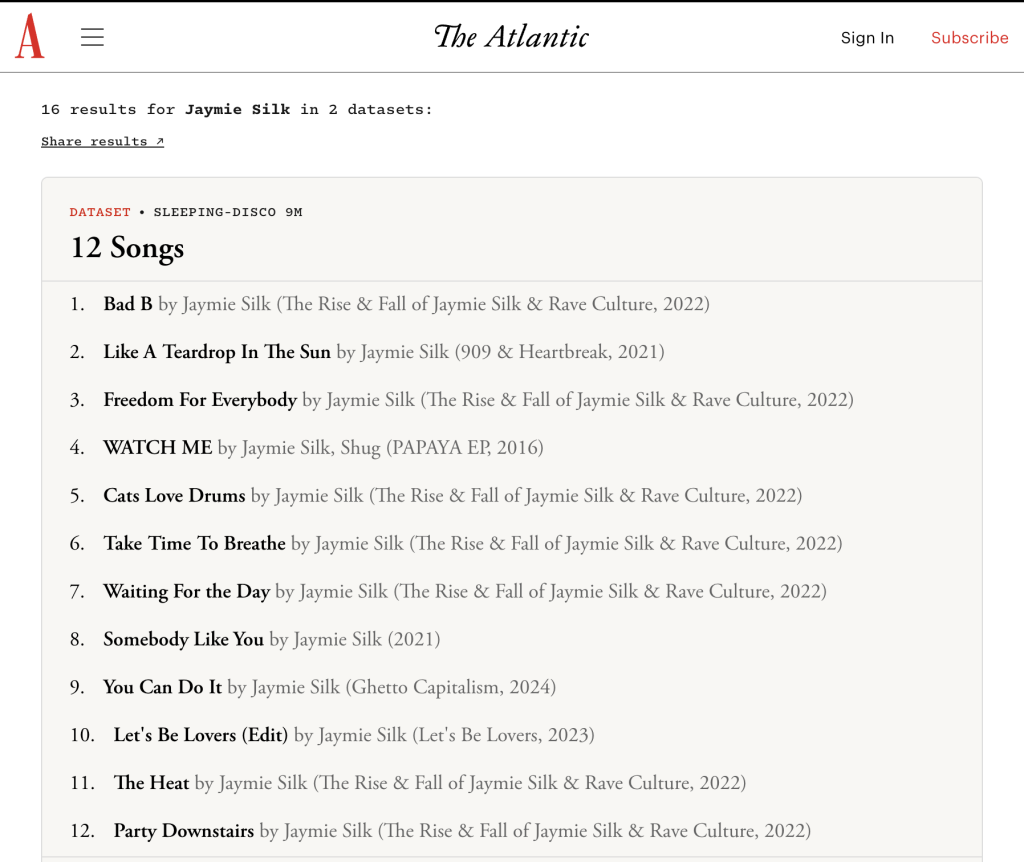
This has to be peak 2026 music tech. Across every feed, producers I follow are posting the same revelation: they’re finding their own music in training sets used by AI. Investigations by Alex Reisner at The Atlantic are making this more visible — and visceral. And the findings are actually much worse than I think artists realize.
The research, the trend
The reason you may be seeing this from artists is that The Atlantic has made searching the databases simple — and the information is not paywalled, either. There’s a search box atop Reisner’s investigative series “AI Watchdog.” Enter your artist name(s), and you’re greeted with a list of songs available in various public datasets used for training. These datasets are widely used as the basis for generative music products.
AI Watchdog – The Atlantic (not to be confused with the nonprofit of the same name)
Reisner details the research process and its significance in the full story:
The Millions of Songs Mashed Into AI-Generated Music
(I’m going to overlook their recent editorial record on foreign policy — like saying maybe killing children is okay — and say, well, 2026 you have to pick and choose and critically filter all media brands to get the whole story. Great work on this one.)
Not everyone will find their work in datasets. But for those who do, the scale can be astonishing. Berlin-based artist Hainbach has a whopping 151 songs in one dataset alone; see his post on the topic. Here in supposedly privacy-obsessed Germany — that’s totally false, but that’s another story — it seems the situation was even worse. From that dataset:
“A collection of 12,320,916 music tracks from YouTube, totaling 91 years of music. The dataset was assembled by LAION, a nonprofit based in Germany that builds large datasets and has received funding from Hugging Face and Stability AI’s co-founder and former CEO Emad Mostaque.”
As Reisner explains, these datasets most often contain just pointers to the music, not the actual audio, but because they’re publicly available, you can bet that some products are using those links to retrieve sound from other audio and video sites. With limited legal precedents or enforcement of usage policies, there’s not much to stop the scrapers.
So that’s bad, right?
Well, actually, it’s much worse than that. This represents only the publicly available information, shared by researchers. This is the tip of the iceberg.
Pillaging and looting
If your music is not in the search results, for one, don’t be relieved (or disappointed, or however you want to feel). These were readily-accessible examples in this investigation anyone could find by following research footnotes. We know that many products don’t disclose which training sets they’re using. (You should absolutely check and verify the sources.) And then some that do may reveal decisions that unnerve makers.
Let’s take Google alone — just one example we know, apart from the bigger iceberg we don’t.
When Google released Lyria 3, they included a statement about responsibilities. Good so far! That includes several measures that should be welcome:
- Avoiding various unethical uses
- Placing guardrails that are meant to avoid directly mimicking a specific artist (like one named in the prompt, for instance), at least in theory
- Those guardrails can fail, so they make some mention of comparisons (apparent checks)
- Watermarking the output with SynthID, identifying this as generative content
- … and some broad language about obeying intellectual property and privacy rights.
Great! Don’t be evil! Love it!
Wait. The problem is, they also said that they’re “using materials that YouTube and Google has a right to use under our terms of service, partner agreements, and applicable law.”
Most of us would read this as “we trained Lyria on music you uploaded to YouTube,” which could include not only direct uploads but music that you or your label transmitted to YouTube via a Digital Service Provider (DSP). As you may have heard, musicians sued. Google’s answer was even more chilling — while moving to dismiss the suit, they would neither confirm nor deny that they had used training (okay, so hearing that you did), and then that their Terms of Service means you gave them right to do just that (now definitely hearing that you did).
Now, Google is a big company — the Magenta team tells me they used stock audio and MIDI for their set, not your work, in their Magenta RealTime 2 project. But think of all the places you’ve uploaded music and clicked “agree” on user agreements, with Google being a prime example.
Add to that “dark” consumption of data — the kind that isn’t disclosed — and this looks really disturbing. (In fact, I should caution that we run the risk of punishing public disclosure or open information if we only focus on these open sources!)
Not so intelligent after all
All of this is significant, because fundamentally what current “generative” AI models do is predictive. “AI” is a big field covering a wide array of processes — everything from Markov Chains to tools that map audio samples into big cloud visualizations. But the resistance to generative AI and “AI slop” come from a particular approach. And I’d argue that people are not being reactive to new tech, but perceptive about the difference between human intelligence and what is marketed as AI. Even without a background in data science and neuroscience, you’re observing correctly that there’s a difference between predictive, normative output from AI models and uh, human beings making music.
The music models generating audio on a platform like Suno are making sounds by reproducing recognized patterns. This has very little to do with how human creativity works, despite the industry’s use of terms like “training,” “learning,” and “intelligence.” You’ll notice that once the industry gets technical, they say “inference.” The lay explanations from companies like Google still veer dangerously into anthroprophization like “a trained model stops learning and starts working, turning its knowledge into real-world results.” Just keep reading, though, and you’ll see what they mean — prediction. It’s very sophisticated prediction, so no, it’s not “auto complete.” But it is in the same family as auto-complete, mathematically speaking — and it’s closer to that than human creativity. (Listen to a toddler riff on a song they made up in their head for comparison.)
You shouldn’t even necessarily trust a data scientist or engineer to fully grasp the difference, because that’s not their field. You can listen to me as a musicologist, but I’m not a brain specialist. You could turn to someone with a PhD in psychology, research in brain science, and a professional relationship with Prince, like — Susan Rogers, for instance:
And then it’s also important to understand tokens. Now people think of tokens as the financial currency of your Claude Code subscription and whatnot, but the term “token” originates in how these large data models divide up materials into smaller pieces, then use them for their predictive output.
In the case of these music models, the actual sound materials do get tokenized, chopped up into these smaller bits. (As AI engineers at Google and whatnot read what I’m writing, I’ll be sure to share if they correct my descriptions here.)
We then have two problems. One, datasets matter a lot to the output, so the lack of transparency and rules around the sources and consent are deeply troubling. Two, our entire society’s notion of authorship and originality can get lost if we churn all of human experience into giant data libraries.
It’s a lose-lose situation. If the output is too close to the source, it’s likely to be read as plagiarism (correctly so). If it’s not close, it remains problematic, because the original meaning is lost.
And there’s the fear: just as we’re now getting with text and imagery, we’re rapidly entering a world where music is a bunch of meaningless “good enough” goop. Slop is great paradigm for understanding what happens if you switch over to all-generative content. It potentially mashes everything into Chicken McNuggets — or, perhaps more aptly, Soylent Green slurry.
So one way to illustrate this, as Reisner does, is that you get stupid things like Czech figure skaters dancing to New Radicals’ “You Get What You Give” but completely wrong. Lyrics minus prosody. And they thought it was “good enough” — which is why this tech holds real disruptive power.
@g_nielsenart ok I know this is an art account but I have been seething about this ever since Shana Bartel caught it and wrote about it in her blog (which you should be reading it’s very good – link below) and I just NEEDED to get it out of me. https://www.patreon.com/posts/142706982?utm_campaign=postshare_fan&utm_content=android_share #icedance #icedancing #figureskating #IceSkating #plagiarism ♬ original sound – GNielsen Art
Arguably, this example is not a good demonstration of the music training impact, because most of what you get here is in the lyrics. But the lyrics are easy to follow; it reveals the token structure underneath. The model spits out these full recognizable text strings, and then mucks up the musical context that gave them meaning and impact. Now imagine the musical materials in the same way, and you should see the problem. You will sometimes get mangled parts of the original corpus. Except when you don’t get that, what you get is not a lot better — the pink slime of music.
If the lyrics illustrate the one problem (outputs that are just regurgitating the input), the music illustrates the other problem (meaningless bland musical nothingness — like even compared to a generic 90s hits playlist).
Plus, back to that matter of tokens having a financial value — you don’t earn anything from this. Musicians sacrifice their entire lives to produce the data set, only to have it chopped up and every little piece becoming a boon for a bunch of investors and tech giants. It’s hypercapitalism’s worst nightmare. The only good news there is that this whole thing is so expensive that people may conclude as I just did that it’s not worth the money. Then the whole system — data centers, big tech, and all the finance that put it in motion — collapses. Schade.
The ultimate appropriation
It should also go without saying that yet again this quckly devolves into class/labor extraction, increasing the gap between rich and poor (or rich and just everybody), and it’s also tied to anti-Black racism and colonialism, especially in the USA. (Look up how many older songs and tropes in the US lead back to blackface and minstrel shows if you really want a linkhole. Yeah, I see you, Mickey Mouse.)
I’m going to resist the temptation to spiral fully into the issue and leave that for another time. But I can’t count the number of times I’ve read an article or heard a piece covering generative AI music where the reporter said, “wow, this is really convincing,” and even used the word “soul” — then played a generated piece of AI music obviously mimicking Black artists.
The ghost in the machine, the rubber “soul,” is Black soul, again, because of course it is.
Since I use Jaymie Silk’s song data above, he quotes SZA who speaks directly to how systemic racism is again at the heart of the matter:
[SZA] said Diplo has equity in Suno. One of the biggest Al music generation platforms right now.
“We make up 13% of the American population yet influence the world w our sound and perspective. I AINT HEARD A WHITE AI SONG YET. We have no protection in legislature medical or creative. The easiest to steal from.”
Jaymie also makes the connection to digital colonialism, and puts the racial aspect bluntly:
Al music needs training data.
The most rhythmically dense, emotionally legible, culturally loaded music in the world is Black music.
House, soul, hip-hop, Afrobeats, footwork, R&B.
Generations of innovation built under economic pressure and structural theft.
See his full post:
And as always, race, class, and other inequities all overlap. Repeat that argument for every music maker who’s on the edge financially, or with their health, or marginalized in other ways. You can also bet that as big labels provide protection and/or compensation for their top artists, the rest of the world — and especially the Global South or whatever you want to call it — will be left out. See the recent deals between the AI industry and the music industry. They’ll take the spoils; everybody else loses.
So there you go. Welcome to the nightmare of genAI. I’d argue this makes frank discussions and transparency even more important — meaning we should continue to dive into the wide range of AI applications and understand exactly how they work. And we should be objective, rather than partisan, about the implications. But those implications may lead you to some pretty inescapable conclusions.
In other words, we need to do more of what The Atlantic just did.
“You got the music in you” wound up being accidentally prescient. There’s probably a metaphor about tokens and inference in these lyrics but I’m going to just stop ranting now. Sorry, we’re now in the white-est, mall-iest 90s place again.
window.fbAsyncInit = function() {
FB.init({
appId : ‘1924463534459933’,
xfbml : true,
version : ‘v2.10’
});
FB.AppEvents.logPageView();
};
(function(d, s, id){
var js, fjs = d.getElementsByTagName(s)[0];
if (d.getElementById(id)) {return;}
js = d.createElement(s); js.id = id;
js.src = “https://connect.facebook.net/en_US/sdk.js”;
fjs.parentNode.insertBefore(js, fjs);
}(document, ‘script’, ‘facebook-jssdk’));
‘ The preceding article may include information circulated by third parties ’
‘ Some details of this article were extracted from the following source cdm.link ’
‘ O artigo anterior foi obtido e traduzido do site internacional da celebrity.land ’ Source Link