The Royals have not historically been a great organization at identifying and developing hitters with strong plate discipline. Since 2000, the Royals swing at more pitches out of the strike zone than any team and rank dead last in walk rate. Too often, the Royals have leaned toward toolsy hitters with athletic upside that come with swing-and-miss concerns, rather than prioritizing hitters whose value is anchored in strike-zone control, contact quality, and good swing decisions.
That may be changing under scouting director Brian Bridges. A common theme in the last two draft classes has been hitters who have a plan when they step up to the plate, with less of an emphasis on speed burners or guys with raw power.
The upcoming draft provides an opportunity for the Royals to improve their stock of hitters in the farm system with some players who can work the count and find a good pitch to hit. Here are some college hitters who may be available after round one that have exhibited some good plate discipline.
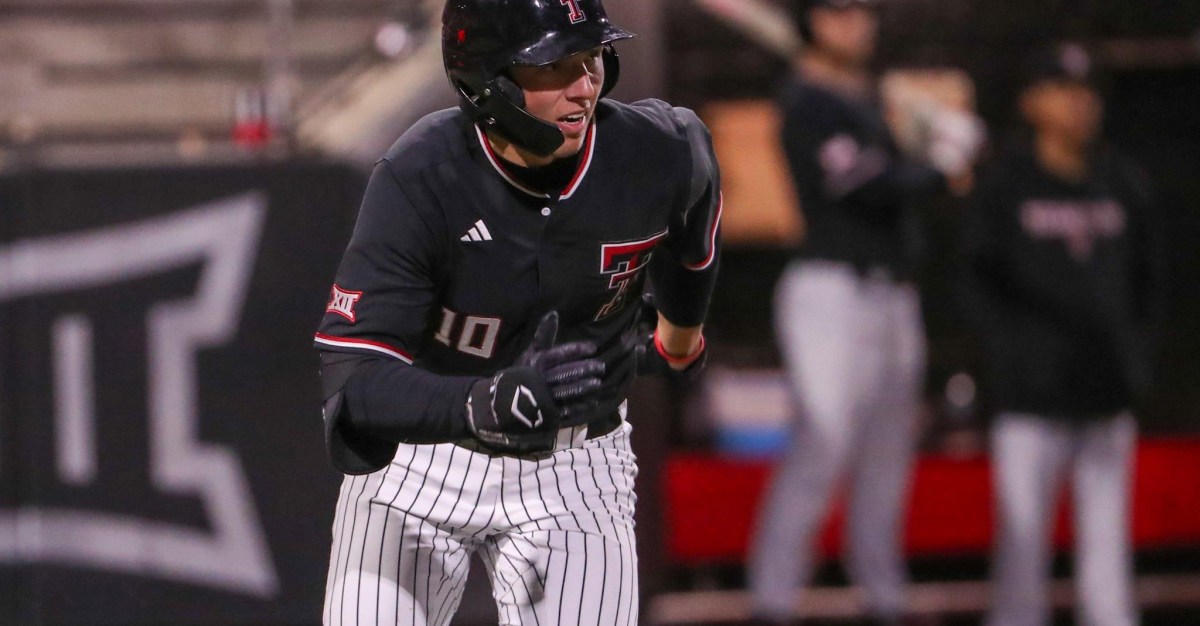
OF Logan Hughes, Texas Tech
Baseball America rank: #45
Hughes is a power hitter who has smashed 37 home runs over the last two seasons for the Red Raiders. He hit .375/.510/.735 with 18 home runs and 50 walks in 55 games this year, earning Baseball America second team All-American honors. They write he is a “patient and selective hitter who does a nice job staying within the strike zone” with a “penchant for putting the barrel on the ball even on the rare occasions when he does expand the zone.” Despite his prodigious power, he wasn’t a swing-and-miss guy, with a terrific 12.2 percent strikeout rate in his career. Hughes doesn’t offer a lot of size or athleticism, and will likely play in the corners, but he brings elite bat speed, a terrific hit tool and good eye to the plate.
OF Ty Head, North Carolina State
Head brings a great approach with solid tools as a left-handed hitter. His 88% overall contact rate and 91% in-zone contact rate put him among the better pure hitters in the class. He hit .291/.460/.556 with 57 walks and just 23 strikeouts in 56 games with the Wolfpack this year, and posted similar strikeout and walk numbers last year. There is some swing-and-miss risk in his timing and a tendency toward a “slap” approach that can limit damage, but evaluators believe there is real hit-tool upside if the swing is refined. Head is a plus runner who could handle centerfield at the pro level, and he developed some decent power this year with 14 home runs.
OF Caden Bogenpohl, Missouri State
A native of the Cape Girardeau area, Bogenpohl is physically imposing at 6’5”, 245 lbs. His exit velocities were among the best at the MLB Draft Combine with Baseball America describing his batting practice as exhibiting 80-grade power. On the other hand, Bogenpohl hit just six home runs for the Bears, hitting .274/.427/.413 with 52 walks in 55 games and a higher groundball rate than you’d like for a guy with his profile. At the combine, he had a more upright stance with a “simpler pre-swing load” so he could unlock more power with good instruction at the pro level. While he does walk, he can have issues with secondaries, and scouts wonder if his plate judgment will translate at the pro level.
OF, Brayden Dowd, Florida State
Dowd began his career at USC, but ended up at Florida State, hitting .293/.456/.527 with 51 walks in 51 games last year. Standing at just 5’10”, he is far from a toolsy hitters, but has a compact left-handed swing with excellent fastball recognition. Baseball America notes that against high velocity (93+ mph) pitches, he has a terrific 96% contact rate. He has some pop, smacking ten home runs last year, but scouts wonder if he will have any power with wood bats. He did struggle last summer in the wood bat Cape Cod League. The Michigan native has above-average speed, and may be able to stick in centerfield.
3B/OF, Brayden Martin, Maryland
Martin stands out for elite contact ability rather than loud offensive production. His contact rates are exceptional- 95.6% overall and 97.1% in the zone – and his approach is defined by extreme selectivity at the plate, including a very low swing rate. He struck out just 20 times in 286 plate appearances, while drawing 56 walks.
The question isn’t whether he can put bat to ball, it’s whether the passivity and lack of impact contact limit his ceiling against better pitching. He hit just five home runs in three seasons with the Terrapins, and isn’t likely to develop more pop on his small frame.
Tiroly is a polished college hitter whose value starts with his approach rather than his tools. The Virginia infielder consistently controls the strike zone with excellent swing decisions and strong bat-to-ball skills, rarely expanding the zone and projecting for an above-average on-base percentage. He hit .319/.408/.576 with 30 walks and low strikeout rate of 16 percent. He hit 16 home runs, but is more of a line-drive hitter who makes solid contact. He’s a right-handed second baseman, a profile that isn’t widely coveted, but if he can continue to hit, he’ll make teams regret not choosing him.
Kent Schmidt, Georgia Tech
‘ The preceding article may include information circulated by third parties ’
‘ Some details of this article were extracted from the following source www.royalsreview.com ’