Staff Picks
It’s not just you: Everything is more expensive these days.
Across the Seattle-Tacoma-Bellevue area, prices are up about 4% from a year ago, according to the Bureau of Labor Statistics. In the recreation category — which includes physical TVs and bikes as well as sporting events and concerts — prices rose nearly 9%.
But there are plenty of local art experiences don’t have to cost you a thing.
Many Seattle museums and even some theaters offer pay-what-you-can options. And galleries are always free. For April, I’ve lined up six excellent art exhibits that happen to be completely gratis.
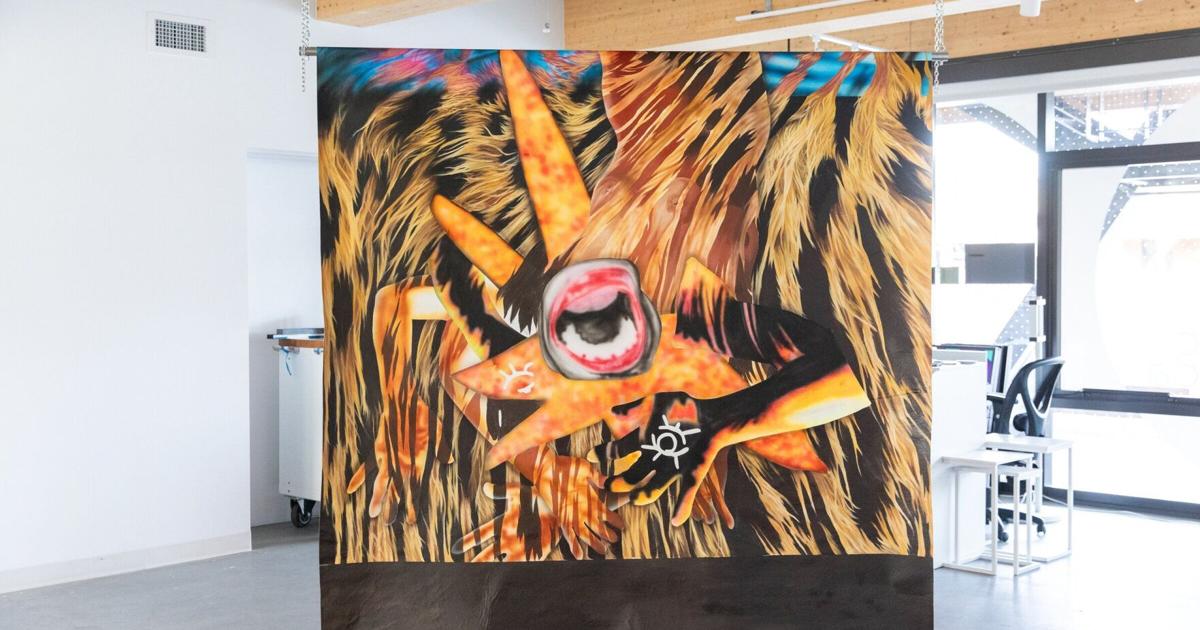
‘Boren Banner Series: Chloe King’
Since debuting in 2020, Frye Art Museum’s Boren Banner Series — a public art project on the museum’s exterior — has made a major impact. At 16 feet by 20 feet, artists get an opportunity to present what is most often their largest work to date, and a concurring exhibition inside the museum brings additional exposure.
I’m excited for Portland/Oakland, Calif., artist Chloe King, a Cornish College of the Arts graduate, to get more attention.
King works with different materials, including photography, video, painting and installation, to question how cultural memory is shaped. This new work deals with queer nightlife as “a sanctuary and site of excess.”
April 15-Oct. 11; Frye Art Museum, 704 Terry Ave., Seattle; free; fryemuseum.org
‘June T Sanders: prairie psalm’
Hands return again and again in June T Sanders’ delicate black-and-white photos. Cupping the sky as if to hold the sun. Offering a photo slide between thumb and forefinger to a friend. Forming a gloved roof atop raised eyebrows.
“Hands contain energy — and at times — landscapes. Anything can be a psalm if it is hallowed like one,” Sanders writes in her artist statement.
The artist and educator lives in the hills of rural Eastern Washington, close to the Palouse Prairie, an endangered ecosystem of gentle hills and grassland meadows where Sanders took many of the photos for this new show.
April 2-May 2; Solas Gallery, 300 S. Washington St., Unit Z, Seattle; free; solas.gallery
‘Preston Singletary: A Clockwork Raven’
In the raven, a central figure in ancient Tlingit mythologies, Seattle artist Preston Singletary has found a luminous new direction for his blown glass designs, which blend his Tlingit heritage with contemporary art techniques.
Continuing his raven collaboration with the writer Garth Stein, known for the bestselling novel “The Art of Racing in the Rain,” Singletary expands on the story of raven in a major new exhibit that is both mythically timeless and politically apropos.
Raven, you see, is all of us: “Driven by hunger, he is always on the look out for opportunities,” Singletary wrote in 2024. “Sometimes he is benevolent and sometimes he represents the worst aspects (of) human nature. He is capable and fallible at this same time, like all humans.”
April 4-25; Traver Gallery, 1100 W. Ewing St., Seattle; free; travergallery.com
‘Eric-Paul Riege: ojo|-|ólǫ́’
The soft sculptures by rising contemporary artist Eric-Paul Riege, who is Diné, aren’t quiet objects. Informed by Navajo weaving and jewelry-making traditions, the works sway and whisper and jingle, rustling and reacting to the touch.
For this exhibit, Riege studied the patterns and construction of Navajo weavings, weaving combs, textiles, jewelry and dolls created for the tourist market in collections held by Brown University’s Haffenreffer Museum of Anthropology and the University of Washington’s Burke Museum of Natural History and Culture.
The result is a new body of work that will be activated during live performances within the exhibit, opening up questions “about the relationship between agency and objecthood,” per a news release, “and the display of Native cultures and peoples within museums.”
Through Oct. 25; Henry Art Gallery, 15th Avenue Northeast and Northeast 41st Street, Seattle; free; 206-543-2280, henryart.org
‘Ai Weiwei: Circle of Animals/Zodiac Heads’
Heads up: If you go on a walk at Olympic Sculpture Park starting this April, you could find a 10-foot, 1,500-plus-pound rat head.
Twelve zodiac head sculptures by the acclaimed Chinese dissident artist Ai Weiwei were installed recently in Ackerley Meadow just outside the PACCAR Pavilion.
Curated by Foong Ping, the Seattle Art Museum’s Foster Foundation curator of American art, as part of a wide-ranging Ai Weiwei retrospective, the bronzes — an ox, tiger, rabbit, dragon, snake, horse, ram, monkey, rooster, dog, boar and rat — were inspired by 18th-century fountain sculptures looted from Beijing by Western troops.
Through October 2027; Olympic Sculpture Park, 2901 Western Ave., Seattle; free; 206-654-3100, seattleartmuseum.org
‘Moga’
You know flapper girls, or perhaps you’ve heard of the French garçonnes — but did you know that Japan had mogas?
A portmanteau for modan gāru, or modern girl, these women had bobs and clothes influenced by Western fashion. They listened to jazz and defied sexual and gender norms in 1920s Japan.
In this show, Seattle artists Patti Warashina, Catherine Cross Uehara, Hanako O’Leary, Michelle Kumata, Sakura Davis, Erin Shigaki and Elizabeth Jameson (all of whom have Japanese or Japanese American ancestry) reclaim and expand upon the idea of what it means to be a modern woman.
O’Leary is working on a monumental quilt made from thousands of origami vulvas — and inviting women and “those who identify as daughters” to a free, intermediate-level origami workshop on April 25 from 11 a.m. to 1 p.m.; registration required.
April 18-May 17, with an opening reception 5-8 p.m. April 18. Open to the public 2-4 p.m. on April 19 and 26; appointments required otherwise. To make an appointment or register for a workshop, email [email protected]. Fresh Mochi, 2900 21st Ave. S., Seattle; free; freshmochi.com
‘ The preceding article may include information circulated by third parties ’
‘ Some details of this article were extracted from the following source www.yakimaherald.com ’