He is arguably cinema’s greatest composer of film music, but John Williams has admitted to not enjoying the genre.
Although he created the soundtracks to masterpieces such as Jaws and Jurassic Park, Star Wars and Saving Private Ryan, the 93-year-old composer, who has won five Oscars, believes that, as an art form, film music cannot compare with history’s great works.
His confession has come in a series of interviews conducted by Tim Greiving for a major forthcoming biography, titled John Williams: A Composer’s Life, to be published by Oxford University Press in September.
Such is the power of Williams’s music that it is his repetitive use of two notes in Jaws, conveying the ominous threat of the approaching great white shark, that first comes to mind when audiences think of Steven Spielberg’s masterpiece.
But Williams told Greiving: “A lot of [film music] is ephemeral. It’s certainly fragmentary and, until somebody reconstructs it, it isn’t anything that we can even consider as a concert piece…
“Just the idea that film music has the same place in the concert hall as the best music in the canon is a mistaken notion, I think.”
Williams recalled that, during his years of working at the Boston Pops, he would be asked to “play some great film music”.
“Well, I go, here, this was a great score, and I’d look at it – and there’s no score there. There’s a couple of cues that have to be put together. Something over here doesn’t play because it’s two and a half minutes long, and it wasn’t good to begin with…
“Film music, however good it can be – and it usually isn’t, other than maybe an eight-minute stretch here and there… I just think the music isn’t there. That, what we think of as this precious great film music is… we’re remembering it in some kind of nostalgic way.”

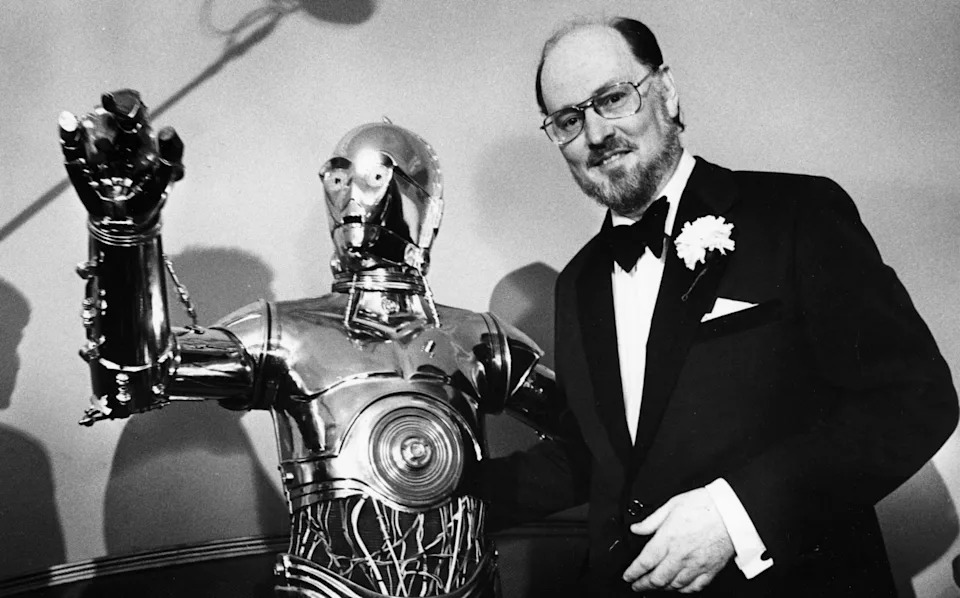
Williams with Star Wars droid C3P0 in 1980 – Boston Globe
Greiving described Williams’s dismissal of film music as “sort of shocking”, but said it is “not false modesty” but he is “genuinely self-deprecating, and deprecating of ‘film music’ in general”.
He added: “He clearly took the job of composing music for films as seriously as anyone in history ever has… He perfected the art of film scoring. He took it to its greatest heights. He elevated film music to a high art form.”
With his soft, unassuming demeanour, Williams tells Greiving: “If I had it all to do over again, I would have made a cleaner job of it – of having the film music and the concert music all being more me, whatever that is, or more unified in some way. But none of it ever happened that way. The film thing was a job to do, or an opportunity to accept.”
He also spoke of his long-standing collaboration with Spielberg, for whom he scored Close Encounters of the Third Kind and E.T., among other movies. He described Spielberg as “very musical”, in contrast to “most of the directors that I’ve worked with”.
He said: “My career with Steven began to develop, one film by another. No plan. He didn’t have one either, and we were just going ahead and doing what we thought we should do next.”
He added: “I think a lot of things [films] I didn’t do because people thought – and they were right – that I was chronically and consistently busy with Steven. I’ve had people say that to me: ‘Well, we thought you were married to Steven.’ Which I suppose, in many ways, I was, or have been, or still am.”
Beyond his film work, Williams has composed dozens of concerti, fanfare and other concert works.
He has welcomed new concert arrangements of some of his most famous film scores, including Star Wars, Schindler’s List, E.T., Memoirs of a Geisha and Harry Potter.
Titled John Williams Reimagined, it will be performed by a classical trio – pianist Simone Pedroni, flautist Sara Andon and cellist Cécilia Tsan – at London’s Cadogan Hall on October 27, with an accompanying album.
‘ The preceding article may include information circulated by third parties ’
‘ Some details of this article were extracted from the following source www.yahoo.com ’