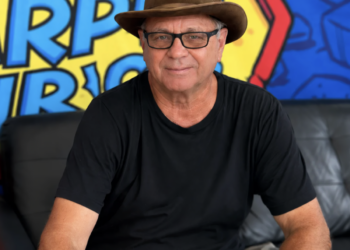
The latest edition of the band may be more Irish than ever, said Jem Finer, the multi-instrumentalist who co-founded the group with MacGowan and Spider Stacy in the early 1980s. To fill the space the larger-than-life MacGowan left behind, the Pogues will feature an expanded rotation of singers, including next-generation Irish songwriters Lisa O’Neill, Daragh Lynch (of the band Lankum), and John Francis Flynn.
In fact, on a recent overseas phone call, Finer said the band wasn’t formed to play only Irish music. He and Stacy – both Englishmen – met MacGowan when they were all living in the post-punk industrial landscape of King’s Cross, London.
“We had all sorts of different influences from the start, all the different cultures that were there – Irish, Turkish, Greek, English, Welsh, Spanish, American,” Finer said.
MacGowan, who answered to the alias “Shane O’Hooligan” in his early years on the punk scene, “was very much influenced by not just his Irish background but all these other things, and where we lived. There’s all these songs that could only have been written in London,” Finer added.
Finer, who plays several instruments, including banjo, mandola (a larger mandolin), and hurdy-gurdy, is a trained computer scientist who in recent years has invested himself in high-concept musical installations. His composition “Longplayer,” which debuted on the first day of the new millennium, is designed to last 1000 years without repeating.
“Actually it’s something really nice now, having all these Irish musicians with us,” Finer said. “Over the years I’ve become more and more interested in traditional Irish tunes and stories.”
What truly bonded the Pogues’ original members in the early years, Finer said, was their shared sense of being outsiders. While MacGowan was an Irish lad growing up in England, Finer was the son of a Jewish father.
That exposed him to “all the attendant stuff you get as a kid in a slightly bigoted society,” he said. “In a sense, we all had our own experiences of knowing what it’s like to be not fully accepted. And that’s very much what a lot of the band’s music and songs reflect.”
“It’s not a glorification of anything abject, but more a celebration of the human spirit, I’d say,” he added.
Lisa O’Neill, one of the singers joining the Pogues this weekend, is a highly touted songwriter who grew up in a small village in County Cavan. In December of 2023, she may have entered your social media feed when she and Glen Hansard sang a moving rendition of the Pogues classic “Fairytale of New York” at MacGowan’s funeral service, performing inside a packed Catholic church in the Tipperary town where he spent some of his earliest years.
She got her first break back in 2011, when David Gray invited her to be an opening act on his U.S. tour.
“The first show was in Boston, and it was snowing,” she recalled, speaking on the phone from her home in Dublin. “We got to Boston and it felt like I was walking around in a movie. Just the stuff of dreams, you know?”
Like most of her peers, she grew up on the Pogues’ music. Being invited to sing with them is “one of the most exciting things that’s ever happened in my career,” she said.
“I always think Shane has written himself into an eternal life,” she added. (O’Neill will also perform an opening set on Sunday).
While the Pogues’ most beloved songs will always be associated with MacGowan’s lyrical storytelling, Finer co-wrote several tracks with the singer, including “Fairytale,” and he was primarily responsible for most of the band’s abundance of instrumental tracks.
“We were always collaborating, sitting down and showing each other what we’d been writing, exchanging ideas and so on,” he said.
When some of Ireland’s biggest traditional stars – the Chieftains, the Dubliners – embraced the Pogues, it was a validation.
“I wasn’t surprised that some people didn’t like [what we were doing] because they felt we were being disrespectful,” Finer said. On the other hand, he knew there would be others “who would understand that tradition sometimes needs a kind of slashing and burning to move on, to keep it fertile and reinventing itself.”
But by the early 1990s, MacGowan’s well-documented struggles with alcohol and drugs were enough to get him booted from the band he co-founded.
“He was what he was,” said Finer. “Yeah, he had his problems, but I think they’ve been overplayed a lot by the press.”
MacGowan and the Pogues eventually reunited in 2001.
“Thankfully, we found we could work together again,” Finer said. “We all ended up on the very best of terms.”
“He was a dear friend, and he wrote the most brilliant lyrics I’ve ever heard,” he added. “To count him as a friend and work with him was an amazing thing.”
SEISIÚN
With Dropkick Murphys, the Hold Steady, Stiff Little Fingers and more (Saturday, Sept. 6) and the Pogues, Glen Hansard, the Waterboys and more (Sunday, Sept, 7). At the Stage of Suffolk Downs, 525 William F. McClellan Highway, Boston, 2 p.m. (both days). Tickets: $75 and up. stageatsuffolkdowns.com
James Sullivan can be reached at [email protected].
‘ The preceding article may include information circulated by third parties ’
‘ Some details of this article were extracted from the following source www.bostonglobe.com ’