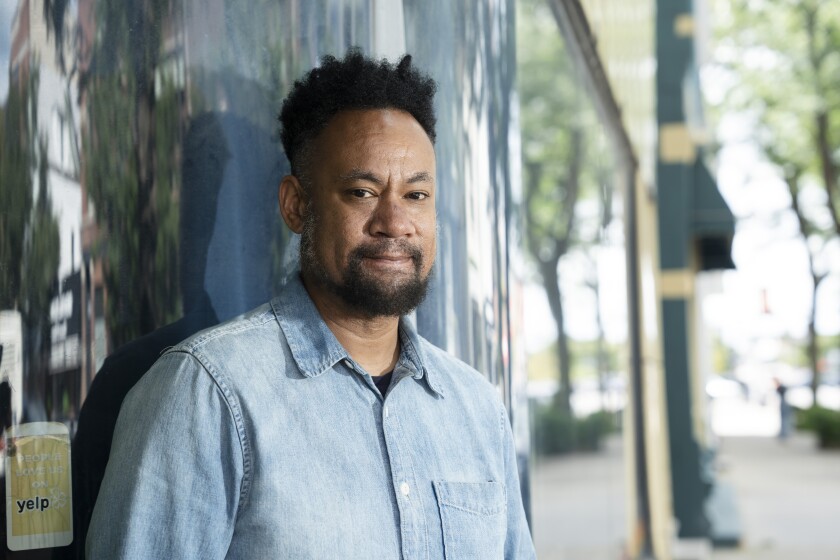
Mike Reed is back in the music festival game, and this time, he’s doing things his way.
The Pitchfork Music Festival co-founder, venue owner and prominent Chicago presenter and musician will launch the inaugural Sound & Gravity festival this week. The five-day event will play out in and around his music hall, Constellation, located near Avondale along Western Avenue.
The programming will spill out into six other venues throughout the neighborhood, including the nearby Hungry Brain, which Reed also owns, and will feature more than 50 artists, like singer-songwriter Bill Callahan, Chicago’s Third Coast Percussion and Nigerien guitarist Mdou Moctar.
Reed, 51, is clear: He is not trying to recreate Pitchfork, the long-running Chicago music festival with indie roots that abruptly exited the city last year with little explanation given by its corporate owner, Condé Nast. Instead, Reed’s goal is to fortify the future of Constellation, the nonprofit venue he opened in 2013, in a moment when small and midsize arts venues are hurting.
“I don’t need to make a new festival,” Reed said. “What I need to do is try to keep the third space that is Constellation and the Hungry Brain going.”
Not only has federal support scaled back for the arts in general, but audience behavior has also changed. Earlier this year, Links Hall — the longtime Chicago venue, focused largely on experimental dance, which shared space with Constellation — closed up shop. That’s another blow to Reed’s bottom line and funds he must now make up for.
To build up the venue’s coffers, Reed decided to stick to what he knows. He didn’t want to host a black tie gala or, as he said, “a Giving Tuesday campaign where we’re gonna give you a mug and you give us 100 bucks.” Instead, Sound & Gravity emerged.
“How about we do something we actually do? And for over 20 years, I have been producing events,” Reed said. “So what if we actually made an event for the types of people that like to come to shows at Constellation? It doesn’t really necessarily matter that the proceeds are going to build the reserves. They’re buying a product that they’re interested in, which is what we’re hopefully doing every day, this is just on a larger scale.”

In addition to Constellation and Hungry Brain, performances will be held at Judson & Moore, Beat Kitchen, Guild Row and Rockwell on the River, all venues within a one-mile radius from Constellation. The decision to include other venues within a small footprint was born both out of practicality and the need for more space, but Reed also hopes the event will be a boost for the neighborhood as well.
“I hope that this would also then translate to some of the other businesses and creative industries in the area,” he said, “and that the neighborhood kind of comes alive in its own way and we’re just the thing that everybody can sort of draft off of.”
The lineup has a heavy focus on jazz, which is largely Reed’s genre of choice. A jazz drummer himself, he’s just come off another year programming Chicago’s annual Jazz Fest. But, his team — including his longtime deputy, the musician Sima Cunningham — also bring their own taste to the mix, infusing the lineup with bits of contemporary classical, electronic music and experimental rockers such as guitarist Steve Gunn.
For Reed, the test in putting together the lineup was: Would the music aesthetically make sense at Constellation? “Some of them, like, let’s say Bill Callahan, could play rooms much bigger,” Reed said. “So essentially, it’s like, could these bands play here? In spite of the capacity issue. And if the answer is yes, then that is part of the aesthetic that plays into it.”
But, even with carefully curated lineups, it’s harder than ever to draw audiences in. People are socializing less and drinking less. And, the festival world is also changing, with a surge of cancellations last year due to factors like rising production costs and waning audience interest in an era of music streaming. Reed is not surprised that audiences are no longer buying what the big fests are selling.

“You can look at Coachella, it’s like, it’s just a marketing vehicle with bands being accouterments for that stuff. It’s not about the music,” he said.
Still, Reed is betting on people’s desire to gather together and hear live music. And he’s putting his chips on a walkable, “choose your own adventure” festival, which he says was inspired, in part, by Big Ears in Knoxville, Tennessee.
“There’s been different versions of this, and they’re all going to have their own unique little thing about it, but the fact that it’s all kind of close together. The longest walk between the venues is 15 minutes. That’s one of the unique characteristics about some of these other events that I was inspired by,” Reed said. “If I did this across town, it wouldn’t mean anything. You’d spend half the day just traveling.”
The schedule is not meant to be prescriptive. For instance, who is the headliner? “Whoever you’re gonna want to see at 11 o’clock,” Reed said.
As the fest approaches, Reed said ticket sales have been strong and have come from buyers in more than 30 states and outside of the country. But, the fest won’t sell out this year — a fact that Reed accepts. Instead, he said, success will be proof of concept.
“The audience and the artists are going to be the biggest advertisers,” Reed said. “There’s no advertising, and there’s no bit of press — even this one — that’s going to do as well as those folks that came out of the first event and said, ‘That was great.’”
Courtney Kueppers is an arts and culture reporter at WBEZ.
‘ The preceding article may include information circulated by third parties ’
‘ Some details of this article were extracted from the following source chicago.suntimes.com ’