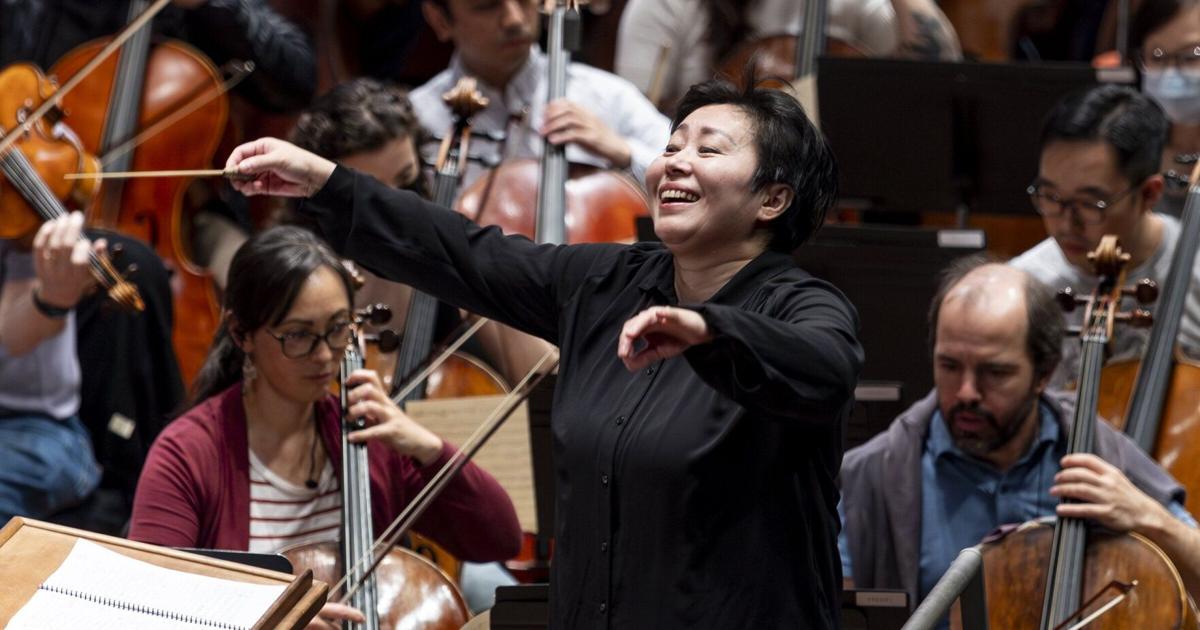
With a tiny flick of her fingers from the Benaroya Hall podium, Xian Zhang unleashes a delicate flurry of clipped, staccato notes from the Seattle Symphony’s violins during a June rehearsal for Beethoven’s violin concerto featuring soloist Hilary Hahn.
As a musical arc crests, she explodes up onto her toes, a grin lighting up her face. The mood seems both rigorous and joyful, Zhang’s high artistic standards balanced by a collegial, respectful spirit. It’s an approach that has propelled her to barrier-breaking success in the classical music world, and one that will hopefully inspire both the Seattle Symphony and its audience for years to come.
On Saturday, Zhang, who has conducted orchestras and opera companies around the world to critical and audience acclaim, begins her tenure as the Seattle Symphony’s new music director — its artistic leader.
It’s a groundbreaking appointment. In a field where very few women lead large-budget orchestras, she is the first woman and person of color to hold that position in Seattle Symphony’s 122-year history, and the first woman to lead a major West Coast orchestra.
She also takes over at a time when the Symphony is still rebuilding its post-pandemic subscription audience and coming off three years without a music director, following the abrupt departure of Thomas Dausgaard in early 2022.
In many ways, Zhang, 52, epitomizes a new kind of leader in the classical music world, a far cry from the old-world maestro who ruled with an iron baton. Her colleagues praise her energy, her collaborative and adventurous nature, her skill with traditional classical repertoire and her appetite for championing new works, developing new audiences and working with other arts organizations.
As the beginning of her tenure approached, Zhang shared her hopes and plans to raise the Symphony’s international profile, strengthen ties with the Seattle community, build the next generation of artists and audiences, and expand the classical music canon.
Though Zhang has been guest conducting since 2008 in Seattle, when she was named music director designate last year, she started getting to know this orchestra and its players anew.
“I always let music lead the way, ” she said. “I don’t try to take charge. And if I do the music well, then the music will win them over for me.”
Road to Seattle
Xian Zhang (pronounced She-YEN Jhong) was born in Dandong, China, to musician parents. Zhang’s luthier father built her first piano when she was about 4 years old, and her mother was her first teacher.
She studied piano until a teacher insisted her hands were too small, so she pivoted to conducting, studying under acclaimed artists Wu Lingfen and Zheng Xiaoying, now 95, the first woman to conduct at the Central Opera House in Beijing.
The first time Zhang stood in front of a professional orchestra, she was just 20 years old. Wu, Zhang’s teacher at the Central Conservatory of Music in Beijing, asked her to step in for rehearsals of Mozart’s opera “The Marriage of Figaro” at the city’s Central Opera House. The rehearsals went so well she ended up conducting a run of performances, too.
Zhang moved to the U.S. in 1998 to pursue her doctorate at Cincinnati Conservatory of Music, where she later became the college’s youngest faculty member ever. Her career hit the fast lane in 2002 when she shared first place in the prestigious Maazel-Vilar Conductor’s Competition. That same year she became assistant conductor of the New York Philharmonic, where she was later promoted to associate conductor.
That led to music director appointments in Sioux City and Milan, and guest conducting stints at major orchestras in Los Angeles, London and beyond. In 2016, she became music director of the New Jersey Symphony Orchestra and, for the time being, splits her time between NJSO and Seattle Symphony, where she’s on a 5-year contract. She intends to move to Seattle in the future, according to the Symphony.
As the artistic leader of a symphony orchestra, the music director not only sets high standards and charts an organization’s artistic course; they are also the public face of the orchestra and a critical behind-the-scenes force for fundraising and community building. In Seattle, Zhang will select repertoire in collaboration with her artistic team and, in her regular appearances on the podium, hone the Symphony’s sound by bringing her style into conversation with the orchestra’s unique musical palette and personality.
“She can control the big orchestra well, and her pacing and energy is remarkable,” said Eric Wyrick, who has been concertmaster at NJSO for 26 seasons. “And, by the way, she has incredible ears and perfect pitch, and can sing any part in the score with no effort.”
“Energy” comes up a lot when discussing Zhang, especially in relation to her diminutive stature. “It’s kind of incomparable, the energy that comes from the podium when she’s conducting,” Jeffrey Barker, Seattle Symphony’s associate principal flute player, said when Zhang was announced as music director designate.
Terry Loftis, president and CEO of New Jersey Symphony Orchestra, had seen Zhang conduct virtually during COVID, but said seeing her work in person for the first time was incredible.
“It’s one of those rare moments in music-making where it’s almost as though she has absorbed the score into her body, and everything that she’s doing with the orchestra is just spontaneous,” Loftis said. “It’s electric.”
Generational impact
Zhang has been breaking barriers throughout her career in classical music.
In 2025, according to a report by the League of American Orchestras, 85.8% of music directors at U.S. orchestras were male and 72.4% were white. At larger-budget orchestras only 5.8% of music directors were women in the 2022-23 season, the most recent season for which data is available. Zhang is only the third woman to lead a large-budget American orchestra, following Marin Alsop, who led the Baltimore Symphony from 2007 until 2021, and Nathalie Stutzmann of the Atlanta Symphony, who was appointed in 2022, according to The New York Times.
But belaboring these many firsts risks overshadowing Zhang’s talent and accomplishments.
“She is here because of her extraordinary capability,” said Sunny Xia, Seattle Symphony associate conductor.
For Xia, seeing in Zhang a version of herself feels powerful. “She is what I hope I will be in a decade or two, and as a torchbearer for the younger generation of female professionals, that is very important,” she said.
Even before Zhang started her job in Seattle, she came to a concert Xia conducted to give her advice and feedback. “She is genuinely interested in helping the next generation of musicians,” Xia said.
That dedication to her colleagues and collaborators demonstrates the people skills a great music director needs today, in addition to technical mastery as a conductor.
“She’s definitely a perfectionist, but with an understanding of how to read the room,” Xia said. “She will push people toward a very high level of art-making but she also understands how to work with real human beings.”
She’s also, said NJSO’s Wyrick, open to accepting the collective knowledge of an experienced orchestra, which isn’t always the case with a maestro.
“It’s very tough for a conductor to acknowledge that (expertise) and also have the confidence to present their own interpretation in a strong and flexible way,” Wyrick said. “Xian is really very adept in those areas.”
That flexibility and collaboration also extends to her work with administration — something the music director of an American orchestra must do a lot of as they work on fundraising and other critical behind-the-scenes projects.
“To be a modern, forward-thinking, innovative symphony in this day and age, it’s critical that management and artistic are in lockstep with each other on the holistic health of the organization on stage and offstage,” said NJSO’s Loftis. “And (Zhang) is a great partner in that regard.”
Up next
Among her immediate hopes for the Seattle Symphony, Zhang expressed aspirations to make more recordings, tour internationally, consider major orchestral-choral works, program and commission new classical repertoire and explore the “full spectrum of range and color” in the Symphony’s sound.
Zhang is also invested in developing the next generation of symphony lovers. In New Jersey, she’s developed strong community ties (NJSO’s Lunar New Year programming proved especially popular) and family-friendly events designed to entice both parents and children, which she sounds committed to carrying forward in Seattle.
Building a broader audience base is important to the Seattle Symphony which, like so many arts organizations, is still rebuilding toward its pre-pandemic capacity. This year, the organization has 5,912 subscribers, down from 8,723 in 2019, and has 164 scheduled performances, down from 228 in 2019, according to a Symphony spokesperson.
In addition to her work with the Symphony itself, Zhang said she’s open to exploring collaborations. While no formal plans have been made for her to work with Seattle Opera, she expressed interest in discussing such an arrangement — her recent work conducting for opera, including a lauded production of “Tosca” at the Metropolitan Opera in New York, has been as vibrant as her orchestral career.
In New Jersey, “Xian has been a real catalyst in getting us to think more broadly about the (classical music) canon,” and has been a big supporter of NJSO’s collaborations with groups like Nimbus Dance and Shakespeare Theatre of New Jersey, which is partnering with the NJSO on a production of “Romeo & Juliet” in January 2026 said Erin Lunsford Norton, NJSO’s vice president of artistic planning.
Zhang is also excited about contemporary composers, with Steven Mackey, Billy Childs, Reena Esmail and Qigang Chen among those Zhang has championed.
Zhang “really has an unerring taste in new music,” said Raff Wilson, Seattle Symphony’s vice president of artistic planning. “The pieces that she’s brought to us already have excited the audience and I think that’s certainly going to grow.”
Zhang’s first season — which includes the works of Gershwin, Mahler, Mussorgsky and Beethoven, as well as contemporary composers Chen, Mackey, Melissa Douglas and Nokuthula Ngwenyama — is quite musically broad, and in time, Wilson said, he sees a lot of opportunity for her to explore different composing voices and musical sound worlds in more depth.
After more than three years without a music director. a period of stability will benefit the entire organization, Wilson said, from artists to administration to audience.
“The kind of trust that an audience builds with a conductor who’s there consistently means that we’ll be able to bring very interesting music to Seattle,” he said.
However, Seattle Symphony is still without a president and CEO since Krishna Thiagarajan’s resignation early this year. Both Zhang and a Symphony spokesperson confirmed that a national search is underway for Thiagarajan’s replacement, but offered no further information.
Still, the music will continue. Zhang’s energetic, dynamic presence on the podium may be a joy to watch, but that external presentation is the last thing on her mind.
“I just hope I serve the music well,” she said. “That’s really my only wish.”
‘ The preceding article may include information circulated by third parties ’
‘ Some details of this article were extracted from the following source www.yakimaherald.com ’