It’s a near-Sisyphean task to make awards shows interesting these days. We know the drill when it comes to the Emmys: The host opens with a monologue that references the year’s buzziest shows and actors, makes some risqué joke (usually about politics—a topic that was purposefully avoided this year), and struggles to get a laugh. Meanwhile, presenting actor duos try to pretend like they have chemistry with their assigned stage partner, and most winners drone on thanking a list of deserving people who have supported them throughout their careers. And all of this goes over the allotted network timeslot by, at least, a solid 20 minutes.
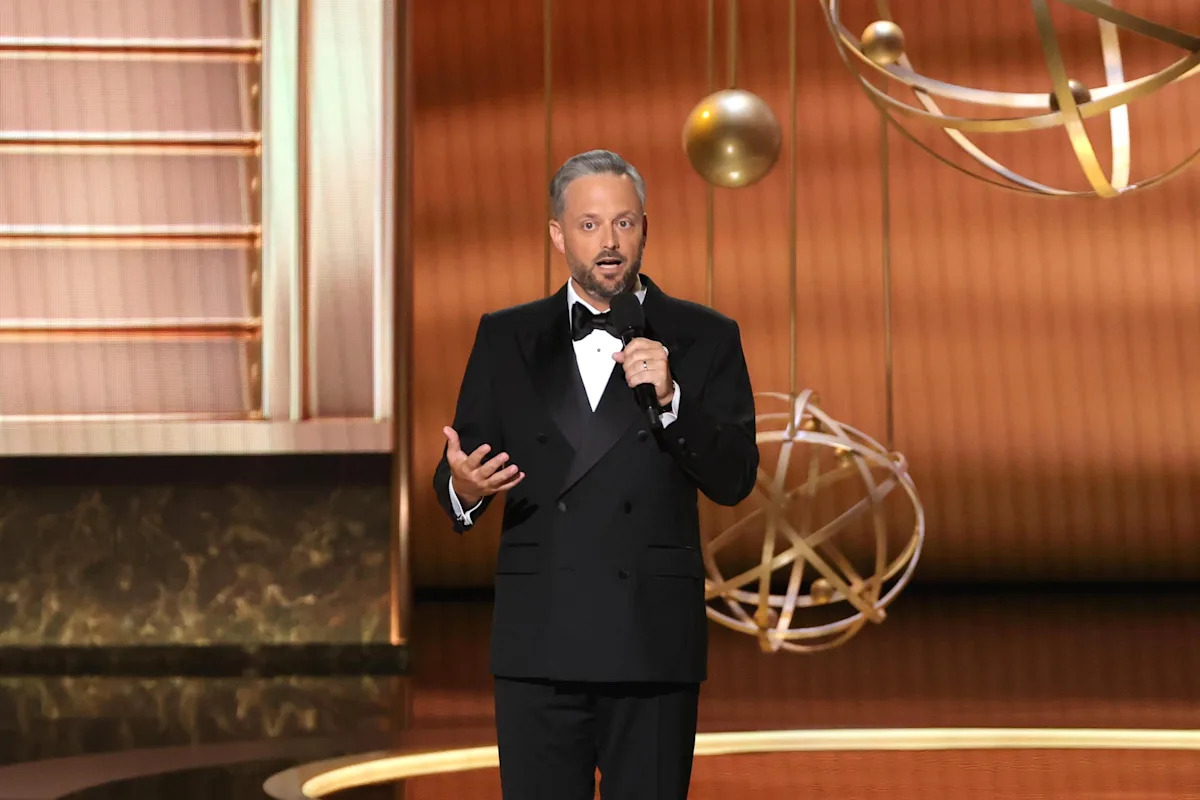
So when politics are off the table, when barbs and awkwardness can only take you so far, and when pressure from producers is mounting to keep everything on time, what’s a host to do? Stand-up comedian Nate Bargatze, who helmed the 77th Primetime Emmy Awards on Sunday night, had a controversial answer.
After Bargatze’s (surprisingly very funny) opening monologue—which came in the form of a skit about the birth of the technology for television, allowing Bargatze to make fun of the increasingly broken and senseless industry, while making a callback to his breakout Saturday Night Live sketches about the American Revolution—the comedian introduced a new tactic. He threw a dollar amount up on a screen, showing a total of $100,000. Bargatze claimed that he will donate $100,000 to the Boys & Girls Club of America (that being the awards ceremony’s chosen charity, identified not only by the donation but by the child ushers from the organization helping the presenters and winners on and off the stage). At this announcement, the audience cheered, a moment that Bargatze instructed them to “remember” because he had another shoe he was waiting to drop. Bargatze then revealed that if a winner’s acceptance speech went over the allowed 45 seconds, $1,000 would be deducted per every second they go over. However, as a plus, if the speech giver finished in under 45 seconds, then $1,000 would be added per every second they saved.
This provided ample material for quips and comedic relief throughout the broadcast. When The Pitt’s Katherine LaNasa won for Best Supporting Actress in a Drama Series, she ended her speech with a wave goodbye, going one second over the 45-second mark. Bargatze followed after her speech with an updated tally of $99,000, calling her gesture “an expensive wave.” When Hacks’ Hannah Einbinder won for Best Supporting Actress in a Comedy Series, she went over the timeline, in part, to say “Go Birds! Fuck ICE! And free Palestine!” Einbinder promised to pay the difference after her inspiring rally cry, as the tally was brought down to $80,000.
Of course, any new tactic of such pointed nature is bound to have some detractors. Some viewers decried the money tracker as tacky and unfunny. And yes, there’s a case to be made that, as The Cut’s Olivia Craighead pointed out, it’s unfair to put a cap on what is likely the biggest moment of some of these actors’, writers’, and directors’ careers thus far. The mood in the room palpably shifted whenever there was a big upset of a win—like Somebody Somewhere’s Jeff Hiller winning over the likes of Ebon Moss-Bachrach, Harrison Ford, and Colman Domingo for Best Supporting Actor in a Comedy—and Bargatze started tsk-tsk policing their overly long speeches. At times, Bargatze sounded a bit more like a hall monitor than a host, and the running joke didn’t get the same level of laughs as the night wore on.
However, I maintain that the whole idea was still funny and, dare I say, worth implementing in future awards ceremonies. Sure, Bargatze referred back to the bit one too many times, tiring it out a bit by the end—having literally any other material would’ve been nice!—but the gag ultimately achieved its stated goal: Some of those acceptance speeches were nice and tight! The conceit was funny, and even a little deep: How much does the celebrity ego matter over the children of America? Time to put your money where your mouth is, Hollywood.
In the end, the tally landed in the red. Still, Bargatze promised to still donate not just the original amount, but between his contribution and CBS’ contribution, a full $350,000. While divisive, his innovation may have proven a helpful device for the broadcast, for my sleep schedule, and for the Boys & Girls Club of America. That’s a win in my book.
‘ The preceding article may include information circulated by third parties ’
‘ Some details of this article were extracted from the following source www.yahoo.com ’