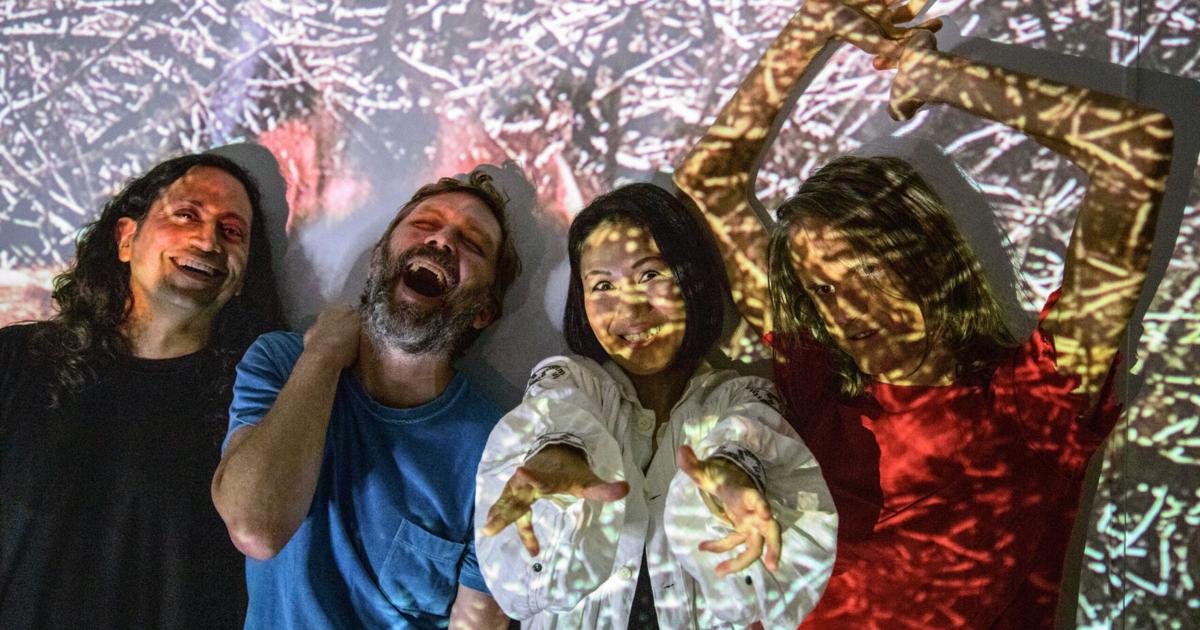
Deerhoof has spent the last 30 years playing with creative tension, says drummer Greg Saunier. The often experimental, always interesting indie rock band has been on a constant search for how to balance vocalist and bassist Satomi Matsuzaki’s soft, direct voice with the loud, angular instruments around her.
“I think this is common in human relationships. The very thing that attracts you to someone else can also be the thing that repels you,” Saunier says from his home in Tucson, Arizona. “I think [Matsuzaki] was drawn to Deerhoof in the first place because we were so chaotic and had such a tendency to overplay in every way.”
Deerhoof this fall is heading out on its “31 Flavours Tour” to mark the band’s 31st year. They stop in New Orleans for a show Thursday, Oct. 2, at Music Box Village. New Orleans musician Jess Joy, who has worked with Saunier over the years and recorded her latest album, “Won’t Be Kicked Out the Garden,” at his home studio, will open the concert at 8 p.m.
Saunier co-founded the noise punk project Deerhoof in San Francisco in 1994 with guitarist Rob Fisk, who left the band before 2000. Matsuzaki joined the band in 1995, only a week after moving to San Francisco from Japan. Guitarist John Dieterich followed in 1999, and guitarist Ed Rodriguez joined in 2008.
Over the course of its 31 years, Deerhoof has released 20 well-received, full-length albums, including its latest “Noble and Godlike in Ruin.” On this tour, Saunier says, they’re playing newer material as well as digging back into the band’s extensive catalogue.
It’s been an interesting experiment to revisit older material, Saunier says. A lot of their studio recordings have been difficult in the past to recreate live due to overdubs and vocal harmonies. And there’s the tension between vocals and instruments.
“Sometimes there are things you can do on a recording that are very difficult in a live situation, and one that comes up a lot is the band wailing away on the recording, playing full blast, and then we go to record vocals and Satomi practically whispers them,” Saunier says.
Deerhoof’s “Noble and Godlike in Ruin” — a title pulled from Mary Shelley’s “Frankenstein” — is another example of the band’s ability to remain fresh with wide-ranging musical interests, including math rock, funk and free jazz influences.
The band has often used its music to talk about human rights and issues impacting marginalized people. Those topics are all over their latest album, especially on songs like “Under Rats,” which features poet and rapper Saul Williams, and “Immigrant Songs,” a track taken from the perspective of immigrant workers living in a hostile America.
Earlier this year, Deerhoof announced it was removing its music from Spotify. The band had become increasingly frustrated with the company’s practices and the poor pay for musicians, Saunier says. So when it came out that Spotify’s CEO Daniel Ek was investing in a company developing AI software for use in military decisions, Deerhoof quickly decided to leave the platform. More bands have since followed.
“Just for our own mental health, we just [wanted] out of here right away,” Saunier says. “We are not willing to have our music associated with being pro-profiteering from war and arms dealing.”
Thirty-one years in, it’s “staggering to imagine that we found each other,” Saunier says. The members of Deerhoof have figured out how to communicate and give each other space. Often creative tension and imperfections show up in the music.
“You hear the seams, you see the flaws and you see the process,” Saunier says. “The process is somewhat still audible in the finished result.”
General admission tickets to Deerhoof and Jess Joy are $29.87 for adults and $21.17 for children via musicboxvillage.com.
Learning to live in a world of constant crises.
‘ The preceding article may include information circulated by third parties ’
‘ Some details of this article were extracted from the following source www.nola.com ’