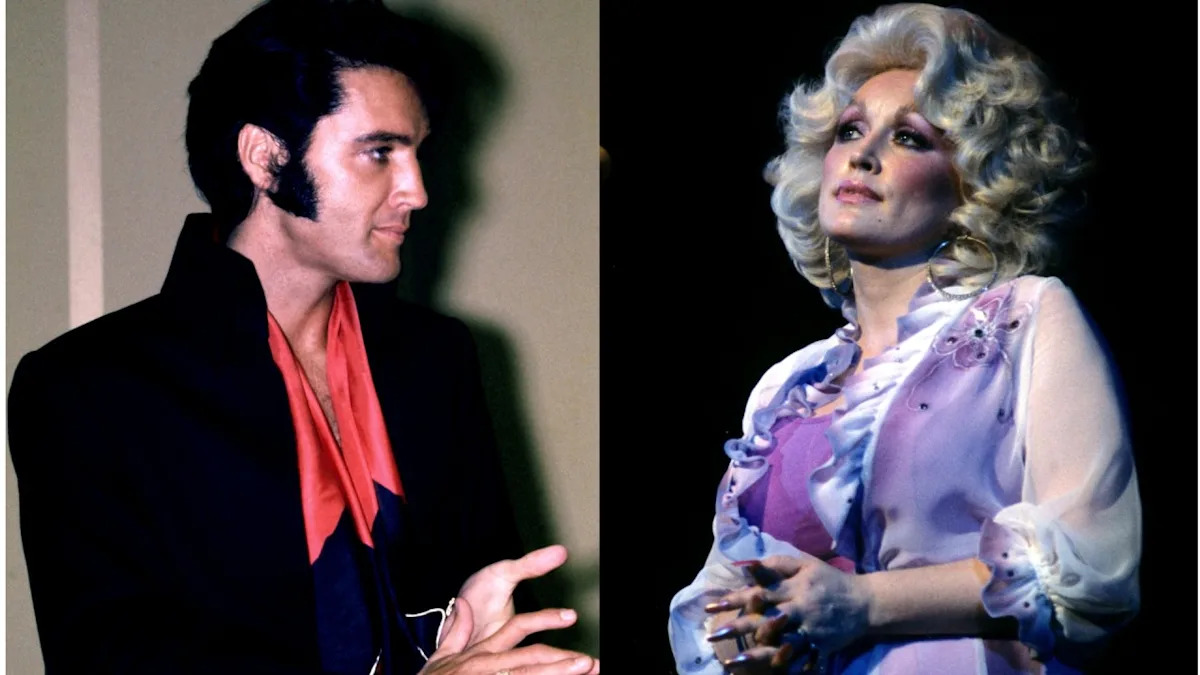
Dolly Parton was already a celebrated voice in country music before recording a song made famous by Elvis Presley. Released just six months after the original, Parton’s poignant take on the emotional song transformed the classic into a deeply personal and unforgettable version.
Presley recorded “In The Ghetto” in January 1969, and released the song in April of the same year. The Mac Davis-penned song became the King of Rock and Roll’s first top-five hit in four years, per Billboard. The song was recorded in a session including “Suspicious Minds,” “Kentucky Rain,” and “Don’t Cry Daddy,” reported American Songwriter.
Parton’s take on “In The Ghetto” was recorded in June 1969. The flip side of the single contains “The Bridge,” her own song from her first LP, Just Because I’m a Woman. At the time of its release, Presley’s version was topping the Billboard charts, while Parton’s version only reached No. 50.
The differences between Parton and Presley’s versions of “In the Ghetto” lie in vocal style, arrangement, and delivery. Her softer, heartbreaking delivery showed melancholy for the situation rather than the social urgency of Presley’s recording.
Parade Daily🎬 SIGN UP for Parade’s Daily newsletter to get the latest pop culture news & celebrity interviews delivered right to your inbox 🎬
Parton transforms the song with a stripped-down arrangement, and her interpretation emphasizes personal empathy and heartbreak, giving the classic a warmer, reflective quality. Presley’s rendition focuses on the story’s societal edge, speaking directly to the listener to stand up and pay attention.
‘In The Ghetto’ inspiration
American Songwriter reported that Mac Davis was inspired by the Civil Rights movement of the late 1960s when he first wrote the song. Its original title, however, was far less striking.
“I was going to call it ‘The Vicious Circle,’” Davis admitted. “But try to rhyme with circle.”
Per The Tennessean, Davis explained, “The word ‘ghetto’ was just becoming popular to describe the parts of urban areas where poor people were living and couldn’t get out. They were stuck there, and everybody took off to the suburbs.”
“At any rate, I’d always wanted to write a song about it, where a kid is born, he doesn’t have a male parent, and falls into the wrong people and dies, just as another kid comes along and replaces him. It’s just a vicious circle.”
However, after hearing Presley’s rendition, Davis admitted he initially wished the King of Rock and Roll hadn’t sung it in his now-iconic style. “I remember thinking, ‘I wish he hadn’t said Ghet-to.’ I wish he had just said ‘In the Ghetto.’”
He concluded, “That’s a typical songwriter reaction. But that lasted maybe five seconds, and then I realized I had a huge hit.”
Dolly Parton’s rendition of the Elvis Presley classic “In The Ghetto” showcases her ability to make a song distinctly her own while honoring its original emotion. Her heartfelt interpretation stands as a memorable and uniquely moving take on the timeless hit that helped cement Presley’s legacy as a storyteller of both social and personal struggles.
This story was originally reported by Parade on Oct 14, 2025, where it first appeared in the News section. Add Parade as a Preferred Source by clicking here.
‘ The preceding article may include information circulated by third parties ’
‘ Some details of this article were extracted from the following source www.yahoo.com ’