According to the new film “Metallica Saved My Life,” the band had its first “insane reaction” from a crowd in San Francisco in 1982 – and the documentary channels that same voltage.
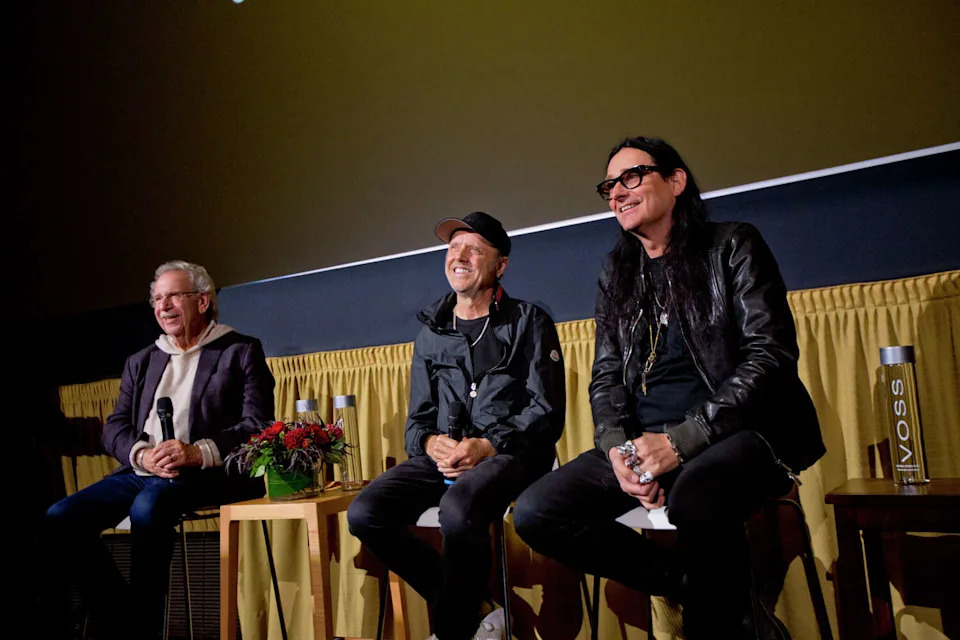
The new documentary screened Thursday, Oct. 9, at the 48th Mill Valley Film Festival, and was followed by a live Q&A with filmmaker Jonas Åkerlund and an ever-toothpick-doting Lars Ulrich, the band’s drummer. A wider theatrical release is slated for this spring.
Loud, fast and full of motion, the documentary feels like the music. The cuts, zoom-ins, punches of illustration and collisions of color recreate the chaos of a Metallica show. The Sequoia Cinema crowd sat politely – good posture, hands folded neatly in laps – and the contrast between the on-screen oomph and the calm in the seats was almost comical. Still, a charge ran through the room, a flicker of the adrenaline fans describe, convincingly, as life-sustaining.
The film jumps from San Quentin to San Jose, Botswana to Antarctica. Along the way, it threads in familiar faces – Tony Hawk tipping his helmet to Metallica’s skate-scene roots, John Cena thrashing around in the pit, and a few academics who help decode what makes the band’s sound hit so hard.
The fans, though, are the backbone of the documentary. They span continents, generations and reasons for devotion. There’s a man from Japan who opened a Metallica-themed bar; a couple who rekindled love gone stale at a concert; a lifelong collector with walls lined in posters; another with drawers full of guitar picks.
One fan featured in the film, Chilean-born Camila Guerrero, sat in the front row, watching “Metallica Saved My Life” for the fifth time. She had come all the way from Adelaide, Australia, for the screening.
Lars Ulrich of Metallica and filmmaker Jonas Åkerlund participate in a Q&A at the 2025 Mill Valley Film Festival. (Tommy Lau)
Another fan gives the film its name. In Iraq, he recounts, he was stopped by a soldier while out past curfew – a moment that could have ended his life. He was listening to a Metallica cassette. The soldier heard it, recognized another metalhead surviving under the same regime, and let him go.
Together, the stories build a case for Metallica as a means of survival. A man credits the band with saving his life after a motorcycle crash. Another says it pulled him out of depression, and away from suicide.
If the documentary has a thesis, it’s this: The connective force that ripples out from music is what matters most. It’s music made by friends, for friends, that can turn fans into family.
Everyone seemed to leave the theater buzzing, still sipping on the emotional residue of the screening. Jaywalking across Throckmorton Avenue, the old fans and the newly converted were high on Metallica as philosophy, as purpose, as permission to scream into the void.
BEST OF SFGATE
History | Why a wealthy banker blasted a huge hole in a Bay Area cliff
Local | There’s a mansion hidden directly under the Bay Bridge
Culture | Inside the Bay Area’s cult-like obsession with Beanie Babies
Local | The world’s last lost tourist thought Maine was San Francisco
Get SFGATE’s top stories sent to your inbox by signing up for The Daily newsletter here.
This article originally published at New film chronicles intense fandom around the Bay Area’s most iconic rock band.
‘ The preceding article may include information circulated by third parties ’
‘ Some details of this article were extracted from the following source www.yahoo.com ’