Those who didn’t get a chance to say a proper goodbye to the Bellevue Arts Museum at its old building, following its indefinite closure in 2024, will still have a chance to view exhibits there during the upcoming Bellevue Arts Fair Weekend.
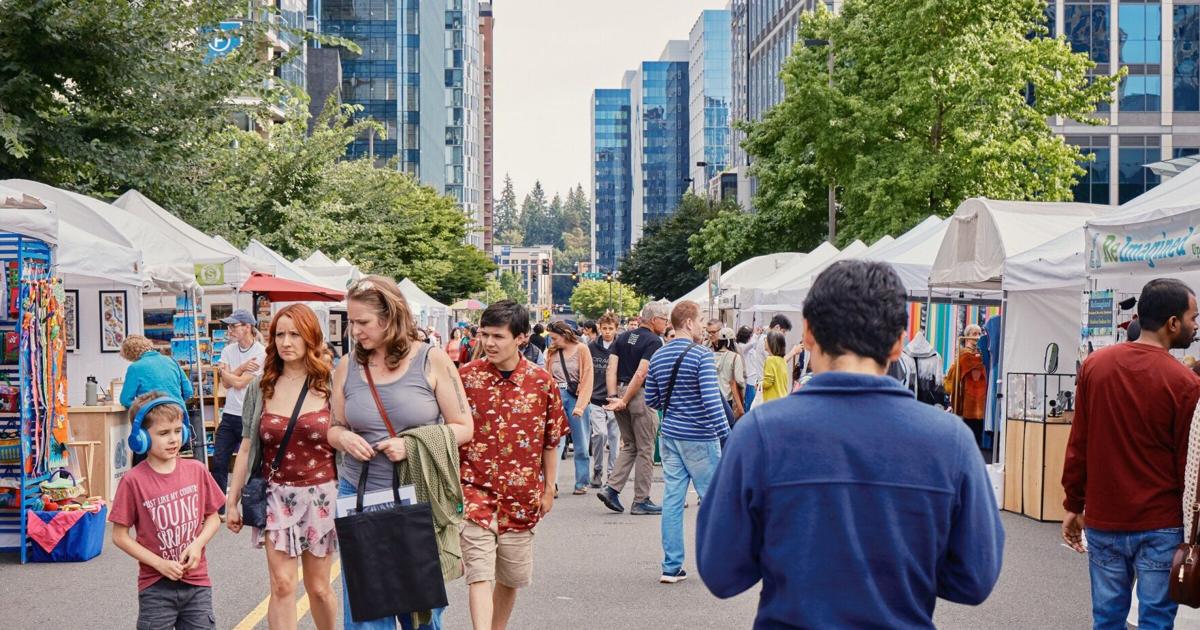
The multiday festival offers two robust arts-and-crafts fairs — BAM’s Arts Fair and Bellevue Downtown Association’s Downtown Arts Market — for the (free) price of one, taking over downtown Bellevue through Sunday. It marks the second year of collaboration between BAM and BDA, who first joined forces in 2025 to produce one of the largest arts-and-crafts fairs in the Pacific Northwest.
This year, 350 artist booths will appear in Bellevue Square alongside live music performances, food vendors and hands-on activities like woodturning and doll-making. About 150,000 attendees are expected to come through the festival.
BAM’s Arts Fair will be concentrated on the first level of Bellevue Square’s West Parking Garage, while the Downtown Arts Market will take over the PACCAR lot and stretches of 106th Avenue Northeast, with a Creative Corridor connecting the two along Northeast Sixth Street. The location has shifted slightly from previous years due to construction, so organizers encourage downloading their new app for navigation and detailed information on exhibits and performances.
“In many cases, a patron may not know they’re in one fair or the other,” said Patrick Bannon, president of the Bellevue Downtown Association. “It just made sense for us to present a unified experience for people.”
This year, several major exhibits will be featured inside the old BAM building — now owned by KidsQuest Children’s Museum.
“We’re so happy to have one more opportunity to be in the building and to do programming here,” said BAM CEO Cassandra Johnston. “There’s so many people who have connections to this building and this organization. … It’s such an important part of the community.”
BAM’s Arts Fair has existed since the 1940s, predating — and now outliving — the physical institution itself on Bellevue Way Northeast. This year marks the fair’s 80th anniversary, joined in step by BDA’s much younger Downtown Arts Market, which was established in 1990.
The decision for both fairs to collaborate came after BAM’s announcement in 2024 that it was closing indefinitely due to a financial crisis and its filing for receivership — a court process similar to bankruptcy in which an independent third party takes over a business in order to protect its assets and pay its creditors. BAM emerged from receivership last month.
BAM’s downtown Bellevue building will become the permanent home of KidsQuest Children’s Museum, with a projected date of early 2029.
Johnston said it is “likely” that BAM will end up on the Bellevue College campus, but details are still up in the air.
“I think a lot of people are thinking that the museum doesn’t exist anymore,” said Johnston. “The organization is absolutely committed to continuing to be in the community.”
She added that BAM has no intention of letting the fair fall to the wayside, guaranteeing its return for its 81st birthday next year.
“It will likely look different. It looks different every year, though,” said Johnston. “It will happen in some space, somewhere, sometime, somehow.”
The ability to display exhibitions in the old BAM building during this year’s fair gave organizers the opportunity to think big. They are holding what is planned to be the first iteration of a yearslong exhibition series called “Living Traditions,” which intends to cover different communities and artistic traditions in the Pacific Northwest. This year’s version is focused on Japanese art and traditions in the region.
The physical programming being featured during the fair — in-person demonstrations of woodblock printing, ceramics, calligraphy and more — is only a fraction of the curatorial work done by art historian Anna-Marie Moblard Meier and master Japanese calligrapher Shizu Usami for the exhibition. The bulk of that work lives online — a compilation of historical context and information about public art across the region relating to Japanese tradition — and is accessible to the public anytime.
A project called the Star Festival (Tanabata) will snake its way through the museum, made up of hundreds of paper wishes written by students from Bellevue’s Bennett Elementary School and Japanese-English dual-language preschools across Bellevue.
Another exhibit featured in the BAM building follows a similar line of thinking: Rong Choy’s “With Our Little Hands” is interactive, meant for young children to participate in and touch.
“Traditionally, you try to leave (art) alone. You don’t really want it handled. But after having my daughter, it became increasingly difficult to keep her away from it,” said Choy, who was born and raised in Singapore and has lived in Seattle for over two years. “I wanted to make an exhibit for little kids to be able to immerse themselves and play in one of my mindscapes.”
BAM says it will continue to be present in Bellevue one way or another – with the fair being a testament to that.
“(The fair) is in itself a living tradition,” said Meier. “It diminishes the distance between the art and the public. So I think that’s a great thing, and I think it’s a good way to go.”
‘ The preceding article may include information circulated by third parties ’
‘ Some details of this article were extracted from the following source www.yakimaherald.com ’