When I was about 5 my mother and I would take the subway downtown for my Saturday ballet class. I loved everything about that day but was particularly proud of my pink tights and slippers. By putting them on, I became something no one else believed me to be: a princess. It never occurred to me that those tights were supposed to mimic skin tones. Why would that have occurred to 5-year-old me? My skin wasn’t pink.
When I was 7, we moved, and I switched to gymnastics. I could have asked for more ballet classes, but I think even then I’d gotten the message that ballet wasn’t for girls who looked like me.
Still, in 7th grade, when a friend and I discovered that anyone could sign up for lessons at the American Ballet Theatre, we took the express bus downtown and signed up for a class. The assistant looked pleadingly at the instructor the moment we entered, and the experience was mortifying. We didn’t know any of the exercises, we were too tall, too inexperienced. We somehow made it through that class and then back to the Bronx. We never tried it again.
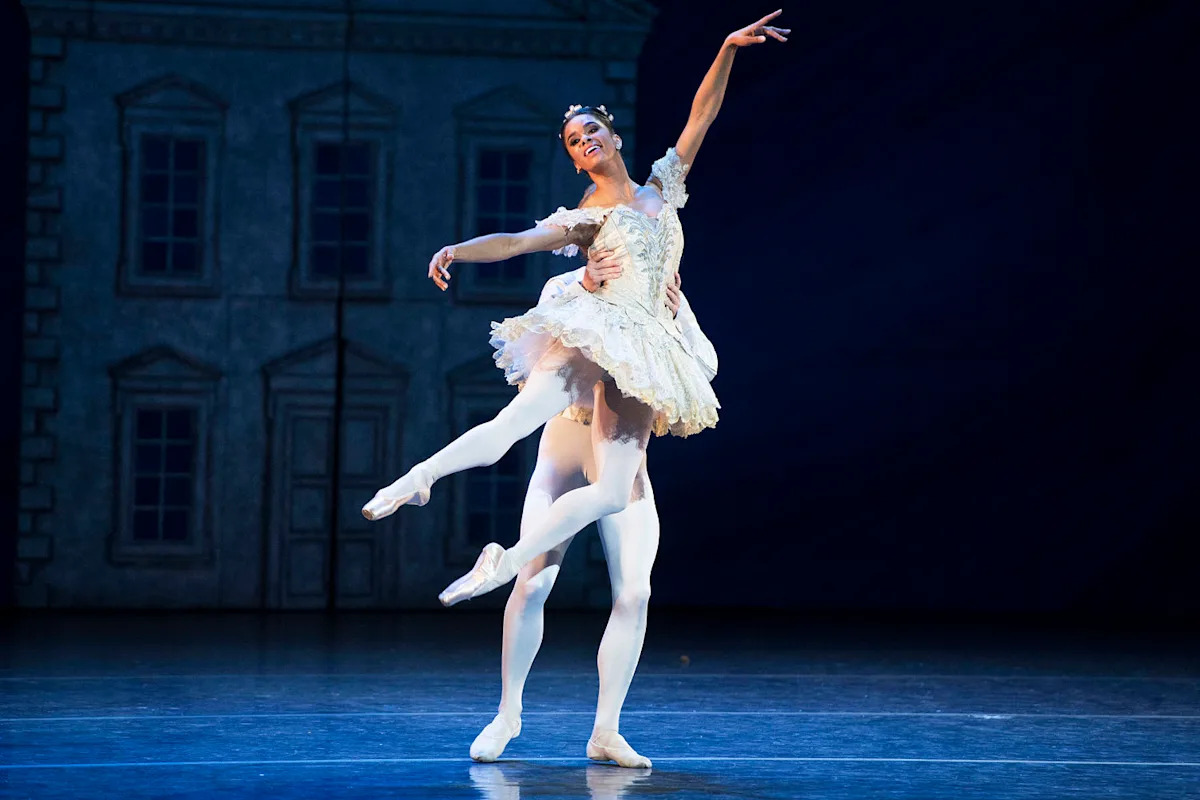
Although Misty Copeland started ballet at 13, no one laughed her out of class. Now 43, Copeland, the first Black female principal dancer in the history of the American Ballet Theatre, retired from the ABT after a final dance at Manhattan’s Lincoln Center on Wednesday night.
She told the Associated Press in June, “I’ve become the person that I am today, and have all the opportunities I have today, because of ballet, (and) because of American Ballet Theatre. I feel like this is me saying thank you to the company. So it’s a farewell. (But) it won’t be the end of me dancing.”
I can’t recall the first time I saw Copeland, but I do know what seeing her stirred in me. She was the princess my 5-year-old self imagined I could be. She was elegant and graceful and strong, and photos captured her flying through the air. She was the best princess.
But I secretly worried for her. She was always mentioned as the only, the one, Black dancer. That’s a heavy psychological weight to carry. And for as much as she championed diversity throughout her career — even going as far as to petition Apple for pointe shoe emojis in colors other than pink — her retirement means the ABT will again be without a Black female principal dancer.
Because images of the astonishingly beautiful Copeland depict her as so strong, so fierce, I was shocked when I met her to see how small she is. She laughed at my surprise, but what she said next illustrated the difficulty she’d had being a pioneering Black ballerina. When she began, she said, she was told that she had the perfect ballet body, but the more attention she got, the more she heard that she was too large — that is, that she didn’t have the perfect ballet body after all.
Before Wednesday night, Copeland hadn’t performed in five years. She had had a baby in the preceding period and had convinced herself she was never going to dance again.
I’m a filmmaker, and my film crew was given six months to document Copeland’s return to the stage. She was incredibly open — allowing us to film her at home as well as follow her to Pilates and strength training sessions and to doctor appointments where she received treatment for the ailments caused by decades of dancing. Even those who know the story of Copeland dancing “The Firebird” on a fractured leg might not understand the physical toll dancing has taken on her body.
Her training regimen was extreme — punishing days of classes and workouts — and she started doing barre exercises on the floor because it was too painful to do them standing.
My film crew was there the first time Copeland got back on pointe. We’d been with her while she worked toward this moment, and I held my breath as she raised up, knowing the effort it had taken. Then, unexpectedly, she was moving across the floor in a whirl of pirouettes. Everyone in the room knew we were seeing something special. Misty Copeland was back.
She was clear about why she doing this last dance. It was for her fans, for people like 5-year-old me who didn’t think ballet was for us.
When Copeland danced as Juliet on Wednesday night, Calvin Royal III was her partner in the balcony pas de deux. In 2020 Royal became the ABT’s first Black male principal dancer in two decades. I can’t recall ever seeing two Black people perform a famous ballet on such a major stage. Copeland was very aware of the symbolism, aware that she was gifting the audience a once-in-a-lifetime experience.
Misty Copeland, the unlikeliest prima ballerina, from the unlikeliest background, achieved the highest rank in ballet. She did it her way, with grace determination and strength. Her final performance was stunning, precise, elegant, powerful, emotional. There will be more Black primary ballerinas.
But there will never be another Misty.
This article was originally published on MSNBC.com
‘ The preceding article may include information circulated by third parties ’
‘ Some details of this article were extracted from the following source www.yahoo.com ’