Gus Van Sant is back. It’s been seven years since his last feature, 2018’s Don’t Worry, He Won’t Get Far on Foot, though he’s stayed busy directing six episodes of Ryan Murphy’s Feud: Capote vs. The Swans. His newest movie, Dead Man’s Wire, had its stateside premiere at the AFI Film Festival on Saturday after screenings in Venice and Toronto, and as he stated during a a post-screening Q&A, the timing couldn’t have been more appropriate.
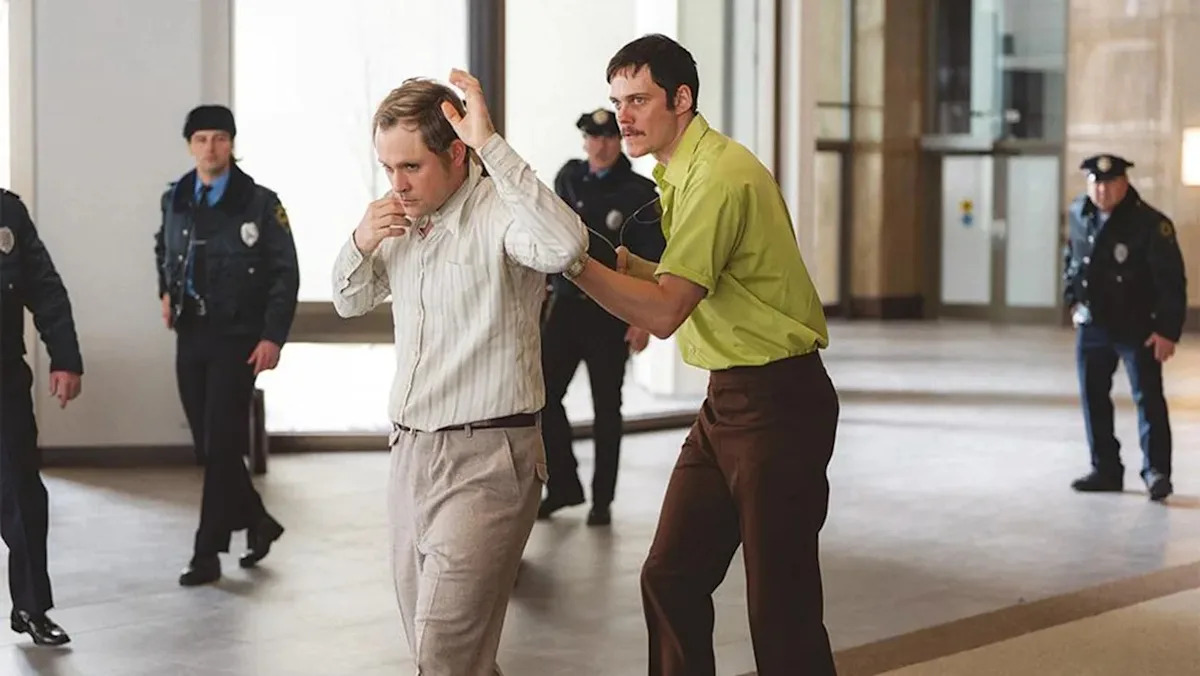
Set in 1977, the film depicts the kidnapping of bank mortgager Richard Hall (Dacre Montgomery) by Tony Kiritsis (Bill Skarsgård), who was convinced Hall and his father, M.L. (Al Pacino), refused to extend his mortgage in order to seize his property. The “dead man’s wire” of the title refers to the shotgun contraption Kiritsis ties between his neck and Hall’s — which will trigger a blast if either one of them falls down for any reason. As news of the kidnapping spreads, a media circus forms outside of Kiritsis’s apartment, as onlookers watch with equal parts shock and admiration.
More from Gold Derby
Right before filming began, the assassination of UnitedHealthcare CEO Brian Thompson cast an eerie pall over the production. The parallels between Kiritsis and Thompson’s accused assassin, Luigi Mangione, were not lost on Van Sant. “Mangione was a specific thing. We were curious about how that was similar to our own story,” he revealed. Tensions were already high as Donald Trump was set to return to the White House, although looking back, things were relatively calm compared to today, where “it’s pretty day-by-day intense.”
The real life incident portrayed in the film was something Van Sant had never heard of, “even though they interrupted broadcasting” to cover it. “Either I wasn’t watching or didn’t read about it the next day — or else it was relegated to midwest broadcasting,” seeing as how the events took place in Indianapolis. Luckily for Van Sant, the digital copy of Austin Kolodney‘s original screenplay “had internet addresses to go onto YouTube and hear or see the actual event. So as you were reading, you can hear the 911 call by clicking on the script and going to the incident, which was kind of a new thing for me,” and helped with the blending of archival materials and recreations.
Van Sant’s movies have often involved outsiders and oddballs, beginning with his indie breakouts Drugstore Cowboy and My Own Private Idaho, a landmark of the New Queer Cinema. He’s also been drawn to true crime, from the tabloid satire To Die For to the Columbine-inspired Elephant (which won the Palme d’Or at Cannes in 2003). Although he admits he isn’t sure what draws him to the genre, he thinks it has to do with “the underdog fighting his way out” of a situation.
To play this underdog, Van Sant tapped Skarsgård, who he had seen in It and Nosferatu, among other things. “He was always choosing — and I’m not sure why — horror projects,” which perhaps psychologically influenced his casting. Having worked with Bill’s father, Stellan Skarsgård, on Good Will Hunting, Van Sant was “curious to see whether there would be any similarities” in their working styles. The elder Skarsgård “was very up for almost anything that we were wanting to do,” Van Sant said. “He was very adventurous. So I was assuming Bill would be as adventurous, which he was. Bill is very funny, and he would throw things in every now and then [to cut the tension].”
The heart of Dead Man’s Wire is in the growing relationship between Kiritsis and Hall, who are quite literally chained to each other throughout much of the runtime. “There wasn’t any talk literally about the common ground they were finding, but they [Skarsgård and Montgomery] were doing it on their own throughout the rehearsal process,” Van Sant explained. “They were very experienced and very good actors, so they were naturally taking all these different turns that helped that sort of communication [between the characters].”
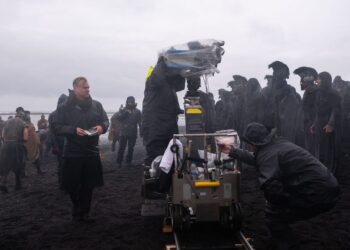
Those rehearsals proved crucial to getting the film done on a tight 20-day shooting schedule. Van Sant had just one day to shoot all four scenes with Pacino, who communicates with his son’s kidnapper while on vacation in Florida. Pacino “is so experienced that it was very easy,” the director said. Oftentimes, they would shoot a take and move onto the next thing. Even though the various department heads were freaking out about getting everything done on time, Van Sant assured, “I didn’t feel it, really. I can go fast.” That’s not surprising, given his experience directing Feud was even more rushed and truncated.
That 20-day schedule meant a lot of footage needed to be captured in a short amount of time, and Van Sant relied upon cinematographer Arnaud Potier to recreate a ’70s look with limited resources. Part of the film’s effect came from the use of period video cameras to shoot the news footage, which Potier found at a rental house. “I wanted to just go for it, because of the timing,” Van Sant said. “I said, ‘Just grab everything really fast and handhold the cameras. I wasn’t giving too much guidance” — instead just seeing what would happen in the moment. There were at least three to five cameras rolling at all times, “not to save time, but just as a way to capture things that were going on.”
It’s been 40 years since Van Sant made his debut feature, the micro-budget Mala Noche, and since then, he’s jumped back-and-forth between Oscar-winning hits like Good Will Hunting and Milk, dogma-inspired indies like Gerry and Last Days, and curios like his shot-for-shot remake of Psycho. “I think every film for me is such a different opportunity to use things that you haven’t used before, to try things out,” he said of his career. One wonders what he’ll try out after Dead Man’s Wire.
Best of Gold Derby
Sign up for Gold Derby’s Newsletter. For the latest news, follow us on Facebook, Twitter, and Instagram.
‘ The preceding article may include information circulated by third parties ’
‘ Some details of this article were extracted from the following source www.yahoo.com ’