“The oldest and strongest emotion of mankind is fear, and the oldest and strongest kind of fear is fear of the unknown.” — H.P. Lovecraft, 1927
I shivered when I saw the Cyclops. Before Christopher Nolan’s latest blockbuster The Odyssey, I was only aware of the Homeric tale via osmosis. Because my high school, for some reason, determined the Greek classics were for honors students, which left the rest of us dumb-dumbs reading Shakespeare. But I knew the saga was full of monsters, and being familiar with Nolan’s insistence on realism, the promise of seeing strange things through his filter had me buzzing in my seat before the lights went down. After all, Nolan was the director who deprived Bane of his venom in The Dark Knight Rises. How on earth could he imagine a one-eyed colossus?
Then I saw him: Polyphemus, in the dark, chewing on one of Odysseus’ men in a near replication of Saturn Devouring His Son, one of the most frightening works of visual art ever made. But the terrors didn’t stop. From Odysseus’ encounter with the armored Laestrygonians (whose anachronistic medieval-style armor informs their otherworldly aura) to the king of Ithaca’s eerie ordeal at the mouth of hell, The Odyssey is underscored by its dreadful atmosphere where mortals live under the oppressive shadow of gods. The movie is by far the closest Nolan has come to directing horror, and speculation over what the director’s next project should be—or what “unfilmable” text he oughta adapt—I humbly propose that whatever Nolan chooses, it should be a horror movie. The Odyssey has already mapped out what that might look like.
Throughout The Odyssey’s epic runtime, I was reminded less of Homer and more of H.P. Lovecraft, the architect of cosmic horror who instilled terror in our insignificance at the feet of uncaring giants. His legacy, however complicated (read: he was a vile racist), is cemented in works like The Call of Cthulhu, At the Mountains of Madness, and The Shadow Over Innsmouth. It isn’t just because they share a penchant for tentacled monsters, but rather Nolan’s choice to frame his “monsters” from eye-level view and render most of the Greek pantheon absent yet omnipresent, that feels evocative of Lovecraft. (Aside from Charlize Theron’s Calypso, only Athena, played by Zendaya, appears on screen, and there’s an easy argument to make that she is only a product of Odysseus’ tortured conscience.)
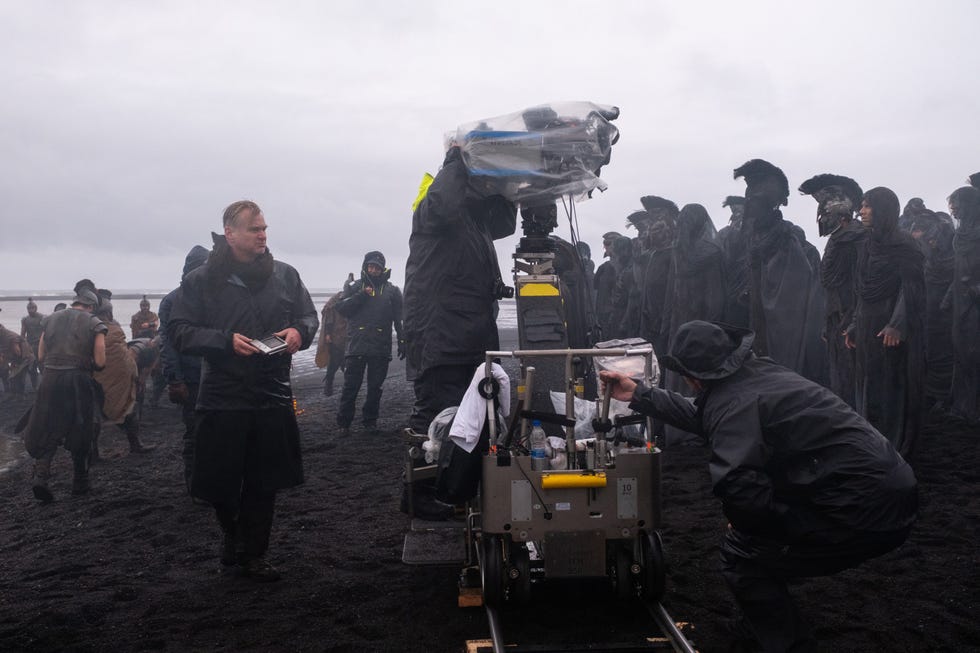
This may be chiefly owed to Nolan’s insistence for tactile realism in his craft. We’re talking about a director who built a sixty-foot puppet on set so that Matt Damon and co. could react to anything besides a tennis ball, and hired actual seven-foot tall stunt guys to play the Laestrygonians. But Nolan’s trait has the ironic effect of making the Greek gods real—it’s just in terms of how humanity saw them for millennia. You don’t see the god(s) you worship, but you’ve weathered hurricanes and watched lightning crack the sky. Before science told us how warm moisture and air density create thunderstorms, it was easy to chalk it up to the gods being really, really pissed off.
Since The Odyssey opened wide, scholars have criticized Nolan’s choices. Among the critics is none other than Emily Wilson, whose 2017 translation made The Odyssey a twenty-first century best-seller and whom Nolan credited for shaping his film. In an interview with Associated Press, Wilson lamented Nolan’s omission of the gods in the story.
But Nolan didn’t actually exclude them. On his blown-up IMAX canvas, Nolan framed them in negative space—a feature, not a bug, in Nolan’s system of filmmaking. That’s also a pillar of cosmic horror, where the things that overwhelm the characters are typically out of sight. (Cthulhu, perhaps the most iconic monster in Lovecraft’s canon, “appears” through written secondhand testimonies.) In the times when Lovecraft characters do lay eyes on unspeakable things, it’s a traumatic experience that shatters their grasp of the natural order. In Nolan’s film, the sight of a humongous cyclops is strong enough to make your sensory systems go haywire. Polyphemus’s slow-burn reveal has the tempo and vibe of a masked slasher approaching their first victim until you glimpse the beast in all its terrible and naked glory.
Nolan’s Odyssey is as stirring as it is tenebrous; even quiet moments around fires and warm meals are just a respite from the ever-encroaching darkness. That’s a uniquely Lovecraft signature, where victories aren’t won by brute force or clever strategy but by sheer luck of the draw. Many of Lovecraft’s tales end with the protagonists given the meager reward of simply living to see another day (if at all), and they are almost always left knowing too much to live a normal life again. That’s basically Odysseus’s routine at sea, and Nolan paints his journey in the same exact bleak shades. Though we know Odysseus is eventually triumphant in his journey, he’ll never reclaim his throne, and he lives forever burdened by his actions at Troy and the deaths of his men.
The Odyssey is a lot of other things: a studio tentpole, a summer blockbuster, another crowd-pleaser centered on bringing Matt Damon home. It’s also an exercise in cosmic horror, snuck in the casing of an oversized fantasy epic. It’s a moving proof of concept for all that Nolan inherently possesses to suit the horror genre, which I think he would be exceptional. I’m also not alone in feeling this way. Nolan himself has spoken as much on his movie’s press tour, notably with The Hollywood Reporter. In a post-release interview, Nolan confessed that his latest work allowed him to whet his appetite for horror, and offers insight as to how he might approach a true horror movie.
“I’ve always believed that horror as a genre has to be approached very carefully from a conceptual point of view,” Nolan said. “In other words, you have to have an amazing idea. When you go see a film like Obsession, that’s an amazing idea. That movie works like a motherfucker. It’s not about the technical side. It’s not about what technical itches I would have to scratch. It’s about story. So I’m always looking.”
I’m not in the business of telling artists like Christopher Nolan what they should do. But if he is deadly serious about wanting to make audiences squirm and shiver again, as I did during The Odyssey, I will happily nudge him to the horror section.
‘ The preceding article may include information circulated by third parties ’
‘ Some details of this article were extracted from the following source www.esquire.com ’