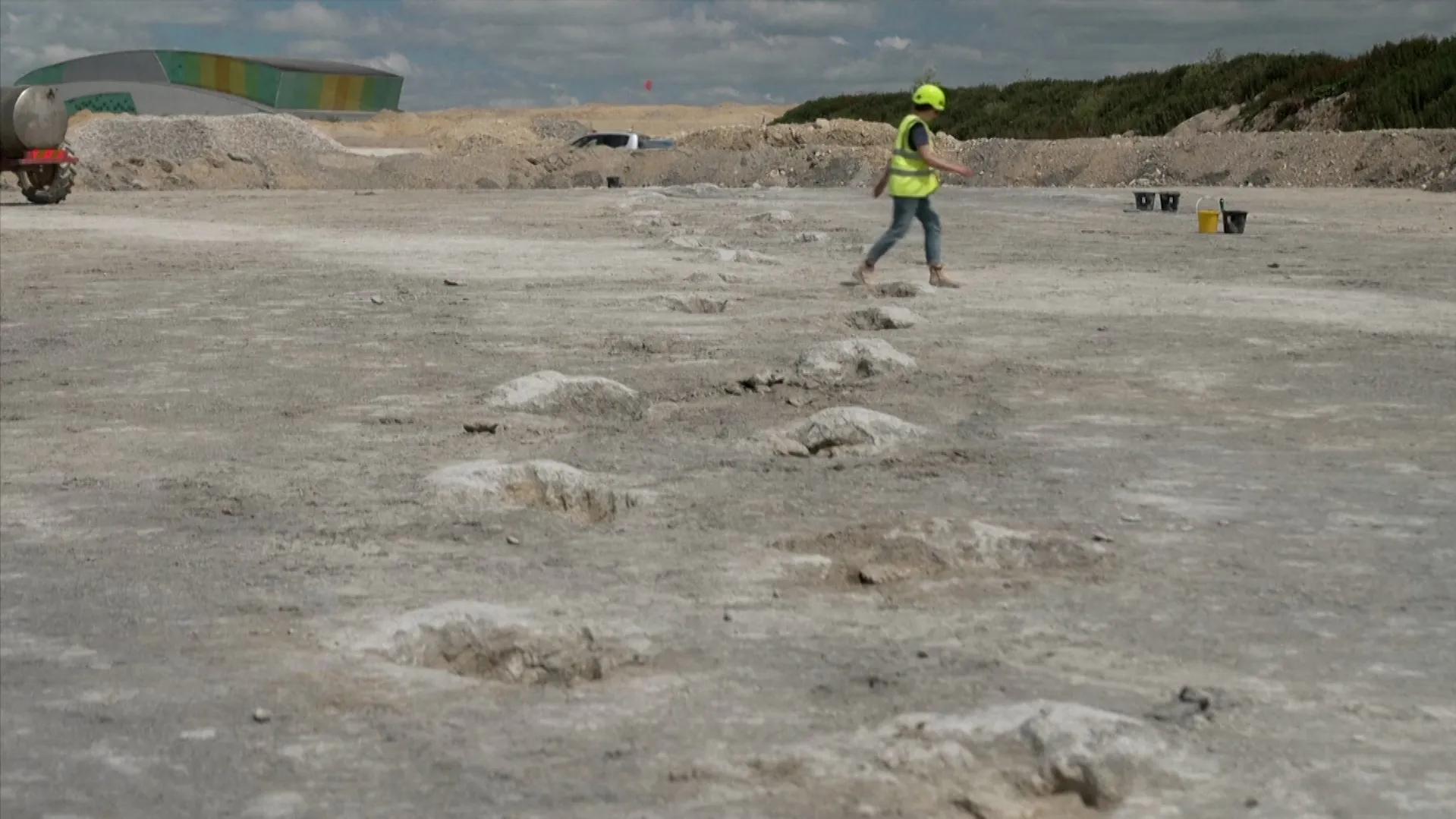

Dinosaur footprint discovery reveals ancient highway
Researchers have uncovered around 200 dinosaur footprints at Dewars Farm Quarry in England with five extensive trackways.
- The Sam Noble Museum will celebrate the 25th anniversary of its current building with a free admission event on November 8.
- The museum’s history dates back to 1899, but it only moved into its modern 198,000-square-foot facility in the year 2000.
- The anniversary event will feature hands-on activities, a chance to win a family membership, and a holiday toy drive.
NORMAN — Nowadays, visitors to the Sam Noble Museum of Natural History can take one “Dinovator” to rise up eye to eye with the articulated skeleton of the world’s largest Apatosaurus or a different glass-walled elevator to get into “The Belly of the Beast,” which means coming face to face with the fierce Sooner State predator Saurophaganax trying to take down the long-necked herbivore.
They also can sprawl on a shining terrazzo marble floor and pretend the life-size woolly mammoth sculpture is about to squish them or wander among the diverse wildlife of present-day Oklahoma, from a grassy prairie where the buffalo roam to a limestone cave that’s home to all sorts of secretive critters.
But fossil preparator Kyle Davies recalls the days when the University of Oklahoma’s natural history museum wasn’t anything like the international award-winning facility it is today. Instead, its priceless collections were spread out among at least 10 buildings across the Norman campus, with many of them not suited for people to live in, much less to store ancient bones and artifacts.
“One of them was an old horse barn from the (ROTC) horse artillery unit,” recalled Davies, who has worked at the museum since the 1990s. “So, we really appreciate having this building now.”
Although the Sam Noble Museum traces its origins to the OU “Department of Geology and Natural History,” which was created by the territorial legislature in 1899, it wasn’t until the year 2000 that it opened in its 198,000-square-foot home at 2401 Chautauqua Ave. in Norman.
To celebrate the 25th anniversary of its current home, the Sam Noble Museum is offering a special free admission event, Curiousiday: Celebrate Oklahoma, from 10 a.m. to 4 p.m. Saturday, Nov. 8.
The event is part of the museum’s monthly Curiousiday series, which features hands-on science and STEAM activities, museum specimens and behind-the-scenes collection chats. Visitors will have the opportunity to explore the museum’s exhibits, buy tasty treats from food trucks and engage in interactive activities hosted by scientists and staff from the institution’s research collections.
In addition to free admission, guests can enter to win a free family membership for a full year of free admission, special programming discounts and other benefits.
Plus, attendees are invited to donate a toy in support of OU’s annual Fill the Trolley holiday toy drive.
“It’s really nice that we’re celebrating our 25th anniversary … and we get to celebrate all the support that the people of Norman and the state gave us through some very, very critical years,” said museum director Janet Braun, who began her career at the Sam Noble Museum in 1984.
“Those initial kids from 2000 and 2001 who went through a lot of our programs are adults now, and they’re bringing their kids to the museum. So, it’s really nice to see this kind of legacy of families and their involvement … in all of our programs at this point.”
What is the history of the Sam Noble Museum?
After it was established by the territorial legislature, Albert Heald Van Vleet was appointed the first “Territorial Geologist and Curator of the Museum.” He immediately began to build the museum’s collections, and by 1902, had accumulated 14,000 zoological, botanical and geological specimens. Unfortunately, all of them were lost in 1903 in the first of two devastating fires, according to the Oklahoma Historical Society.
In spite of these losses, the museum’s collections continued to grow as new professors joined the university. Some significant early acquisitions included geological exhibits acquired from the 1904 St. Louis World’s Fair, archaeological items from Spiro Mounds in 1916 and collections from the 1924 Sykes Expedition to Alaska and Canada.
The latter led to the first of nearly a century of failed efforts to build a facility where all the artifacts could be stored, protected and exhibited. In response to then-OU President Stratton Brooks’ push for support, the state Legislature appropriated funds for the project in 1929, but they were immediately lost as a result of the Great Depression.
The state Legislature made a second attempt in 1945, but the money was diverted for dormitories to house veterans returning to school after World War II. A wealthy OU supporter pledged $5 million to the project in 1960, but the benefactor died without specifying the gift in his will.
A zoologist who now has a rodent, bat and parasite named after him, Michael A. Mares became director of the museum in 1983 and spent the next 17 years working to get the Sam Noble Museum built in its current iteration.
“It was a tough, tough go. I think I resigned five times,” Mares recalled to The Oklahoman. “I’ve worked in museums all my life, so I knew museums. And I’ve worked all over the world, so I knew museums that were in terrible condition. We were the worst I’d ever seen. … We were in 10 different buildings, and most had been abandoned and taken over by the museum.”
In 1987, the state Legislature changed the museum’s name to the Oklahoma Museum of Natural History. The next year, Mares published “Heritage at Risk,” a book outlining the museum’s rich collection and the real dangers to it.
“We had 1,000 baskets, beautiful baskets going back more than 100 years, and it would rain and the water would come in the floor, the ceiling, the walls and all that. We would have to cover the baskets in plastic so they wouldn’t mold. Then, after the water was taken out, and we cleaned and dried everything, then we would take the plastic off, otherwise they would rot under the plastic. And that was just one small part of a massive collection. It was 1,000 baskets out of 10 million objects,” recalled Mares, who will be inducted into the Oklahoma Hall of Fame this month.
“We had an World War II barracks that had a burn-down time of four minutes. The fire department used to bring the firemen to go through our buildings so they could see how bad a building could be. So, that’s what I inherited.”
In 1988, the OU Regents approved initial plans for the new museum and designated 60 acres at the corner of Timberdell and Chautauqua streets for it.
In 1991, the citizens of Norman voted to pass an $5 million bond to support the construction of the new building, and the state of Oklahoma contributed $15 million to the project in 1992.
When the Samuel Roberts Noble Foundation of Ardmore announced a $10 million gift for the project two years later, Mares finally thought the museum had a good chance of getting out of barns and stables and into a proper faciltiy. That gift became the anchor for an OU fund drive that generated $22 million in private money to fund the $37 million building and construction of its exhibits.
Since 2000, the Sam Noble Museum has housed 12 collections, plus labs, libraries, offices and exhibit space. It showcases 4 billion years of Oklahoma natural history through the thousands of artifacts on view in the 50,000 square feet of public galleries.
“I’m very proud of the museum. I made a couple of key decisions: One was, we would not chintz on quality. … The terrazzo floors, the fine finished wood on the walls, all that stuff that you take for granted when you walk in, all that had to be fought for — every piece of it,” recalled Mares, the museum’s director emeritus, who finally retired in 2018.
“When I see people in there, I think it’s wonderful. … It’s a national treasure.”
Curiousiday: Celebrate Oklahoma
- When: From 10 a.m. to 4 p.m. Saturday, Nov. 8.
- Where: Sam Noble Oklahoma Museum of Natural History, Norman.
- Cost: Free.
- Information: https://samnoblemuseum.ou.edu.
(This story was updated to add new information.)
‘ The preceding article may include information circulated by third parties ’
‘ Some details of this article were extracted from the following source www.oklahoman.com ’