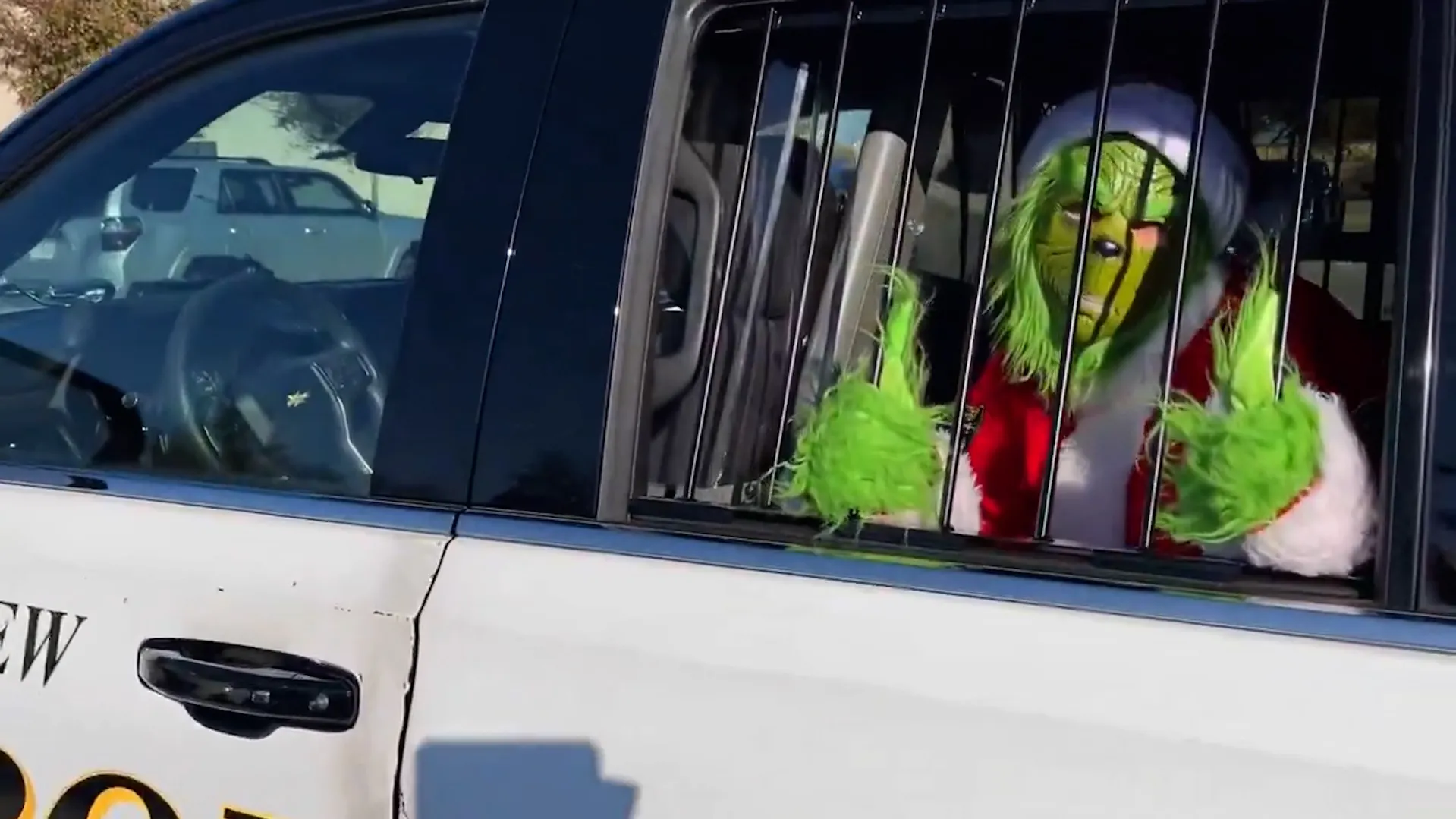

Grinch ‘arrested’ for trying to steal Christmas gifts
Police across the country released videos officers apprehending the “Grinch” as a message to prevent holiday package theft.
- Festivus is an anti-commercialist holiday celebrated on December 23, popularized by a 1997 “Seinfeld” episode.
- The holiday was based on a real family tradition started in the 1960s by the father of “Seinfeld” writer Dan O’Keefe.
- “Seinfeld’s” version of Festivus includes an aluminum pole, an “airing of grievances” dinner, and “feats of strength.”
December 23 isn’t just Christmas Eve Eve, it’s also Festivus.
Festivus is an anti-commercialist holiday that was introduced to the world in the ninth season of “Seinfeld” in 1997.
The quirky Christmas alternative is aimed at those who are fed up with the consumerism associated with the traditions of Christmas, replacing them with grumpy traditions that completely lack holiday cheer. It’s been 28 years since “Seinfeld” introduced the world to Festivus, and fans of the show still celebrate it every year.
Here’s what Festivus is, how to celebrate and how the “Seinfeld” version of the holiday differs from its real-life inspiration.
What is Festivus in ‘Seinfeld’? What do you do to celebrate Festivus?
To celebrate Festivus the “Seinfeld” way, you can get an aluminum pole for your home (instead of a lavishly decorated Christmas tree) and hold an “airing of grievances” meal. The “airing of grievances” is a dinner, during which the goal is to tell your family members how they’ve disappointed you throughout the year.
Why did Frank create Festivus?
The running joke on “Seinfeld,” that Festivus (as we know it) was created by a father and later passed down to his son, is entirely true.
“Seinfeld” writer Dan O’Keefe introduced Festivus to the show based on a tradition his dad started when he was a kid in the ‘60s.
In the show, Frank Costanza (George’s dad, played by Jerry Stiller) “originally invented Festivus as a way to have a holiday that was secular and not burdened by the religious and commercialism of the holiday season,” according to the Festivus website.
Did Festivus exist before ‘Seinfeld’?
Festivus predates “Seinfeld” by a few decades, as the O’Keefe family had been celebrating their own version of Festivus since the 1960s.
Only some of the Festivus traditions in the “Seinfeld” episode are true, according to Dan O’Keefe’s 2005 book “The Real Festivus.”
“It was entirely more peculiar than on the show,” O’Keefe told The New York Times in 2004. He said his family never set up an aluminum pole, but there were wrestling matches between him and his two brothers – which turned into “feats of strength” in the show.
In real life, Festivus didn’t have hard-set rules like in the show.
“I mean this in the nicest way possible: My father was an undiagnosed bipolar, severe alcoholic who nonetheless was extremely high-functioning,” O’Keefe explained in a 2021 interview with the Daily Beast.
The holiday also doesn’t have to be celebrated on Dec. 23.
“We never knew when Festivus was. It was a floating holiday,” he told The Cincinnati Journal News in 2017.
“It appeared whenever my dad felt like it. You came home from school and there were weird things pinned to the walls, strange decorations, strange music playing and strange things being said, and it was on.”
Where to watch the ‘Seinfeld’ Festivus episode
Looking to host a viewing of the iconic “Seinfeld” Festivus episode? The entire show is available to stream now on Netflix.
Buy episodes of ‘Seinfeld’ on Amazon Prime Video
The Festivus episode is season nine, episode 10, and is titled “The Strike.” If you don’t have Netflix and want to watch just the Festivus episode, you can buy just that episode for about $3 on Amazon Prime Video.
What did Rob Reiner have to do with ‘Seinfeld’?
The late, great actor and filmmaker Rob Reiner, who was found dead in his home on Dec. 14, was not directly a producer on “Seinfeld,” but he and his entertainment company, Castle Rock, are likely the reason why the show stuck around for so long.
Days after Reiner died, Jerry Seinfeld said the show wouldn’t have been a success if Reiner hadn’t championed it to NBC.
“Next to Larry David and George Shapiro, Rob Reiner had the biggest influence on my career,” Seinfeld wrote in a Dec. 15 Instagram post. “Our show would have never happened without him. He saw something no one else could. When nobody at the network liked the early episodes, he saved us from cancellation.”
‘ The preceding article may include information circulated by third parties ’
‘ Some details of this article were extracted from the following source www.floridatoday.com ’