Celebrity endorsements remain deeply embedded in India’s advertising playbook, but the economics and effectiveness of star power are entering a more complex phase. While film stars, sports icons and television personalities continue to drive recall in a star-driven culture, brands are grappling with fragmented attention, rising media clutter and diminishing marginal returns on celebrity-heavy campaigns.
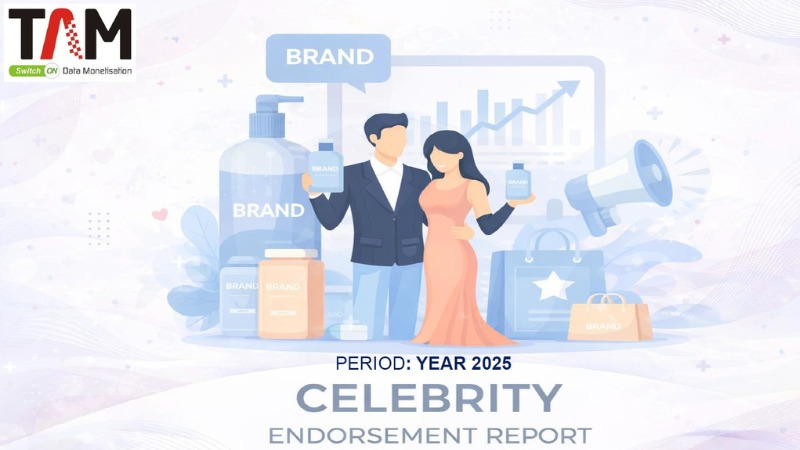
According to TAM AdEx’s ‘Celebrity Endorsement Report 2025’, celebrity-led advertising accounted for over 25% of total television ad airings in 2025, underlining the continued reliance on familiar faces to cut through clutter. Yet, the data also points to a market that is plateauing, with volumes softening and activity becoming more event-driven and front-loaded.
Film Stars Dominate, But Growth Slows
Film actors continued to dominate celebrity advertising in 2025, accounting for 73% of all celebrity-endorsed ad volumes, followed by sports personalities at 20% and television stars at 8%. Male movie actors alone commanded 43% of the total endorsement market, reinforcing the industry’s preference for mass-reach, high-familiarity faces.
However, despite this dominance, overall ad volumes for celebrity-endorsed commercials declined in 2025 compared to 2023–24. While celebrity advertising had grown 3% in 2024 over 2023, momentum weakened in 2025, suggesting that brands are becoming more selective about scale, timing and deployment.
IPL Effect and a Front-Loaded Year
Advertising activity remained closely tied to tentpole moments. The April–June quarter, driven largely by the IPL, emerged as the peak period for celebrity-led advertising, recording the highest daily ad volumes across both 2024 and 2025.
Monthly data for 2025 shows March as the strongest month for celebrity advertising, while December recorded the lowest share, reflecting year-end pullbacks. Noticeable spikes were observed in March, May and September, with softer volumes in November and December.
The broader pattern reveals a front-loaded 2025, with stronger activity in the first half of the year. In contrast, 2024 saw relatively better performance in the second half, indicating a shift in how brands are pacing celebrity investments amid budget scrutiny.
FMCG Continues to Anchor Celebrity Advertising
Nearly 50% of celebrity-endorsed ads came from the top three sectors—Food & Beverages, Personal Care/Personal Hygiene, and Household Products—while the top seven sectors accounted for 79% of all celebrity advertising.
Food & Beverages led with a 24% share of celebrity ad volumes, followed by Personal Care/Personal Hygiene at 16%. Sector rankings remained largely stable year-on-year, with six of the top ten sectors retaining their positions, highlighting sustained reliance on celebrities in high-frequency FMCG categories.
At the category level, Toilet and Floor Cleaners emerged as the largest users of celebrity endorsements with a 9% share, followed by Toilet Soaps at 5%, underscoring the hygiene segment’s continued dependence on trust-led celebrity cues.
Gender Skew Remains Pronounced
Gender representation in celebrity advertising continues to show sharp imbalances. Across the top ten sectors, the average male-to-female endorsement ratio stood at 67:33.
In 2025, male celebrities were especially dominant in Food & Beverages, while female celebrities were more visible in Personal Care and Personal Hygiene categories. Notably, ads in Computers, Agriculture and Media featured only male celebrity endorsers, pointing to persistent gaps in female representation across certain sectors.
E-commerce Emerges as a Celebrity Magnet
Among categories by number of endorsers, Ecom-Gaming led with 41 celebrities, reflecting intense competition and visibility battles, followed by Ecom-Media, Entertainment and Social Media with 34 celebrities. The spread of professions in these categories suggests that digital-first platforms are casting a wider celebrity net to stay top-of-mind.
Visibility Is Concentrated Among a Few Big Names
Television advertising visibility in 2025 was sharply concentrated at the top. Shah Rukh Khan emerged as the most visible celebrity, clocking nearly 30 hours of daily presence across TV channels. MS Dhoni followed with approximately 20 hours of daily visibility.
The Top 10 most visible celebrities included nine male stars and just one female star, Ananya Panday. New entrants to the list in 2025 included Rahul Dravid, Ananya Panday, Karan Wahi and Vicky Kaushal, replacing some incumbents from 2024.
Beyond visibility, MS Dhoni also emerged as the most sought-after celebrity, endorsing the highest number of brands during the year. Four celebrities—Dhoni, Shah Rukh Khan, Ranbir Kapoor and Hrithik Roshan—expanded their endorsement portfolios in 2025, signing more brand deals than in the previous year.
Celebrity Couples Drive Half the Market
Celebrity couples continued to be a powerful endorsement lever. Nearly 50% of all celebrity-endorsed ads featured just four couples:
- Ranbir Kapoor–Alia Bhatt (37 brands)
- Anushka Sharma–Virat Kohli (19 brands)
- Deepika Padukone–Ranveer Singh (28 brands)
- Amitabh Bachchan–Jaya Bachchan (38 brands)
Their sustained appeal highlights how relational familiarity and cross-demographic appeal remain valuable currencies in Indian advertising.
The Bigger Picture
The TAM AdEx data makes one thing clear: celebrity endorsements are far from fading. But the model is becoming more concentrated, seasonal and efficiency-driven. As ad volumes soften and costs rise, brands appear to be leaning on fewer stars, sharper bursts and high-impact moments rather than blanket visibility.
In an attention economy where fame alone no longer guarantees engagement, the challenge for marketers is shifting from who to sign to how and when star power is actually deployed.
‘ The preceding article may include information circulated by third parties ’
‘ Some details of this article were extracted from the following source www.adgully.com ’