Before pulling back the curtain (or, in this case, the floor-to-ceiling, upside-down American flag) on “Topdog/Underdog” at ArtsWest, director Valerie Curtis-Newton gives a sly hint at what’s coming for us with the preshow music.
Wu-Tang Clan’s 1994 hit “C.R.E.A.M. (Cash Rules Everything Around Me)” transitions into the 2025 jazz interpretation of the track from local artist Kassa Overall. Same song, different sound; same relevant idea, expressed decades apart.
Cash rules everything around brothers Booth and Lincoln, the stars of Suzan-Lori Parks’ Pulitzer Prize-winning play and the stunning production now running at ArtsWest, produced in collaboration with The Hansberry Project, where Curtis-Newton serves as artistic director.
On a Thursday night, right before payday, a man named Booth practices his three-card monte patter when a man named Lincoln, in a bushy beard and stovepipe hat, walks into Booth’s room carrying takeout.
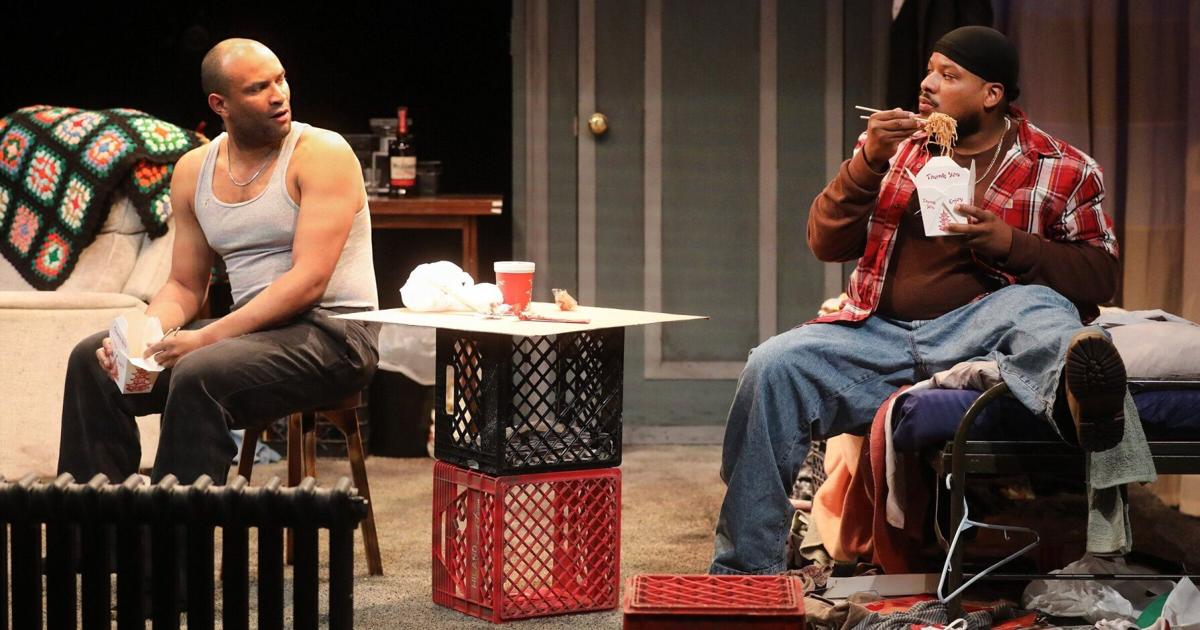
Lincoln (ML Roberts) lives with his little brother after his ex-wife Cookie threw him out, sleeping on the recliner in the shabby room Booth (Yusef Seevers) rents. (The bathroom is down the hall.)
Booth, who gets by as a talented shoplifter, remains convinced his bright future hangs on mastering the three-card hustle and on reuniting with Grace, the ex he’s convinced wants him back.
But Booth needs his big brother to teach him that hustle, a con that Lincoln perfected, cashed in on and then left behind for his current honest job: dressing as “Honest Abe” Lincoln in an arcade where guests shoot capguns at him.
As these two wounded brothers, Roberts and Seevers deliver two of the best performances in recent memory on Seattle stages. These family scars run deep, and Booth and Lincoln can’t help but ruminate on the inheritance, literal and figurative, they got from their parents, both of whom bailed early in their lives.
Being starved of love and forced into sibling rivalry (even their names, Lincoln and Booth, were given to them as a joke by their dad) bred the miasma of dependence and resentment that poisons the affection they have for one another.
The simple production requirements — two actors; a single, claustrophobic set (Pete Rush) — belie the script’s complexity, and Parks’ deft writing deserves your undivided attention.
“Topdog” premiered off-Broadway in 2001, starring Jeffrey Wright as Lincoln and Don Cheadle as Booth. Wright again played Lincoln after the play transferred to Broadway in 2002, opposite Yasiin Bey (then known as Mos Def) as Booth. In 2002, it scooped up that Pulitzer, and in 2018 The New York Times named it the best play of the previous 25 years.
In entertainment years, 2001 is a lifetime ago, and the chasm between “Topdog/Underdog” and so much of the media we consume today (not to mention the way we consume it) feels colossal. This isn’t passive consumption; this is art that asks for your brains and hearts for just a couple of hours, promising to entertain and engage if you can just tune in.
“When people know the real deal it ain’t a hustle,” Lincoln says, explaining why his new job is on the up and up, unlike his former three-card life.
But who even knows the real deal? Do we? If anything has evolved as much as our media habits in the past 25 years, it may be opinions about America and its foundational value, capitalism, as well as who is getting conned and who is doing the conning.
Naming any sort of evolution like that can be risky because “people are funny about history,” as Lincoln says. “They like it to unfold the way they folded it up. Neatly like a book. Not raggedy and bloody and screaming.”
As deftly shaped by Curtis-Newton, “Topdog” gives us laugh-out-loud and heartbreaking moments and, without spoiling any details, an explosive ending that comes as both a shock and an inevitability.
And without that explosion we might not understand what we knew, or should have known, all along: “The first move is to know that there ain’t no winning,” Lincoln tells Booth. “Ta-da! It may look like you got a chance, but the only time you pick right is when the man lets you.”
‘ The preceding article may include information circulated by third parties ’
‘ Some details of this article were extracted from the following source www.yakimaherald.com ’