Since it first opened in 2000 as The National D-Day Museum, the heart of The National WWII Museum in New Orleans has long been its 8,000-square-foot D-Day exhibit.
Over 25 years, tens of millions of dollars and 10 million visitors later, the museum has maxed out its seven-acre campus in the Central Business District and the original exhibit is due for overhaul.
“This exhibit was here on opening day,” said Peter Crean, the museum’s vice president of education. “While the story is the same, the way we tell it is going to be better.”
For the next several months, The D-Day Invasion of Normandy’s two galleries will be closed for a major renovation that is set to debut with four galleries by June 6, 2027, the 82nd anniversary of D-Day, when the Allies invaded western Europe.
Though it took place in northern France, the invasion is a particular point of pride in New Orleans. The daring amphibious attack in June 1944, that was a cornerstone in the eventual defeat of the Nazis, was made possible by Higgins landing craft which were built right in the city.
The historic battle remains crucial to the museum’s telling of the history of the global war. But after 25 years, the museum curators felt it was high time for an update, with new artifacts, oral histories and contemporary interactive displays.
Exhibition technology has advanced over the past quarter century, Crean pointed out, and the museum has continuously collected artifacts as they became available. Roughly 50% of the historic objects that will appear in the update were acquired since the exhibit was first installed.
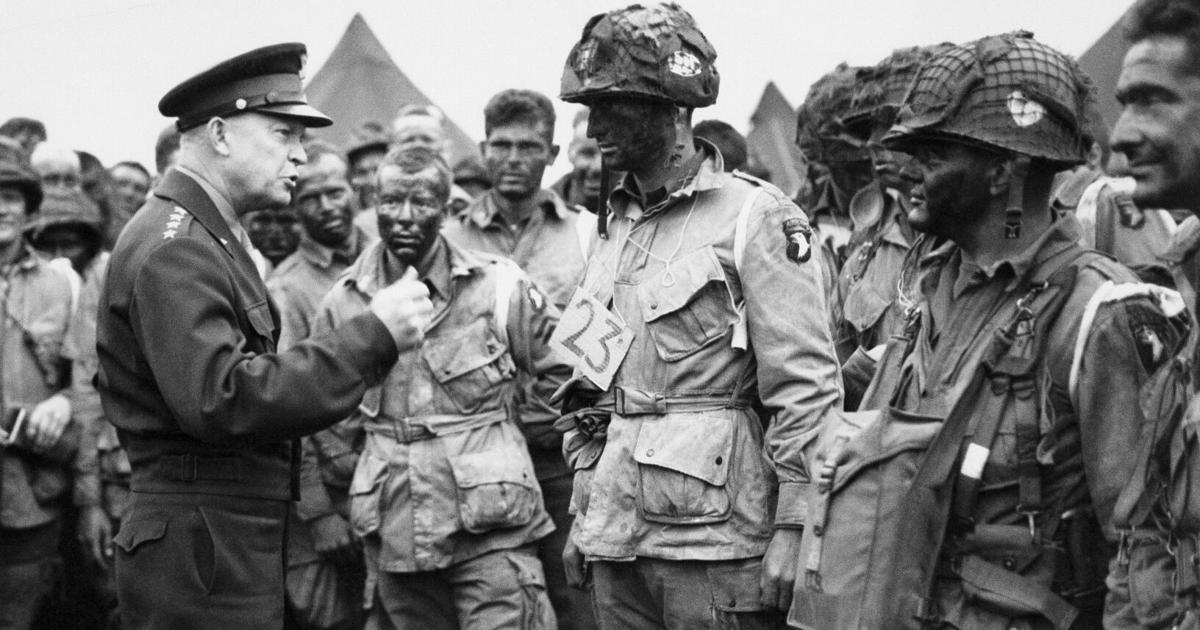
Crean said that future visitors can expect to see a complete 101 Airborne Division paratrooper uniform, a contraband crystal radio from an American prisoner of war camp, and a pistol carried by the late Wallace Stroble, a 22-year-old paratrooper who was famously photographed shaking Gen. Eisenhower’s hand as he prepared to be dropped behind enemy lines.
Gen. Dwight D. Eisenhower, Allied Commander in Chief, speaks with American paratroopers at an undisclosed location in England, June 6, 1944, prior to plans to participate in the first assault on the Coast of France during D-Day.
Though the galleries devoted to D-Day will be temporarily closed, the myriad major exhibits in the rest of the sprawling museum remain open, including the sunlit atrium that displays an actual Higgins boat, not to mention an airplane that carried paratroopers on D-Day, and a sinister German anti-aircraft used to fend off the invaders.
The museum has not revealed what the renovation, designed by Gallagher & Associates Architects, will cost. In June, the museum launched a $300 million fundraising campaign for the next phase of expansion through 2035, which focuses less on physical footprint and more on increased traveling exhibitions, education resources, endowment, collections, content and expertise.
Last year, the museum also acquired three adjoining properties on Magazine Street for office space, meeting rooms and storage. That area near the Higgins Hotel is part of the museum’s education corridor, where a new educational facility under construction at Magazine and Poeyfarre streets.
‘ The preceding article may include information circulated by third parties ’
‘ Some details of this article were extracted from the following source www.nola.com ’