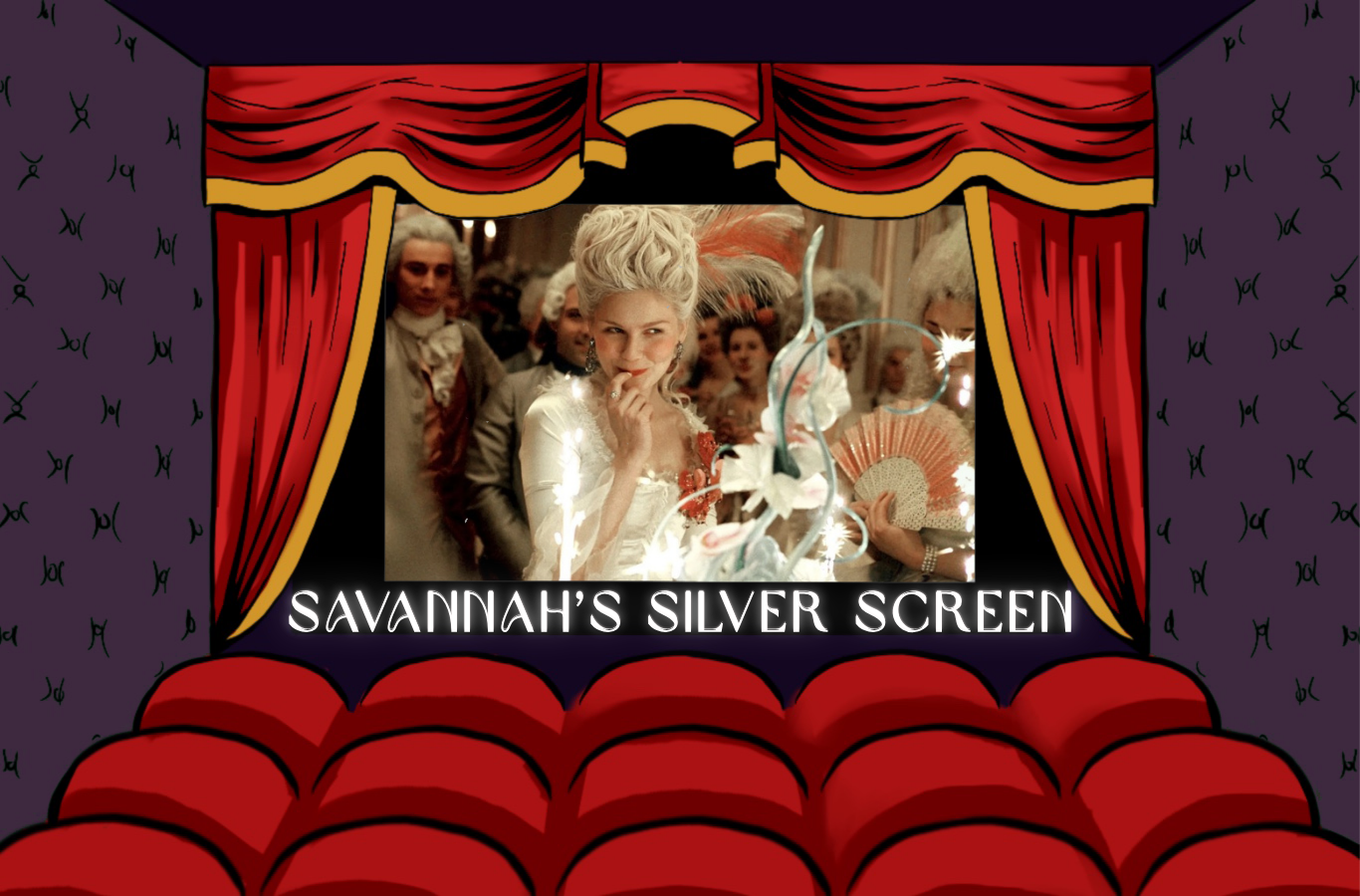
Embellished with heaps of cake, ruffles and wigs, “Marie Antoinette” offers an alternative perspective on the infamous French queen with themes of innocent femininity, coupled with dreamy visuals and costume design.
Sofia Coppola’s “Marie Antoinette” follows the titular 14-year-old as she is sent from Austria to France to marry the Dauphin of France, Louis-Auguste. With the title as the Queen of France heading steadfastly her way, Marie faces the societal pressures placed on her as a member of the royal court and the reputation she must uphold as a foreigner in this historical drama.
Instead of focusing on history’s remembrance of Antoinette as carelessly cruel with riches and debt, Coppola highlights her as a child thrown into a marriage of duty. With a lavish lifestyle and adolescent innocence, the audience sees how Antoinette attempts to find joy amongst strangers in the Palace of Versailles.
From start to finish, I loved this film. While the rich do spend money so frivolously with little to no regard for the non-wealthy, I thought this interpretation did a wonderful job of balancing royal fantasies and historical reality.
As it is only fitting to identify the film’s strengths with its sweeter counterparts, I must say this:
Let us eat cake.
Angel food: actions & dialogue as soft-spoken as angels
Kirsten Dunst as Antoinette is perfect. Throughout the movie, she evolves from the mannerisms of a young girl to the demeanor of a competent young woman. She learns the inner workings of French royalty’s expectations while simultaneously blooming into knowing what she wants as the years pass by.
Two aspects of Dunst’s performance I’d like to focus on are her line delivery and facial expressions.
A scene that encapsulates these two features the best is when Antoinette is dressed by ladies of the court the morning after her wedding. Dunst holds a confused expression as she is awoken by sunlight streaming through her bed curtains and is surrounded by women waiting to have the privilege to help her dress.
As Antoinette is naked and waiting for her dress to be put on her, she softly utters how it is cold with a forced smile, which conveys her discomfort in waiting on others to help her. It also draws attention to the fact that no matter Antoinette’s feelings, the ladies of the royal court will stick to tradition through and through.
Antoinette tries to lightheartedly say how the morning dressing ceremony is ridiculous, but she is cut off with an explanation on how it is the way of Versailles. Dunst’s way of expressing her feelings paints the scene as quintessential in mapping out how she tries to learn France’s ways while still trying to maintain an appearance of contentment.
Dunst behaves as an angel sent from above to learn the ways of otherworldly creatures, forced to pose as a spectacle for all those permitted to see.
Birthday cake: costume designs dancing in color
Given that the film won the 2007 Academy Award for Best Costume Design, it is only best that I praise the film’s arguably most valuable asset.
The scene that takes the cake with the best representation of the movie’s costume intricacy is the montage-like scene with the song “I Want Candy” playing over it.
Not only does the abundance of fabrics in a multitude of colors catch the eye’s attention, but so do the ruffles of dresses and wigs tall enough to reach castle ceilings. While I am not an expert on the historical accuracy of 18th century French fashion, I do love how the pieces are exactly what I picture for the era in my imagination.
With the blue dress Antoinette adorns in the scene, I find myself entranced by the subtle, ripple pattern etched into the fabric, along with sparkly, white lace trimmings. The necklaces she tries on add a whole new level of sparkle to her sequined gowns, and I’m sure the audience cannot bring itself to look away from such shininess.
Another detail of the scene is the amount of shoes that we see. It even begins with shoes, as the camera pans from a pair of blue heels all the way toward fur-decorated heels. It accentuates the ridiculousness of the clothing while making the audience think about the tiniest details that those with such a large amount of wealth could put into what they wear.
A final stylistic choice I enjoy with the scene is how many types of desserts are shown simultaneously, as are the many types of dresses. It implies how the desserts and gowns are one in the same; both items represent a hunger for more and more material wealth. It is a pure display of gluttony and how these cravings can never be satisfied.
The scene shows the characters eating the desserts as they admire the outfits, and it instills a sweet tooth into the audience, blending hunger and desire together. It is even more fascinating how the outfits’ and accessories’ colors are candy-like, simulating the looks of desserts.
Both of these kinds of items beg the question: How could something that appears so delicious be so bad for you?
Wedding cake: symbolism of female adolescence and naivete
Coppola does not attempt to hide Antoinette’s age. Rather, she clearly defines it across the runtime. From Antoinette’s mother introducing her as her youngest daughter to celebrating her 18th birthday on screen, it is a crucial plot point to convey how young Marie Antoinette was when she took on such a huge title.
The symbols for Antoinette’s adolescence and naivete are scattered as almost unnoticeable bits and pieces. From colorful gambling chips to modern sneakers, there is something to be found among Antoinette’s mountain of deficit.
As mentioned above, gambling chips are in most of Antoinette’s party scenes, where she’s shown not particularly caring about winning or losing. She simply wants to entertain herself.
These chips are not shown as carefully-detailed poker chips; instead, they come in glossy, pastel colors like pink and yellow. It is to exhibit how Antoinette doesn’t see the chips as money she throws away, and she doesn’t intend to put any thought into such things at all.
One more physical symbol of Antoinette’s naivete also lies within the “I Want Candy” scene that I discussed before. While she tries on a lavish pair of blue heels, a pair of lavender Converse sneakers sit in the background.
It is another symbol underlining her naivete to the wealth she possesses. She is ignorant to the amount she spends, but that is to be expected of a girl so young. As she does not feel welcome in Versailles by the court, she turns to materialism. It is a form of comfort for her, whereas actual people cannot offer that.
Converse sneakers are akin to what teenagers wear, and for the majority of the film, that is what she is. History cannot change ages, and while her debt-inducing habits did spell France into a financial crisis, she was still a young girl trying to find happiness wherever she could.
Devil’s food: dense history made easily digestible
It is no secret what happens to Marie Antoinette at the end of this tale. While Coppola’s main point was concerning Antoinette herself, she still made sure to show the cracks of crisis that led to the fall of the French monarchy.
It began with warnings to Antoinette about her parties and spending habits. Then, it grew into meetings where the king agreed to send funds to the Americans. It snowballed even further with scenes of villagers rioting against the monarchs’ reign.
An even smaller indication of Antoinette’s role in this fall is when scenes would show the many unfinished plates of food after her parties.
It puts on display how the rich always possessed too much for them to even consume it all. And yet, they still did not try to give back to the commonfolk. Instead, they thought raising taxes would do the trick.
The movie turns even darker toward the very end, showing how people labeled Antoinette as “Madame Deficit.” As the name is scrawled on a portrait of the queen, other paintings of her show how her third child died. The film’s whimsy is clearly no more, and Antoinette and her family are seen hiding from rioters in their own home.
Still attempting to cast Antoinette in a better light, Coppola includes a scene of the queen bowing to the rioters as she stands on her balcony. Although, it is fruitless because despite the gesture, she is still framed as above them all due to her status.
The film ends with a shot of Antoinette’s destroyed bedroom; it is the destruction of her very beginning, and it was what brought her to her own end.
★★★★★
‘ The preceding article may include information circulated by third parties ’
‘ Some details of this article were extracted from the following source lsureveille.com ’