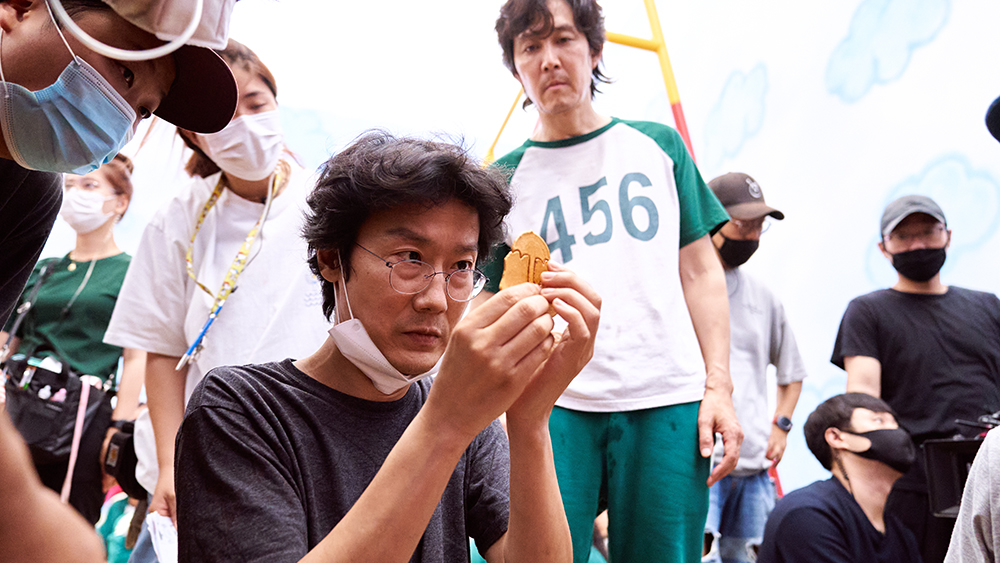
The best feedback Hwang Dong-hyuk received when he first pitched “Squid Game” in 2009 was someone asking him how he could possibly have come up with something so absurd. “That was the most positive response I got,” he told a packed house Sunday at the Xiqu Centre, Hong Kong, where he opened the Asian Film Awards’ day of masterclasses.
Hwang traced the origins of the series to a period of acute personal hardship. His first feature had failed commercially, a second project had fallen apart before production, and he was selling household furniture to cover living expenses. He spent much of his time in manga cafes, reading survival game comics in which protagonists gambled their lives for large sums of money. He wondered whether he could make something similar but distinctly Korean in character. Where most survival narratives featured protagonists with superhuman abilities, he wanted to tell a story about entirely ordinary people playing the simplest games imaginable – the kind any child had grown up playing, requiring no special skills or genius, only the will to keep going.
More from Variety
After a year of fruitless meetings with investors and actors who universally dismissed the project, Hwang made the decision to bury the script in his computer and wait. He made three more feature films in the intervening decade. When he returned to the idea in 2018 and reread the script, he said, he felt an immediate conviction that the time had come. “By 2019, the world had somehow come to look more like ‘Squid Game’ than it did when I first wrote it,” he said. Competition had intensified, the wealth gap had widened, and the economic pressures and social tensions he had imagined as extreme had come to feel entirely plausible. “People’s lives had become harder,” he said. “The story no longer seemed so far-fetched.”
The arrival of Netflix Korea was the final piece. Hwang had always believed the premise would resonate more easily outside Korea than within it – the survival game genre had never been commercially popular at home – and Netflix offered immediate access to a global audience. He also found the series format liberating. His original screenplay was a two-hour film in which the games crowded out nearly everything else. Expanding to eight hours allowed him to develop the backstories of characters like Sang-woo and Sae-byeok, and – crucially – to create the figure of Oh Il-nam, Player 001, the elderly man who turns out to be the architect of the games. “That character didn’t exist in the film version,” Hwang said. “The series gave me the space to build him, and with him the entire emotional logic of the final episode.”
Several games were also redesigned for international audiences. Some of the original choices had rules too culturally specific to be immediately comprehensible to viewers outside Korea. The replacements – marbles, the honeycomb candy carving game, the ddakji tile-flipping game – were chosen because any viewer anywhere could understand them within seconds. The giant doll in the Red Light, Green Light sequence, which became one of the series’ most iconic images, was designed with a deliberate choice. Rather than something conventionally threatening, Hwang drew on the image of a girl character named Young-hee, familiar to every Korean child from first-grade textbooks. “We wanted something cute,” he said. “I genuinely did not think people would find it frightening. Their reaction surprised me.”
The production design of the series reflected a philosophical choice rooted in Oh Il-nam’s psychology. Where most survival narratives set their action in dark, oppressive spaces, “Squid Game” used pastel colors and the aesthetic of a children’s play cafe. Hwang explained that Oh Il-nam built the games to recapture childhood joy – his own and others’ – and that the spaces he designed would therefore be cheerful and colorful, not menacing. The horror, Hwang said, came from what happened within those cheerful spaces, and the contrast made it more devastating.
On the series’ central theme, Hwang said the world of “Squid Game” is one in which people in a hyper-competitive society are conditioned to see those beside them as rivals rather than allies – while the people who actually designed the system watch from above and profit from it. He said he wanted the series to ask whether it was possible for people to recognize that their real adversaries were not their neighbors but those further up, and whether some form of collective response might be imaginable. He stopped short of prescribing an answer but said the question felt urgent.
The session also ranged across Hwang’s broader career. He studied journalism at university – his father, who died when Hwang was young, had been a journalist – but grew disillusioned after participating in the pro-democracy student movements of the early 1990s and finding that the Korean press was too conservative and pro-government to do the investigative work he had hoped it would. He began watching two or three films a day in a lost period after abandoning his journalism ambitions, and eventually went to study film at the University of Southern California. He recalled his first class there, in which the professor asked students successively how many expected to direct one feature film after graduating, then two, then three – and concluded that statistically, not one person in the room would likely make even one. “Looking back,” Hwang said, “the only person from that class who became a feature film director was me.”
His USC graduation short, “Miracle Mile” – about a sibling who travels to the United States to find a brother who had been adopted away, carrying a dying parent’s apology – led directly to his first feature, “My Father,” after a Korean producer saw the short and reached out. The story drew on a memory from his own life: a paternal aunt who had been given up for adoption to America when his family was too poor to keep her, and who returned to find her birth family when Hwang was around 19.
He described the production of “Silenced” – based on the real-life sexual and physical abuse of students at a school for deaf children in Gwangju – as one of the most grueling experiences of his career. He initially turned the project down, he said, but reconsidered after researching the case and concluding that a film might be the last chance to return it to public consciousness. He deliberately chose to make it as a work of narrative cinema – emotionally immersive rather than documentary in approach – on the conviction that audiences needed to care about the characters before they could feel the full force of the injustice. The film’s release led to real-world legal changes. But the psychological cost was severe. “I lost weight, I developed insomnia, I was in a bad way,” he said.
“Miss Granny,” the broad intergenerational comedy he made next – about a grandmother who is magically transformed into her younger self – was a direct reaction to that ordeal. It was also, Hwang said, a personal tribute to his mother and grandmother, who had raised him after his father’s early death. He said he had wanted to make a film that three generations of a family could sit down and watch together, each finding something to recognize in it. The film went on to be one of the top three highest-grossing Korean films of its year and spawned remakes across Asia, including versions in China, Vietnam and India. Hwang said he had been struck, while watching the various adaptations, by how each country’s version drew on its own era of popular music and its own cultural textures – the Indian remake especially, with its Bollywood-style musical sequences.
Closing the session, Hwang reflected on his affection for Hong Kong cinema, which he credited as a defining influence on his generation of Korean filmmakers. He watched Chow Yun-fat’s “A Better Tomorrow” ten times, he said, and when he was seriously studying film as a craft, it was Wong Kar-wai’s “Chungking Express” and “Days of Being Wild” that made the deepest impression. He expressed sadness that Hong Kong cinema had largely disappeared from Korean screens, saying that “Infernal Affairs” was the last Hong Kong film he had seen theatrically and that he had had little opportunity to follow the industry since.
On the question of how Korean content had come to dominate global popular culture, Hwang offered a structural rather than a mystical answer. Korea’s entire postwar economic development, he said, was built on an export mentality – the country had nothing and built everything by manufacturing and selling abroad. That orientation had transferred to the cultural industries over time, with filmmakers, musicians and drama producers gradually becoming more attuned to international audiences alongside domestic ones. He said he did not believe the phenomenon had happened quickly but was the accumulated result of a long habit of thinking outward – and that he himself had had that global audience in mind when he decided to take “Squid Game” to Netflix.
His advice to the aspiring filmmakers in the room was unsentimental. Film technique, he said, can be learned quickly – his own MFA program at USC deliberately avoided admitting film majors, preferring students from other disciplines who already had something to say. The hard part is not learning to use a camera but knowing what story you need to tell. He urged young filmmakers to read, travel, make friends and accumulate experience rather than focusing narrowly on technical skills – and to be honest with themselves about whether they were truly prepared for a path that offers no stability and demands the willingness to risk everything.
Best of Variety
Sign up for Variety’s Newsletter. For the latest news, follow us on Facebook, Twitter, and Instagram.
‘ The preceding article may include information circulated by third parties ’
‘ Some details of this article were extracted from the following source www.yahoo.com ’