This article includes spoilers for “The Drama.”
Lately, there seems to be an appetite for atypical romance films that subvert the genre with social commentary about the world around us rather than a sweeping love story. That trend seemed most apparent last year with Celine Song’s sophomore film “The Materialists,” a thoughtful look at modern dating culture, released by A24.
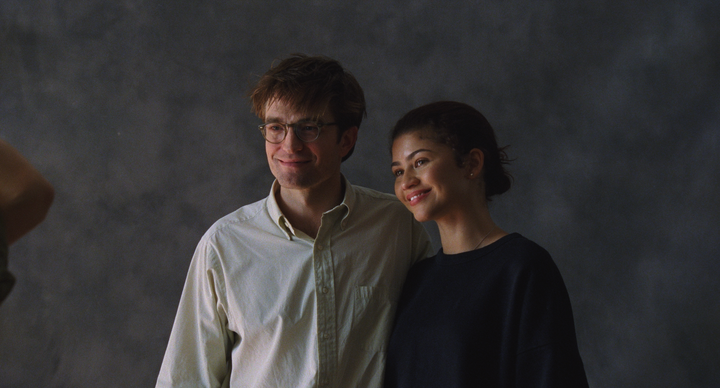
Now, nearly a year later, A24 returns with another offbeat romance steeped in societal reflection: “The Drama,” director Kristoffer Borgli’s dark spin on a rom-com starring Zendaya and Robert Pattinson.
Like most romances tested by conflict, Borgli centers his film around the fallout of a moral dilemma: Could you forgive the person you love most for the worst thing they’ve ever done — even if it contradicts everything you stand for?
Those are the tough questions the film poses, as a long-buried secret implodes a happily engaged couple’s relationship on the eve of their wedding.
According to Borgli, “The Drama” revolves around the idea of stress-testing two people who are “head over heels in love, and who maybe never considered there could be more to the other person.”
“It’s about the power of love — an emotional state you don’t get to control, and how complicated that becomes when your feelings are at odds with your rationale,” the director continued in the film’s production notes.
“When that balance slips,” he added, “you find yourself inside a crucial dilemma.”
“Dilemma” is a bit of a mild description for the conflict at the heart of “The Drama.” Early on, the film veers into controversial territory, tackling a rather sensitive subject — one that has already caught backlash online — with its protagonists. However, it struggles to fully explore its implications for those impacted by it and its message at large, if there’s even one to take away.
Despite the warnings in its title, “The Drama” hardly encapsulates all the chaos that ensues in the film. In fact, the nature of the film’s big reveal is far darker than many would expect from what’s been marketed as “the wedding of the year.”
Even so, that grim twist sends Borgli’s calamitous tale off the rails in the most tumultuous, unsettling and, at times, questionable ways.

You’d never guess just how unhinged “The Drama” eventually becomes based on its subtle opening: an awkward coffee shop meet-cute between Charlie (Pattinson) and Emma (Zendaya). Charlie, a bumbling museum curator, tries to make a move after noticing (rather stalking) Emma from across the room. When she briefly steps away from her seat, he sneaks over to check the title of her book she’s been reading, quickly googling it so he can fake a shared interest. By the time Charlie finally works up the nerve to approach Emma, he’s so caught up in his rambling pickup attempt that he fails to notice she’s deaf in one ear and blasting music through earphones in the other.
Despite the painfully clumsy introduction, the two eventually go on a first date, then another, and before long, they fall deep enough in love that Charlie is certain he wants to marry Emma.
Granted, there’s not much build-up to this supposedly sweeping romance, despite the way Charlie swoons over it in the wedding speech he prepares with his best man and friend, Mike (Mamoudou Athie). We’re never quite shown what compels him and Emma to want to spend a lifetime together. And yet, somehow the film convinces us that these two are soulmates ready to walk down the aisle — even if they don’t know everything there is to know about one another.
That becomes evident one evening as Emma and Charlie are joined by Mike and his feisty wife, Rachel (a fantastic Alana Haim) — also Emma’s maid of honor — for a wedding wine tasting. Sitting around the table together, the group decides to play a game of “What’s the worst thing you’ve ever done?” One by one, they share confessions.
Rachel recalls once locking a mentally impaired boy she found annoying in a cabin closet overnight. Charlie mentions cyberbullying someone as a kid. Both pretty bad, yes, but Emma’s avowal eclipses them all.
After some hesitation, Emma confesses to a secret she’s held since she was 15: She once came close to carrying out a school shooting.
There’s lots of unpacking that happens afterward, but the fallout of Emma’s admission is what inspires the title of “The Drama,” most of which follows Charlie’s spiral in the days leading up to, and even on, his wedding day.
The name of the film could also just as easily describe the discourse that has surrounded “The Drama” the last few months, between leaked spoilers on Reddit and last week’s TMZ report in which a parent of a student killed in the 1999 Columbine High School massacre condemned the film’s “awful” school shooting storyline.
Admittedly, the film’s bombshell is difficult to make sense of between its moments of discomfort and dark humor. That tension feels somewhat intentional on Borgli’s part, as if he aimed to make a film that would purposely leave audiences morally conflicted — or at least spark spirited debates with a supposedly “edgy” twist.
Yet as that twist unfolds in “The Drama,” it never feels as bold as the film seems to think it is, which may be its biggest flaw.

In the weeks since screening “The Drama” at its Los Angeles premiere, it’s been interesting to see how the film has been consumed in real life versus what unfolds on-screen, particularly as it concerns Zendaya.
The A-list actor’s name dominates nearly every headline tied to the film, positive or negative. Her fashion-staple status has also kept the spotlight on her red-carpet and promo tour looks that have driven even more buzz around the hotly anticipated film.
Yet within “The Drama” itself, her character — which Zendaya convincingly plays as soft-spoken and reserved, even when confronted with her startling past — feels comparatively underserved.
There’s the fact that a Black woman is at the center of a narrative involving extreme violence, and yet the racial undertones of that storyline are never fully explored. Whether Borgli acknowledges that in his film or not, there’s a historical perception about “angry Black women” being seen as aggressive, hostile, or, in the case of the plot twist in “The Drama,” violent.
That perception can change how the world — especially people of other races — judges Black women, sometimes in a split second. The clearest example in “The Drama” is Haim’s Rachel, a white woman, who immediately turns hostile toward her friend Emma upon her confession, unlike everyone else present, including Rachel’s Black husband, whom she doesn’t see as threatening. Rachel is also quick to villainize Emma while framing herself as a victim by bringing up the fact that her cousin was paralyzed and confined to a wheelchair due to gun violence, unbeknownst to Emma.
As the film unfolds, Emma’s reveal leads everyone — including her white fiancé — to question her seemingly innocent nature. Yet the film never fully clarifies what else may influence their shifting perceptions of her, and whether racial dynamics also play a role.
The other issue with Emma in the film extends to her backstory, which also feels a tad underexplored. Sure, “The Drama” makes efforts to show how Emma developed an obsession with the mindset of a mass shooter as a teenager (played by Jordyn Curet), but only through brief flashbacks to her past that reveal an upbringing in Louisiana that was marked by seemingly absent parents, easy access to a rifle and a growing fascination with weapons.
Still, without offering any meaningful psychological insight into Emma — beyond a few tense encounters with classmates — the film does little to explain what ultimately drives her toward almost committing such a violent act against peers who seemingly haven’t wronged her outright.
Not even in the present do we get a clear understanding of what Emma thinks or how she feels as those around her come to learn about a past she managed to hide for most of her adult life.
Perhaps those nuances were too complex for Borgli’s twisted romantic dramedy, or maybe they simply weren’t a priority when casting Zendaya or Curet in their roles.
Rather, “The Drama” favors a narrative that focuses on the ever-anxious Charlie, how his world falls apart and the odd choices he makes to cope — like suddenly making a pass at his co-worker Misha (Hailey Benton Gates) — as he grapples with the realization that the woman he planned to marry isn’t who he believed her to be.
Emma, on the other hand, remains mostly unreadable, with her feelings left for the audience to piece together, which feels like a missed opportunity for a more balanced story about how both she and Charlie reckon with the person they thought they fell for.
By the time “The Drama” reaches its conclusion, that slow-burn unraveling detonates into a full-blown meltdown on Emma and Charlie’s big day, as their nuptials spiral out of control. A string of ill-fated mishaps — capped by a particularly unhinged squabble — turns what should have been a sweet memory into a fiasco memorable for all the wrong reasons.
As its shocking twist makes clear, “The Drama” revels in chaos and spectacle. And while that makes for entertaining mayhem, it also highlights the film’s shortcomings.
“The Drama” certainly lives up to its name, but at the cost of adding true depth behind it.
“The Drama” is now playing in theaters.
‘ The preceding article may include information circulated by third parties ’
‘ Some details of this article were extracted from the following source www.celebrity.land ’