Dance review
Ballet was built on a shaky premise from the beginning: fallible human bodies transmitting transcendent, ethereal expressions, both singularly and in large coordinated ensembles. In 1841 France, the popular success of “Giselle,” choreographed by Jean Coralli and Jules Perrot, was instrumental in setting this expectation, and remains a reference point for Romantic ballet on international stages to this day.
In Seattle, Pacific Northwest Ballet’s own lively and rigorous reconstruction of “Giselle,” onstage through Sunday, might arguably be one of the best to see. Casting a long, careful look back to 1841, this assured production found its springboard for sublime artistic manifestations.
Without a familiar score such as those of “Swan Lake” or “Sleeping Beauty,” the tragedy of “Giselle,” scored by French composer Adolphe Adam, generally finds less exposure in America, despite its digestibility. The story is clear and tight: After Albert, a disguised nobleman, betrays the young village girl, Giselle, she goes mad with grief, succumbs to death and is cast among the regal swarm of ghostly Wilis, a midnight band of dead brides out for the blood of any man who passes through their forest.
The heartbreak of “Giselle” is nearly operatic and the dance passages are devilishly hard. It was not until 2011 that Pacific Northwest Ballet brought its version to the stage, and expectations were naturally through the roof. In an unusual move, Pacific Northwest Ballet director Peter Boal unveiled his complete vision of “Giselle” over two rounds of restoration — choreography and staging revisions by Boal, Doug Fullington and Marian Smith appeared in 2011, followed by Jérôme Kaplan’s immersive new sets and costumes in 2014.
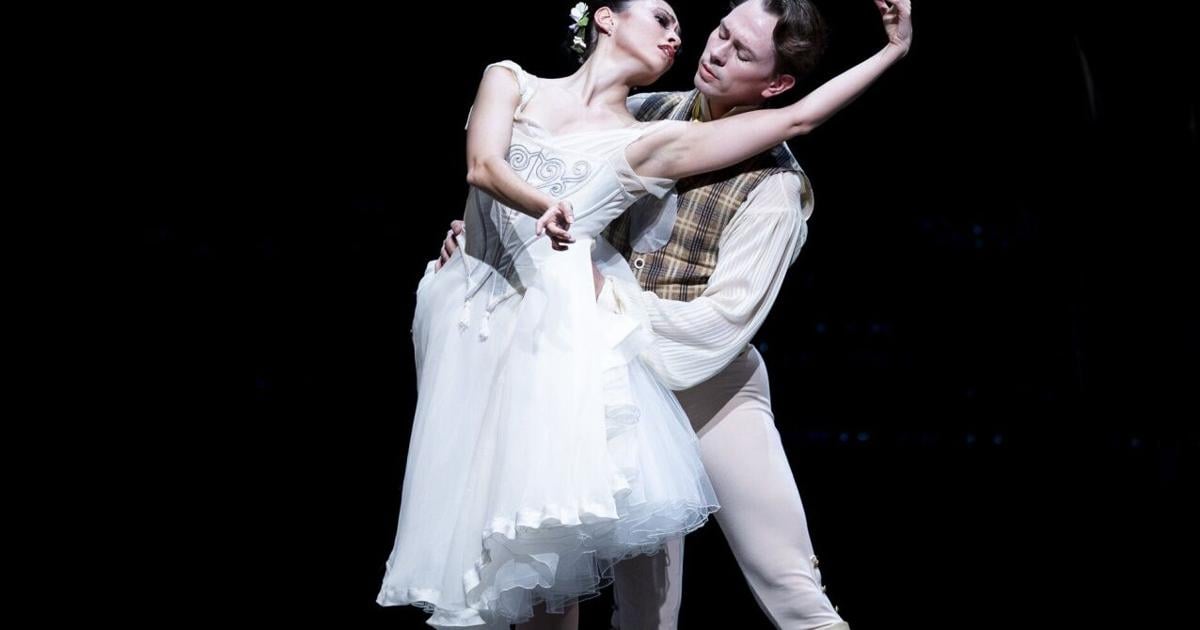
After that long labor, the production continues to deepen, with the dancers gaining more spirit and power as it settles deeper into the company repertory. Last week’s opening-night cast — featuring impeccably honed performances by Sarah-Gabrielle Ryan and Kyle Davis in the tragic lead roles, capped with Amanda Morgan’s emblematic Myrtha — coalesced brilliantly. The PNB Orchestra, under Emil de Cou, inhabited all the vivacity and sorrow of Adam’s haunting score, and then some. This unity casts a spell.
While Boal’s redrafting of “Giselle” attended to its French and Russian linages, it also opened it up for a greater dynamic interpretation. Waves of barely containable energy flood and recede through the phrases, then the scenes, almost Balanchine-style. Characters carelessly uncork hot reserves of love, anger and remorse, delivering fatal consequences to the innocent Giselle.
In the misted afterworld, Myrtha, Queen of the Wilis, leads streaming lines of women in elegant processions. The Wilis’ poetic posture appears humbled at first (heads bowed, arms low, wrists crossing at the waist) until the flock suddenly starts spinning from the same frozen stance, responding to sound without turning their heads, propelled into turns by the muscles of their backs alone. As Myrtha, Morgan exemplified detached concentration, flicking a leg behind her with the speedy nonchalance of a waving cat tail.
The impact of Kaplan’s 2014 set and costumes cannot be overstated, particularly the effect of the insanely delicate silk gowns worn in Act II. When the Wilis add arm positions to their turns, the airborne silk billows up, echoing for several counts like sails filling with wind. When Giselle and Albert first make contact in the Afterworld, Giselle leaps like a child into Albert’s arms, her gown piling around her like a cloud of bedcovers.
Bones to pick with “Giselle” all fall in Act I. The repetitive clapping in the villagers’ dance grows tiresome, and folks around me didn’t see the significance of the peasant pas de deux (performed unevenly on Friday by Clara Ruf Maldonado and Kuu Sakuragi). Yet there’s no easy answer here. Productions that cut too much from Act I end up unbalancing Giselle’s mad scene. Consider, perhaps, how the slower bits of Act I offer useful truth-telling about love and power in cross-class affairs.
‘ The preceding article may include information circulated by third parties ’
‘ Some details of this article were extracted from the following source www.yakimaherald.com ’