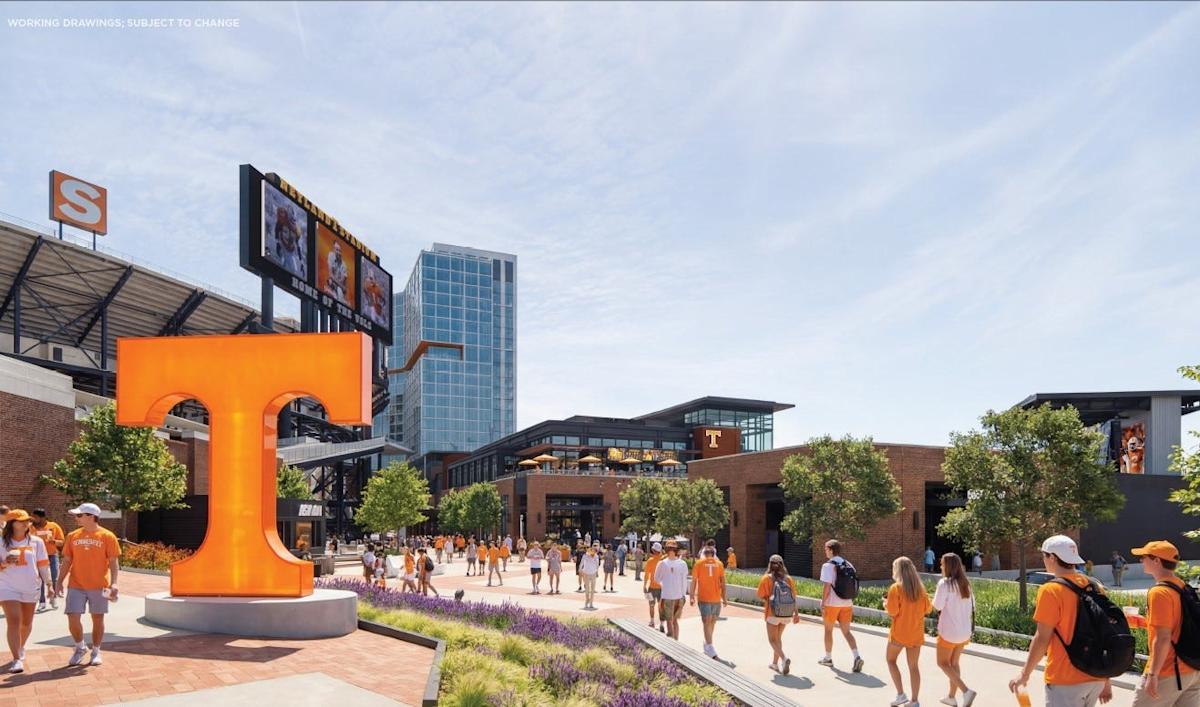
The University of Tennessee will rake in revenue from the Neyland Entertainment District while bearing no financial risk in the $280 million project, UT Chief Financial Officer David Miller says.
“Importantly, the developer is fully responsible for financing, construction and operating the entertainment district. So the university is putting no money into this,” Miller said when the UT Systems Board of Trustees approved the project on May 4.
“We have no financial risk, and we’re not operating it.”
It’s a critical selling point for UT to a portion of the fan base that has questioned the feasibility of the ambitious on-campus project, which includes a mixed-use sports entertainment district, hybrid condo-hotel and a rebuilt G10 parking garage.
Losing the premier parking spaces in the G10 garage for a year during construction is a drawback, beginning with demolition in July. Others are concerned that the hotel overlooking Neyland Stadium will ruin the view of the Tennessee River and recognizable skyline.
Time will tell if those concerns are valid. Chancellor Donde Plowman believes the long-term benefits outweigh the temporary inconvenience.
But Miller said UT has no financial concerns in the public-private partnership. In fact, there are only monetary gains for the university in the Neyland Entertainment District.
What Tennessee gets from Neyland Entertainment District
The $280 million Neyland Entertainment District includes $215 million for the construction of the condo hotel and $65 million for the entertainment district.
UT will put no money into those properties.
Instead, the university will enter into a 99-year lease with 865 Neyland, a team of investors and real estate developers specializing in sports entertainment properties. The developer will finance, own, manage and maintain the entertainment district.
The developer will pay UT an annual base rent of $1.5 million plus between 3-5% of gross revenue above $25 million annually from the condo-hotel and entertainment space in separate payments.
“So there’s a permanent ongoing revenue stream to the university through sales in the entertainment district and the hotel,” Miller said. “… But it’s very important to note that the university has no money in the hotel or entertainment district.”
Plowman said constant visitors to campus will drive that revenue, which will put more money into UT’s pocket. That begins with football games at Neyland Stadium and basketball games at Food City Center. Those two facilities will booked the entertainment district.
But student traffic, concerts, conventions and other events will keep the district busy throughout the year.
‘ The preceding article may include information circulated by third parties ’
‘ Some details of this article were extracted from the following source finance.yahoo.com ’