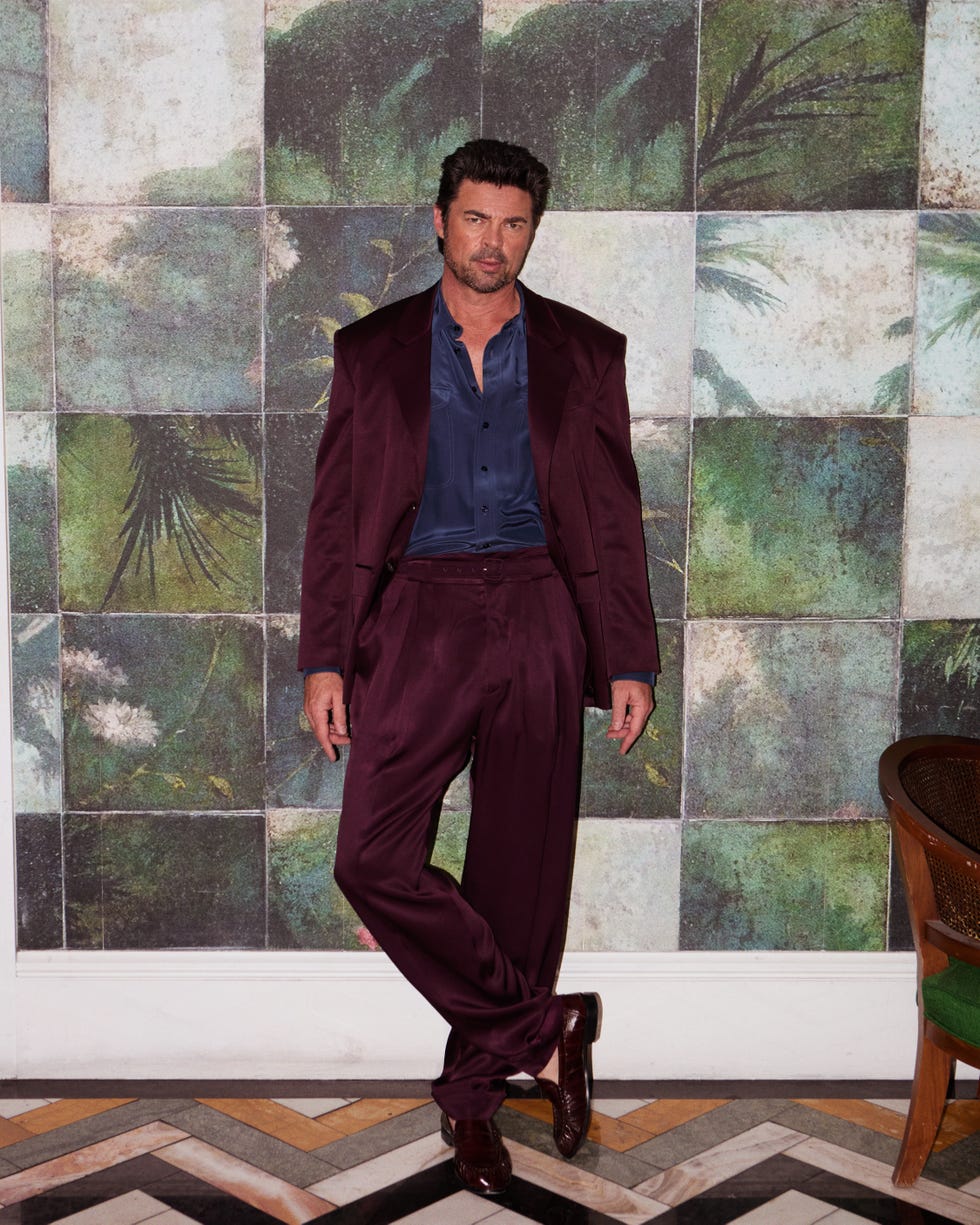
Karl Urban walks into the room like a goddamn movie star. Meticulously coiffed hair, a brown-green henley that highlights his shoulders, piercing eye contact when his reflective Ray-Bans come off—this is who greets me with a hand extended outward in a midtown hotel lobby one drizzling April afternoon. For a man jet-lagged and whose body clock is still on New Zealand time (it’s approximately 5 a.m. in the actor’s brain), Urban, a spring chicken at 53 years old, is up, alert, and feeling great. He compliments my raincoat, a decades-old impulse buy from a New Jersey Macy’s.
It’s hard not to acknowledge Urban’s rarefied air in Hollywood as the man who brings machismo to the multiverse. I’ve watched Urban since babysitters left Xena: Warrior Princess playing in the living room, and when he, as Eomor, intimidated Grima in Lord of the Rings. In eighth grade, my future brother-in-law helped me skip school to see Doom in theaters. (“You must have been the only two in the theater,” Urban quips from behind a mug of black coffee.) Ditching junior prom to see Star Trek with my buddies opening night is a core memory from high school. As was catching Dredd in college. Since 2019, I’ve had countless conversations with people about The Boys, the satirical Prime Video series about superheroes as a corporate commodity. The show just ended its fifth and final season.
“Fuck, I loved playing [him],” Urban says of Judge Dredd, the brutal law enforcer from the 2012 cult film whose fans yearn for a sequel. “I didn’t read comics growing up. But Judge Dredd I did read. The challenge was how you communicate without your most effective tool.” Urban obscures his eyes behind his hand. “How you express fear, doubt, anxiety, without that. It was fucking great. I want to see more Dredd regardless whether I’m in it or not. I probably won’t be, and I’m good with that.”
Urban has had a place in all these tales, if not central to stories of heroes, villains, orcs, and aliens. Sometimes smarmy and often grizzled, Urban’s characters make maximum use of his range as Tinseltown’s resident tough guy for Comic-Con hype. When I ask Urban what he thinks casting directors see in him, he can only guess. “I’m interested in characters, because to me, that’s what it’s about,” Urban says. “The genre is irrelevant. That’s what I look for, because that keeps my job not only interesting, it helps me to develop my craft and explore new territory.”
His latest movie may not seem like new ground, but in Urban’s view behind sunglasses, it’s a new universe. Out last weekend was Mortal Kombat II, a big-budget sequel to the 2021 streaming hit adapted from the iconic ’90s arcade games. In the new film, Urban takes charge as fan-favorite Johnny Cage, a has-been martial arts star who is thrust into the role of representing Earth in a tournament held by the gods. When we meet Cage in Mortal Kombat II, he’s half-asleep behind a table at a crowded convention—an environment Urban is more than familiar with—moping about his bygone glory days.
On that last part, Urban can’t relate. He’s worked consistently for twenty-plus years. But he still knew where Cage was coming from. “He is not only a fish out of water, he’s way out of his depth,” Urban details. “The journey of that character, finding his self-worth and figuring out who he actually is, and that being his power, I felt was interesting, fun, and funny. I relished the opportunity and the challenge.”
For all the times Urban has battled green-screen monsters, he’s never been in a proper martial arts project. Mortal Kombat II was “way above my skill set,” Urban admits. But he knew the nerves were a good sign. “To me, when you are slightly terrified of the role, and of the project, those are the ones you should go for. The interesting shit happens when you can’t touch the ball, and when you’re forced to push yourself.”
Over the next hour, Urban told me about a long life that began in New Zealand’s shores, a long career playing rugged heroes from the worlds of comics and video games, and a long road that lays ahead.
This interview has been edited for clarity.

“Lord of the Rings was probably, arguably, the most important milestone of my career,” Urban says. “If it wasn’t for Peter Jackson and Fran Walsh, their kindness, generosity, and belief in me, I wouldn’t be here today.”
ESQUIRE: You’re coming off back-to-back press tours. You’ve had The Bluff, The Boys season 5, and now Mortal Kombat II. How do you relax after a day of promotion?
KARL URBAN: It depends where I am. I’ll go to a restaurant, have my favorite meal, and go to my friend’s house and sit around as he kicks my ass at Gin Rummy. That brings me back down to Earth.
I understand you got into acting through your mom, who worked in New Zealand television. You wanted to be an actor but you wanted a normal childhood first. Who or what inspired that decision?
I knew from [age] five that’s what I wanted to do. I would define it as being in a monastic groove. I had the choice to go to a gym class every Saturday or a movie theater where they would show kids movies at eleven o’clock. I always went to the movies. But I didn’t want to become synonymous with being a child actor. I knew [acting] is what I wanted to do, so I chose not to do it then and have a regular childhood and amass experiences.
What was your normal childhood like?
I grew up in Wellington in New Zealand. Like a typical kid in the late ’70s, I was brought up in a time where you would have breakfast and your mom would say, “Okay, don’t come back ’till dinner.” You go off and spend all day getting into trouble, then trying to get out of trouble. I’d be on the farm with my cousins. You’d take the four-wheeler and accidentally roll it. You bring the bike back fucked up, and your uncle’s looking at you like, “Did anything happen?” And my cousin’s limping like, “No, we’re fine.” How I didn’t kill myself or my cousins is a mystery. I shudder to think of the trouble we got into. Kids weren’t wrapped in cotton balls. This was pre-digital. There’s a degree of resourcefulness and independence that gets instilled in you.
One of your earliest Hollywood jobs was appearing in episodes of Hercules and Xena, which were shot in New Zealand. What did those early jobs teach you about yourself and your work as an actor?
The importance of positivity. Positivity is like a pond. A drop of positivity in the center ripples out. I had a role portraying a character who had a prosthetic back. They made this costume, and I couldn’t go to the toilet all day. Once I was in, I was in. I made a mental note not to complain, to be positive, because there was nothing going to change that. I watched that positivity come back at me with more opportunities my way. That was a key lesson.
Secondly, discipline. Watching Lucy Lawless, how she conducted herself on set and the professionalism, was such a strong influence that I carried through to The Boys when I found myself number one in the call sheet. She gently lifted that production on the back of her shoulders. She set the tone. That’s what a good number one does.

“I could relate to Johnny on a multitude of levels, because in the course of any career you’re gonna have peaks and valleys,” Urban says of his Mortal Kombat II character.
What drew you to Mortal Kombat II and playing Johnny Cage?
I was drawn to the journey. He has a wonderful arc. He starts dispirited. He lacks that quintessential Johnny Cage attitude. The world has forgotten about Johnny. He’s neglected his training. He’s at rock bottom and it’s at this juncture he gets called to defend Earth.
I could relate to Johnny on a multitude of levels, because in the course of any career you’re gonna have peaks and valleys. Johnny is in a valley. I’ve been in valleys before, and the key is to figure out a way out of it. You come up against an obstacle, you figure a way to get under it, through it, over it, around it, to get what you want or need. That’s something that has held me not only in my life but in my career. Steadfast is that certain obstinance. You stand at the roulette table long enough, your number’s gonna come up.
You’ve done a lot of action movies but never a martial arts film.
Never. I’ve done fights, I’ve done a reverse 180 in a Mercedes G-Wagon in the streets of Moscow. I’ve been on wires. A lot of physical stuff you can push your way through and throw energy and it’ll look great. But martial arts, like jiu-jitsu, karate, Jeet Kune Do, you can’t do that. Form and style are of paramount importance. It was a drastic learning curve learning how to do the simplest things.
I’m a nerd for this stuff: What is Johnny Cage’s martial-arts style?
It’s mixed martial arts, basically. We had incredible fight designers. This wasn’t a scenario where I would come and say, “That’s great but I’d like to do this.” They knew martial arts way better than I do. They knew the games better than I do. So it was a case of me going, “Tell me what to do.” I’m a sponge—I had to learn.
On that note, the original Mortal Kombat game debuted in 1992. What are your earliest memories of Mortal Kombat as a video game franchise?
I was an unemployed, struggling actor in Sydney. By the time I could [play the games], I had a family and a career, and I didn’t have time. My proper introduction was through my sons. When they were a bit older, I would play with them. Them being so adept and of a generation born with a controller in their hands, they would kick my ass. It was a frustrating and humiliating experience. But we bonded over that, and that’s part of the success and legacy of Mortal Kombat. They became this generational form of entertainment.
How did your sons react when you got the role?
Their response was, “Don’t fuck it up.” I felt immediate pressure to get it right.
So much of your work involves fandoms. You’ve dealt with fans of Tolkien, Star Trek, comic books, and video games. What are your impressions of people who label themselves die-hard fans of anything?
I enjoy the opportunity to meet with the fan base. I feel inspiration when they dress up as whatever excites them. I have always found it to be an environment of overwhelming positivity. I feel grateful I have a fan base that has come with me through all these projects. I feel a degree of responsibility to pick roles that are not only interesting to me, but stuff they might like. Which isn’t to say I put too much weight on other people’s expectations. Don’t get me wrong—I’m doing this for me. I’m picking characters based on the story I’m reading in the script, the filmmakers I’m working with, and an opportunity to express myself. That is my selfish motivation.

People still watch Lord of the Rings, and just as often, the making-of documentaries of Lord of the Rings. How do you look back on your experiences making those movies?
Lord of the Rings was probably, arguably, the most important milestone of my career. If it wasn’t for Peter Jackson and Fran Walsh, their kindness, generosity, and belief in me, I wouldn’t be here today. I learned so much working on that, and working with them and the likes of Ian McKellan and Viggo Mortensen.
Sometimes I find myself driving and Led Zeppelin’s “Ramble On” will come on. I hear “Gollum and the evil one.” I think to myself, Fuck, I was in Middle-earth. I get hit by images of standing on the set of Edoras. No other project I have been part of has resonated in a profoundly deep way. Shooting Mortal Kombat reminded me of Lord of the Rings. The scale was not dissimilar. It was as big as movies get.
It’s funny—you call Raiden “Gandalf” in Mortal Kombat II.
That was a series of improvisations I started doing, because I sort of thought, I’m gonna make Johnny Cage a fan of Lord of the Rings. They gave me runway, and I went for it.

Will Urban continue to kick and punch his way through the action genre? “I will continue to take on the challenge of doing physical roles for as long as I can,” he says. “I enjoy getting to the end of the day feeling like I’ve done a day’s work.”
I have to ask: What’s the story behind you and Viggo buying Gundam in Japan?
We were in Tokyo promoting Lord of the Rings. Vigo was missing his son Henry and I was missing my son Hunter. We went to a toy store and bought them Gundams. Took the time out of our work day to get something for them. It’s a special memory.
Is there a memory that sticks with you from Mortal Kombat II in the same way?
The day we were shooting the Johnny Cage/Baraka fight. Something I had trained months for, a sequence of over 20, 25 moves unbroken. Getting to the point where all the hard work paid off and I was able to execute it was, to me, the aspect of the job I enjoy the most. When you get to the end of the day, and you’ve done your job to the best of your ability and everybody has done the exact thing. You’ve worked to create this thing for others to enjoy.
Though you kick ass in Mortal Kombat II, not many actors sign up for a huge franchise in their fifties. Do you have anxieties about aging as an actor in Hollywood?
I will continue to take on the challenge of doing physical roles for as long as I can. I enjoy getting to the end of the day feeling like I’ve done a day’s work. I look to actors of a different generation and am inspired by their example. Liam Neeson, Harrison Ford. I am also open to the opportunity to explore roles that are not action orientated, that are grounded, maybe indie in sensibility. I want to work with new people and new filmmakers. Push myself to take on new characters I haven’t portrayed before and different genres I haven’t been in before.
‘ The preceding article may include information circulated by third parties ’
‘ Some details of this article were extracted from the following source www.esquire.com ’