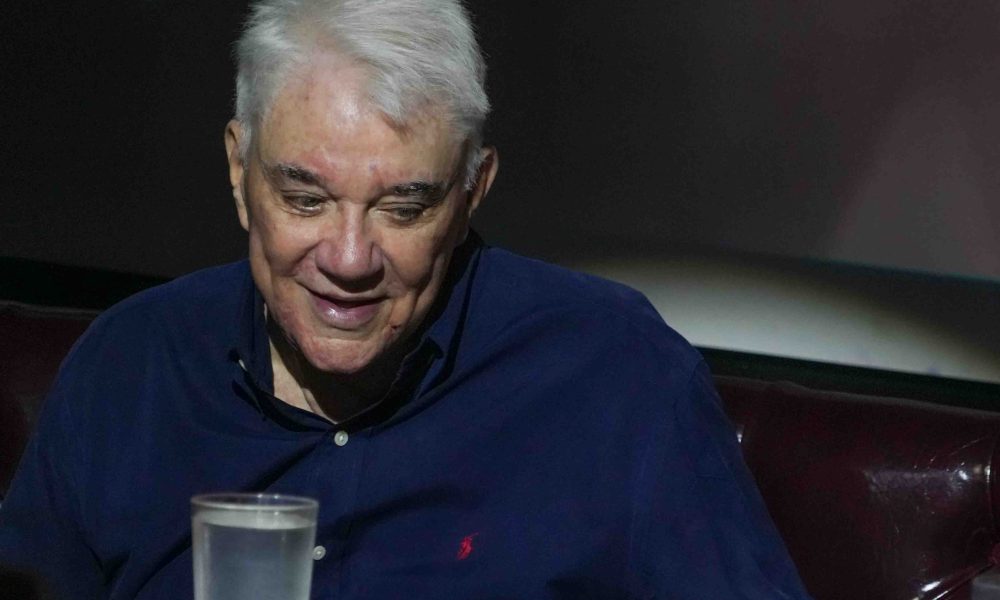
With the death of Rex Reed, New York loses not simply a critic, but an entire era of cultural life that may never exist again.

REX REED, POLLY BERGEN
Rex Reed was one of the last great celebrity critics — a figure who moved through film, theatre, television, journalism, nightlife, and celebrity culture not as an observer standing outside the velvet rope, but as part of the ecosystem itself. He belonged to a time when critics were public intellectuals with glamour attached to them, when wit mattered, when opinion carried consequence, and when cultural commentary was expected to have both style and teeth.

MARILYN MAYE, REX REED
For decades, Reed’s byline was instantly recognizable. Whether writing for newspapers, magazines, or appearing on television, he cultivated a voice that was impossible to mistake for anyone else’s: acerbic, elegant, theatrical, deeply literate, occasionally savage, frequently hilarious, and always unmistakably alive. He understood something modern criticism often forgets — criticism itself is a performance art.

MICHELE LEE, REX REED
He could destroy a film in a single paragraph. He could elevate an unknown performer into public conversation overnight. When he loved something, he loved it extravagantly.

LORNA DALLAS, REX REED
That was the key to understanding Rex Reed. The sharpness was only half the story. Underneath the famously lethal wit was a man who genuinely adored artists, performers, movies, theatre, glamour, and the strange electricity of show business itself.

Rex Reed, Linda Purl
Born in Fort Worth, Texas, Reed arrived in New York with ambition, intelligence, and an instinctive understanding of reinvention. By the late 1960s and 1970s, he had become one of the most visible film critics in America, writing for publications including the New York Daily News, The New York Observer, Playboy, Women’s Wear Daily, and numerous national magazines. He became a fixture on television talk shows at a time when critics themselves became celebrities.

Rex Reed
Rex was absolutely a celebrity. He appeared everywhere — on talk shows, at premieres, opening nights, parties, charity events, restaurants, and the kinds of old New York gatherings that no longer really exist. He moved comfortably among movie stars, Broadway legends, socialites, writers, producers, and journalists because he was one of them. He represented a glamorous, deeply verbal, hyper-cultural New York that thrived on conversation, opinion, and theatricality.

Rex Reed, Stephen Sorokoff
His reviews became legendary not merely because they were sharp, but because they were readable. Reed understood rhythm. He understood comic timing. He understood language. Even people furious at him often kept reading because the prose itself entertained.

Joyce Breach, Rex Reed, Michael Feinstein
Like all critics with real influence, he inspired both admiration and backlash. Some considered him too harsh, too personal, too cutting. Others believed he represented the final generation of critics willing to write honestly without fear of social media pile-ons, studio politics, or publicist management. Whatever one thought of him, nobody accused Rex Reed of being bland. Blandness may have been the one unforgivable sin in his universe.

Rex Reed, Clint Holmes, Eda Sorokoff
What many people did not see publicly was his warmth. I met Rex Reed in Los Angeles when I was just seventeen years old, singing at Ye Little Club in Beverly Hills as part of one of Joan Rivers’ introductions to emerging performers. He could easily have brushed off a nervous teenager trying to find her footing. Instead, he was charming, generous, deeply complimentary, and encouraging. That stayed with me.

Gianni Valenti, Rex Reed
Over the years, I would see him again at theatre openings, events, and around the city especially when I moved to New York. He was always gracious in person — elegant in the old-school sense of the word. He possessed that increasingly rare ability to make conversation feel glamorous. The last time I saw him was at MCC Theater during Theresa Rebeck’s Seared. It somehow feels fitting that my final memory of Rex Reed exists inside a theatre. Theatre people understood him instinctively because he himself was theatrical — larger than life, dramatic, emotional, opinionated, and deeply invested in performance.

Rex Reed, Joanna Carson
Reed also represented something increasingly endangered within journalism itself: the unapologetically subjective critic. He did not pretend objectivity was possible in the arts. Art was emotional, personal, instinctive, sometimes irrational. His reviews came not from detached neutrality but from passionate engagement. He responded viscerally to beauty, talent, pretension, dishonesty, laziness, genius, vulgarity, and ambition. That passion made him volatile at times, but it also made him matter.

Rex Reed, Ginny Mancini
Today, criticism often feels flattened by algorithms, consensus culture, fear of backlash, collapsing media structures, and the disappearance of strong editorial voices. Rex Reed came from the opposite world — one where critics were expected to risk being disliked in pursuit of saying something memorable and true. And memorable he certainly was.

Aaron Weinstein, Rex Reed
He loved old Hollywood glamour. He loved Broadway. He loved stars. He loved eccentrics. He loved great writing. He loved conversation. He loved talent and he loved New York — particularly the sophisticated, neurotic, artistic New York that once revolved around opening nights, screenings, parties, gossip columns, and impossible personalities.

Billy Stritch, Rex Reed
That city is disappearing now. With Rex Reed gone, we lose another bridge to that world. Not merely a critic. Not merely a columnist, but one of the last living embodiments of a uniquely American cultural creature: the glamorous intellectual wit who treated criticism as both blood sport and love letter.
‘ The preceding article may include information circulated by third parties ’
‘ Some details of this article were extracted from the following source t2conline.com ’