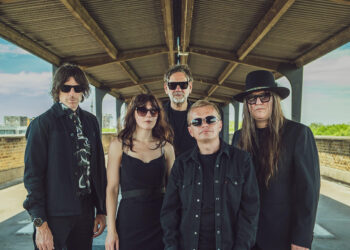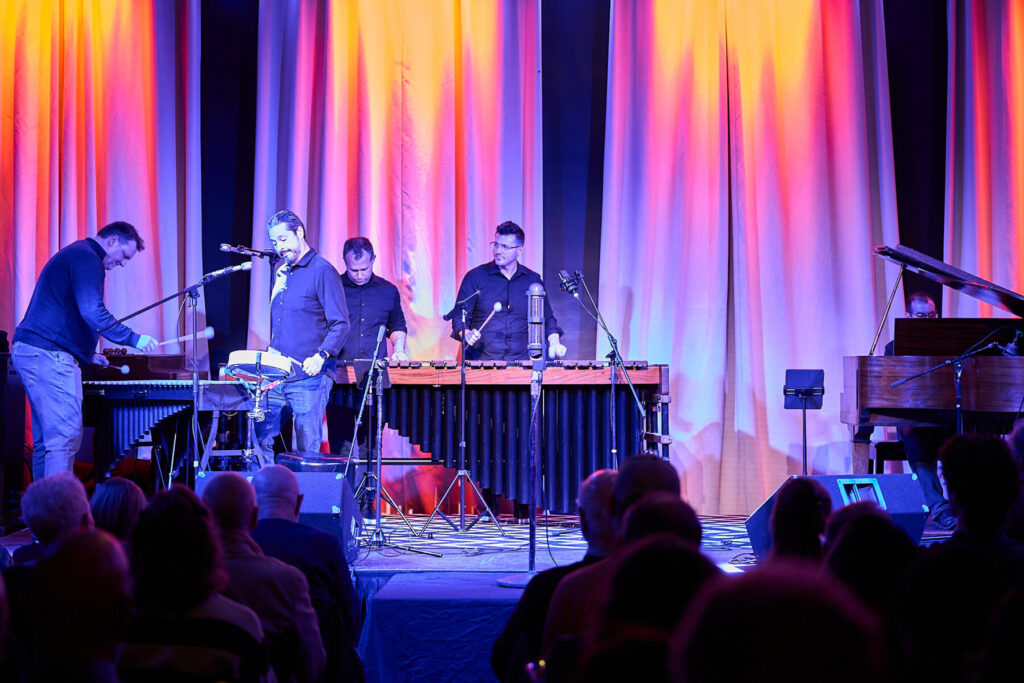
On April 17, ChatterPDX debuted their LATEworks series. The ensemble took to the Hallowed Halls studio to perform music by Steve Reich, Andy Akiho, Kaija Saariaho, John Luther Adams, and ChatterPDX artistic co-director James Shields. They also premiered Slip by Kimberly Osberg, one of Chatter’s three composers-in-residence, who wrote the piece in only forty-eight hours.
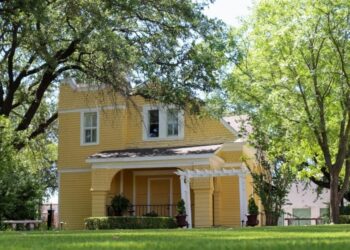
ChatterPDX have spent the last few years building up an audience for their Sunday morning shows downtown. Now the group is branching out, much like their mother ensemble in Albuquerque. ChatterABQ have their own performance space in downtown Albuquerque that they use for all sorts of projects beyond their Sunday morning series. Chatter’s Lateworks series is thus of a kind with their performances at the Gordon House outside Silverton, where the group is exploring new spaces, new repertoire and new ensembles.
The performance was part of the Oregon Symphony’s Bang It! festival of percussion music. Oregon Symphony percussionists Sergio Carreno, Stephen Kehner, Jon Greeney and Michael Roberts (as well as Portland Percussion group member and PSU’s percussion area coordinator Chris Whyte) joined Shields, his fellow artistic co-director Trevor Fitzpatrick and the rest of the Chatter crew. For its association with the Oregon Symphony’s Bang It festival, there wasn’t a ton of percussion music on the program. What we did get, however, was great: Music for Pieces of Wood by Reich, Karakurenai by Akiho, and Dark Wind by Adams.

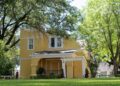
Hallowed Halls, like many recording studios and performance venues, didn’t begin its life as one. The building sits near the intersection of Foster and 64th. It opened as a Carnegie library in 1919 before being purchased by the city in 1972. From their website: “the studio was founded as a recording studio by Greg Allen in 2015 to honor the legacy of his mother Susan Joyce Linowes Allen, a passionate musician and music therapist, who died from cancer when he was a toddler.” Justin Phelps is the lead engineer of the place now, and has experience working at similar studios such as Tiny Telephone in San Francisco. It is a multi-purpose space, hosting events, recording sessions and rehearsals for touring acts.
One finds littered around the halls posters and stickers from bands that have passed through. One corner of the building is done up like a tiki lounge, with couches, barstools and a pirate’s skeleton hiding above the fake bamboo leaves. Before the concert began, composer Rośsa Crean hosted a “speed-friending” in the lounge space. It was pretty loose, intending to match people with potential collaborators, and the conversations seemed lively, but we will have to see if any collaborations come of it. Maybe it was a test-run for future, bigger speed-friendings within Portland’s musical community.

As guests continued to enter, Oregonian composer Ryan Francis began his preshow performance of his Quartet for Synthesizers. Francis really enjoys working within textural limitations: what can he do with a four-voice synthesizer and a sequencer? The quartet was constantly evolving; the timbre and texture never stayed static for long. A filter was always opening or closing, a new melodic phrase would enter, an element would come forth or retreat back in the mix. Each movement had a distinct character, emphasizing arpeggios, swelling chords, portamentos, or polyrhythms, all in the synth’s mellow tone with a soft attack. As the audience clapped between movements, Francis would peer up with a small grin before returning to fiddling with faders and knobs.

The set proper opened with percussionists from the Oregon Symphony performing Steve Reich’s Music for Pieces of Wood and Andy Akiho’s Karakurenai. Music for Pieces of Wood is composed for an ensemble of claves. Greeney held down quarter notes the whole time, but still grinned and grooved with the music. The other four percussionists built up layers of polyrhythms note-by-note, each new entrance marking out the slow process unfolding before fading into the background texture to let the next percussionist build up their part.

Carreno described Akiho’s music as a “puzzle, like a Rubik’s cube,” in reference to its polymetric grooves. Through all Karakurenai‘s groupings of threes, fours and fives, one could follow a consistent pulse with a solid backbeat. The piece blends pitched mallet instruments playing melodic ostinati with unpitched instruments providing the fundamental groove the polymeters spin around. The percussionists were tight, bobbing to the rhythm. After the performance, Shields said with his usual ice-breaking humor, “for a festival called Bang-it y’all have a lot of finesse.”
The title of Saariaho’s Oi Kuu means “to the moon,” or “for the moon” in her native Finnish. Shields on bass Clarinet and Trevor Fitzpatrick on cello had many call-and-response movements with plentiful reverb to create a massive sense of scope. The clarinet’s multiphonics growled like the call of distant animals in the night. The duo pulled gestures forth from the hazy atmosphere that accumulated through the piece. Like Saariaho’s best work, Oi Kuu is strange yet evocative. The piece was only five minutes long, but it felt like you were listening to the echoes of a deep underground cave, where your sense of time distorts.

Kimberly Osberg composed Slip in forty-eight hours as a challenge from Chatter. She explored multiple meanings of the word, all circling around the essence of the world – things going unexpected ways. With so little time to compose, the music had an immediacy and rawness to it – it’s unpolished, which fits the theme quite well. The piece opens with a multi-timbral chorale that falls off balance, while the main section trades between different rhythmic feels quite rapidly. There was plentiful sound painting, for instance using microtonal glissandi to depict a long fall. The ensemble of Shields, Fitzpatrick, Will Pyle and David Felberg playfully bounced musical ideas between each other. I would love to hear it again to hear more of the subtleties Osberg brought to Slip.

Blending resonances
James Shields described John Luther Adams’ compositional method as “blending resonances.” To really enjoy it one has to listen to the notes that hang above the notes. The bass clarinet creeps in under the piano’s chords tolling in the low register, followed by vibraphone and marimba also playing crescendo-decrescendo tremolo chords. Maria Garcia’s piano performance drew out notes from the muck of the low register. The piece was long, but it draws you in with its expansive soundworld of pulsating dissonances hidden within these cresting chords.

After an intermission, the ensemble returned to perform two pieces by James Shields. His Duo no. 7 is also cheekily called “Music in Twelfths,” as a reference to Philip Glass’ Music in Fifths. The music was a barrage of ascending phrases in irregular meters. You can hear Shields taking quick catch-breaths in between these phrases, since he admits that he left himself nowhere to breathe in the music. Shields and David Feldberg played off each other very well during the piece, even as the notes just kept coming and coming.
For Moderate, Turning, pianist Monica Ohuchi joined Shields. The piece was somber, drenched in melancholy. Some moments featured a slow, repeated tolling of dense chords; others felt more prismatic, with single notes drifting through the resonance space of the piano. The whole thing danced around a minor key, with the open textures leading time to breathe in these moments, including what Shields called a “super emo, faux-Baroque passage” that felt of a piece with the rest of the music’s dark sound world.

Like all Chatter performances, there was poetry too. John Beer chose to read a poem that fit with the final piece of the program, Steve Reich’s Violin Phase, performed by Feldberg. His poem had only two words, “drip” and “drop,” permuted into new orders. You stop listening for a traditional sort of meaning and instead to the natural cadence of these two words that rise and fall like a melody. Violin Phase, similarly, was one simple pentatonic phrase that repeated and phased so much it became a texture.

The program bifurcates into two sorts of music: rousing, post-minimalist percussive pieces built from a torrent of notes, and spacious night music. For a show called LATEworks, both felt appropriate, regulating the flow of energy throughout the night.


‘ The preceding article may include information circulated by third parties ’
‘ Some details of this article were extracted from the following source www.orartswatch.org ’