Movie review
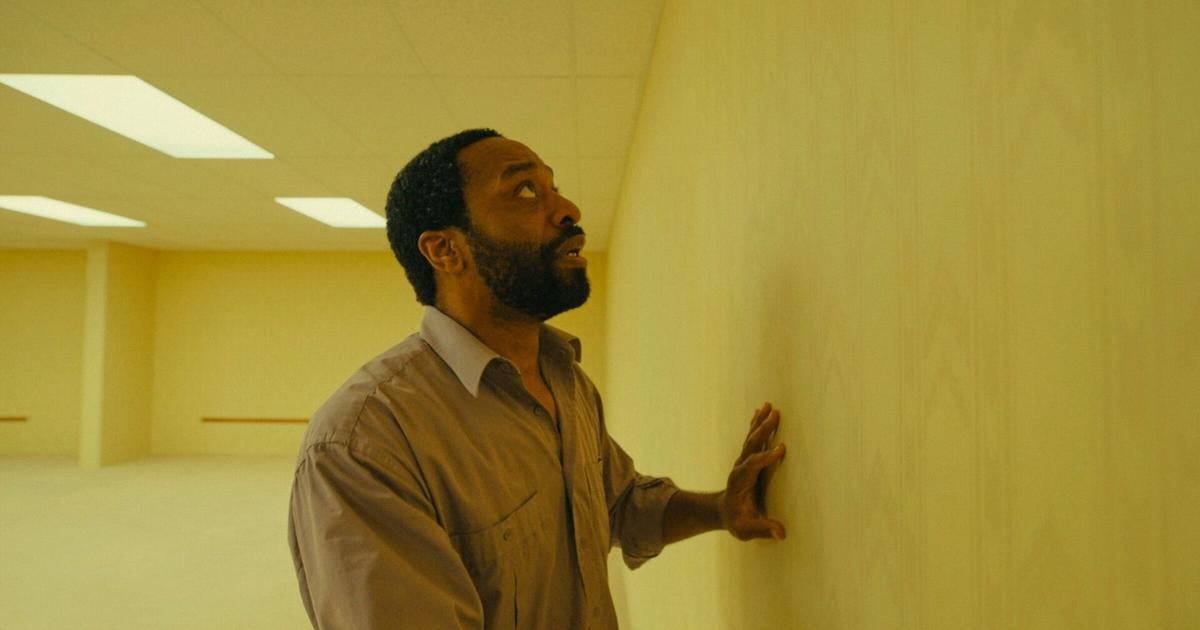
In “Backrooms,” director Kane Parsons’ eerie and evocative feature debut, a troubled furniture salesman stumbles upon a vast underground labyrinth of rooms that seem to expand on forever. At every turn, he finds something strange yet familiar, as if he’s glimpsing a distorted version of his sad existence. Soon, he’ll not only discover he’s not alone down here, but the man who entered may no longer wish to exit. Instead, he may decide to stay down here awhile.
This is both all you need to know about “Backrooms” and also only a small fraction of the dark pleasures Parsons’ haunting horror film offers. In many ways, the so-so narrative, which centers on the aforementioned furniture salesman Clark (Chiwetel Ejiofor) and his therapist Mary (Renate Reinsve), is secondary to the world they get plunged into.
But what an absolutely magnificently realized world it is. A triumph of cinematography, editing, production design and visual effects, you almost wonder whether Parsons may have ventured into the real backrooms to shoot his film. While his film fumbles a bit narratively, awkwardly overexplaining much of the characters’ backstory, once we enter this surreal world, it’s an inescapably exhilarating experience.
Part a found-footage descent into the unknown a la “As Above, So Below” (though thankfully much better than that), part an expansion on Parsons’ YouTube shorts exploring this same setting, and yet also something entirely new, “Backrooms” thrives when it comes to creating an enveloping atmosphere. This is a film where you may find yourself holding your breath as you accompany the characters as they wander farther and farther into the eerily off-yellow halls of this nightmare world. It’s part of a rise in what is being loosely referred to as “liminal horror” in cinema (think the recent “Exit 8”), in which otherwise ordinary spaces are made into something effectively uncanny and unnerving.
At the same time, Parsons’ film feels inexorably tied to something like Mark Z. Danielewski’s experimental horror novel “House of Leaves,” especially in terms of how the setting begins to reflect the psychological torment of the characters. It’s plenty exciting, with one joyously staged chase scene that gets the pulse racing, but it also proves unexpectedly, chillingly contemplative in the final stretch. Parsons thankfully doesn’t provide any neat explanation; rather, he pointedly fades a character futilely attempting to explain things into the background, dropping the very floor out from under us in a final sequence as understated as it is unsettling. In these final frames, you may find yourself wishing you, too, could stay there just a while longer.
‘ The preceding article may include information circulated by third parties ’
‘ Some details of this article were extracted from the following source www.yakimaherald.com ’