They are fighting over a treasure trove of earrings, necklaces, brooches and a diamond-and-pearl-encrusted crown worth hundreds of millions of dollars.
They also argue over titles and precedence within a long-defunct dynasty – and now also over the return of the mortal remains of Italy’s last king to his homeland.
With remarkable persistence, Italy’s former royal family continues to find its way back into the headlines.
Politically, the House of Savoy lost its relevance a long time ago. Eight decades ago, Italians voted in a referendum to abolish the monarchy and establish a republic. Italian King Umberto II was forced into exile in Portugal after spending little more than a month on the throne.
More than 54% of voters in Italy’s first free election after over two decades of fascist dictatorship under Benito Mussolini – and the first in which women were allowed to vote – rejected the House of Savoy, which had provided Italy’s monarchs between 1861 and 1946.
Umberto II (1904–1983) and his male descendants were barred from returning to Italy. The ban remained in place until it was lifted by a constitutional amendment in 2002.
Leadership dispute sparks ridicule
Eighty years after losing the throne, the descendants of Italy’s former royal family still appear unable to accept their diminished status. A long-running dispute over the leadership of the family recently made headlines worldwide.
Two cousins are competing for one role. Aimone di Savoia and Emanuele Filiberto di Savoia are both claiming to be the rightful head of the House of Savoy.
The dispute dates back to 2006, when Vittorio Emanuele, the son of Umberto II, was stripped of his position as head of the family by a council established to safeguard the honour of the Savoy dynasty after a series of scandals. The council replaced him with his cousin, Amedeo di Savoia-Aosta.
Following Amedeo’s death in 2021, his son Aimone assumed the claim. However, after Vittorio Emanuele died in 2024, his son Emanuele Filiberto declared himself the legitimate successor and family leader.
In a statement heavy with dynastic rhetoric, Aimone said he felt “obliged to reaffirm and confirm my dynastic status and my role as head of the House, together with all its prerogatives.” He also described the result of the 1946 referendum as “disputed” and said the king had left Italy “full of sorrow.”
Battle over jewels and burial place
The family has repeatedly generated controversy. A few years ago, the Savoys demanded the return of family jewels and other valuables that have been held in the vaults of Italy’s central bank since 1946.
Emanuele Filiberto, who is also known in Italy for appearing on television programmes including the Italian version of “Let’s Dance” and a survival-style reality show, has been particularly vocal, saying, “They belong to us.”
Now he is demanding the return of his grandfather’s remains from Geneva. Speaking to the Italian newspaper Corriere della Sera, Emanuele Filiberto argued that this year in particular “the time has come to make peace with history.”
And where should Umberto II be reburied? In Emanuele Filiberto’s view, there is only one suitable location: Rome’s Pantheon, where kings Vittorio Emanuele II and Umberto I are already buried.
“I refuse to consider any other possibility,” he says.
The monarchy’s fascist legacy
Many Italians still view the family unfavourably because of its historical role during the fascist era.
Following the Fascists’ March on Rome on October 27 and 28, 1922, king Vittorio Emanuele III appointed Mussolini prime minister. In 1938, he signed Italy’s racial laws, which led to the persecution, discrimination and eventual deportation of Jews.
By tolerating and supporting Mussolini’s regime, the king granted it additional legitimacy.
The family’s reputation suffered enormously as a result. Although Vittorio Emanuele III abdicated in favour of his son Umberto II in 1946, the move came too late. Less than a month later, Italians voted for a republic and parliamentary democracy, rejecting both Umberto II and the House of Savoy.
Republic Day celebrations overshadow royal nostalgia
The family’s present-day behaviour has also irritated many Italians.
Commenting on the dispute between the throne-less royals, the newspaper La Stampa accused the two cousins of displaying “detachment from reality, from people’s problems and from concerns about the future, which certainly do not include the crown of Italy.”
The paper argued that the family had brought disgrace upon itself.
Italy celebrated the 80th anniversary of the republic with festivities across the country in early June.
In Rome, a large public ceremony was held in front of the Quirinal Palace – now the residence of the president and formerly the seat of Italy’s kings.
Ahead of the celebration, Emanuele Filiberto said, “I cannot say that I celebrate June 2.”
One thing, at least, remains clear: while Italy moved on from monarchy decades ago, some members of its former royal family still seem unwilling to do the same.
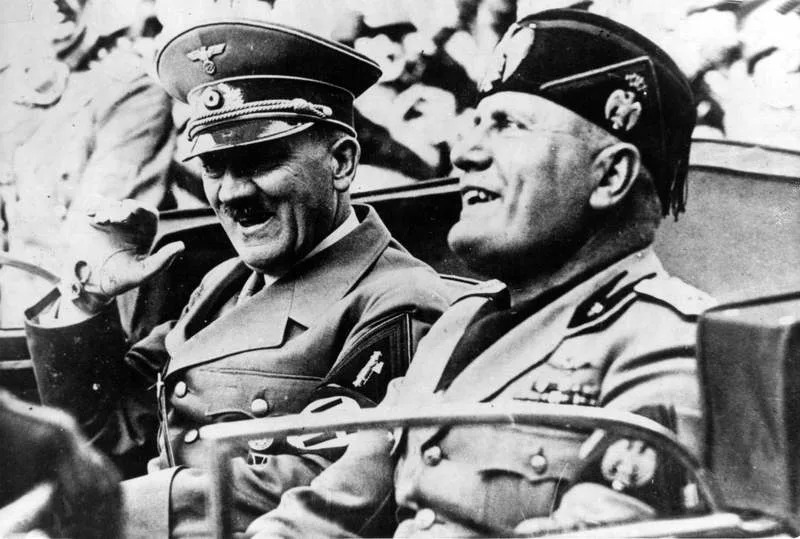
Adolf Hitler (l) and Duce Benito Mussolini (r) drive through Florence in 1938, in a show of power of fascism. DB/dpa
‘ The preceding article may include information circulated by third parties ’
‘ Some details of this article were extracted from the following source www.yahoo.com ’