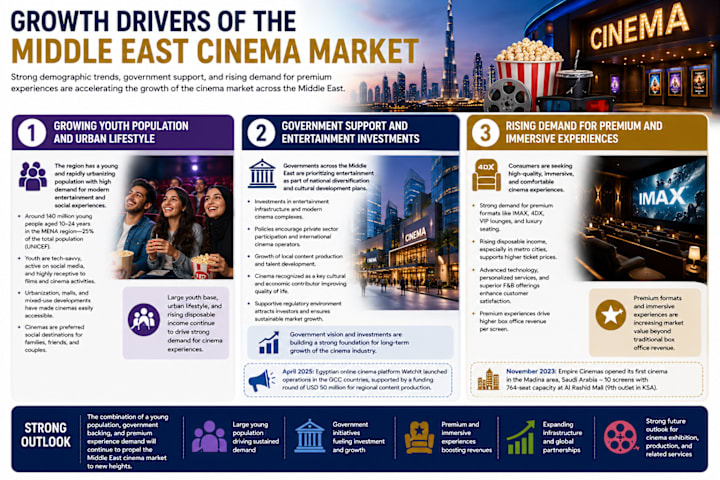
Across the region, governments are investing heavily in cultural development, entertainment infrastructure, tourism, and creative industries. Shopping malls are becoming lifestyle destinations, entertainment districts are expanding, and consumers are spending more on experiences than ever before.
At the center of this transformation is the cinema industry.
What was once a relatively limited market in several parts of the region has evolved into a vibrant and rapidly expanding sector. Modern multiplexes, premium movie experiences, luxury seating, immersive technologies, and growing local film industries are helping cinemas become an increasingly important part of everyday life.
The region’s youthful demographics, rising disposable incomes, and strong appetite for global entertainment content have created ideal conditions for industry growth. At the same time, government initiatives designed to diversify economies beyond oil have accelerated investments in entertainment infrastructure.
According to Renub Research, the Middle East Cinema Market is projected to grow from US$ 1,720.33 million in 2025 to US$ 3,650.87 million by 2034, registering a compound annual growth rate (CAGR) of 8.72% between 2026 and 2034. This expansion is being supported by multiplex development, premium cinema formats, government initiatives, and increasing consumer demand for modern entertainment experiences.
As cultural openness, urbanization, and digital connectivity continue reshaping the region, cinemas are becoming one of the most dynamic segments of the Middle East entertainment economy.
Cinema Has Become More Than Just Movies
Modern cinemas are no longer simply places where people watch films.
Across the Middle East, cinemas have evolved into social destinations that combine entertainment, dining, shopping, and lifestyle experiences. For many consumers, a cinema visit is part of a broader leisure activity that includes restaurants, retail shopping, and social gatherings.
This evolution has changed how operators approach the business.
Rather than focusing exclusively on movie screenings, cinema companies increasingly invest in premium seating, luxury lounges, gourmet food options, immersive technologies, and personalized customer experiences.
Consumers now expect more than just a screen and a seat.
They want comfort, convenience, and memorable experiences that justify spending time outside the home. This shift has significantly increased the value of cinema visits while creating new revenue opportunities beyond ticket sales.
As a result, cinemas have become important contributors to the region’s broader entertainment ecosystem.
A Young Population Is Driving Demand
One of the strongest drivers of cinema growth in the Middle East is its youthful population.
The region is home to one of the world’s youngest demographic profiles, creating a large audience eager for entertainment and social experiences. Young consumers tend to be highly engaged with movies, social media, digital culture, and global entertainment trends.
According to regional demographic data, approximately 140 million young people between the ages of 10 and 24 live across the Middle East and North Africa region, representing roughly 25% of the population.
This generation is highly connected and technology-oriented.
Movies, cinema outings, and entertainment experiences are often shared across social platforms, creating additional visibility and excitement around theatrical releases. Young audiences are particularly attracted to blockbuster films, premium formats, and immersive technologies.
As urban populations continue growing and consumer spending increases, youth-driven demand is expected to remain one of the market’s most important growth engines.
Governments Are Investing in Entertainment
Government support has played a critical role in accelerating cinema development across the region.
Many Middle Eastern countries are pursuing economic diversification strategies that prioritize entertainment, tourism, culture, and creative industries. These initiatives aim to improve quality of life while reducing dependence on traditional economic sectors.
The cinema industry has benefited significantly from these efforts.
Governments have encouraged private investment, supported infrastructure development, promoted cultural initiatives, and facilitated partnerships with international entertainment companies.
In April 2025, Egyptian streaming and cinema platform WatchIt expanded operations into Gulf Cooperation Council countries following a US$ 50 million funding initiative focused on producing regional content. Such investments highlight the growing commitment to entertainment and media development throughout the region.
This supportive policy environment continues creating favorable conditions for long-term market expansion.
Multiplex Expansion Is Reshaping the Industry
One of the most visible indicators of growth is the rapid expansion of cinema infrastructure.
Modern multiplexes are being developed throughout major cities and emerging urban centers. These facilities often include multiple screens, advanced projection systems, premium seating, and integrated entertainment experiences.
The presence of cinemas within shopping malls has been particularly important.
Mall-based locations benefit from high foot traffic while allowing consumers to combine shopping, dining, and entertainment in a single visit. This model has proven highly successful across many Middle Eastern markets.
As new malls, mixed-use developments, and entertainment districts continue opening, opportunities for cinema expansion remain substantial.
Improved accessibility is helping cinemas reach wider audiences while supporting overall market growth.
Premium Cinema Experiences Are Driving Revenue
Consumers throughout the Middle East increasingly seek premium entertainment experiences.
Rather than focusing solely on affordability, many moviegoers are willing to pay higher ticket prices for superior comfort, advanced technology, and exclusive services.
Premium formats have become major revenue generators.
Luxury seating, VIP lounges, private viewing areas, personalized service, and upscale food offerings help operators increase spending per visitor while enhancing customer satisfaction.
These premium experiences are especially popular in metropolitan areas where disposable incomes are higher and consumers prioritize lifestyle-driven spending.
The shift toward premiumization is helping cinema operators grow revenue even as competition within the broader entertainment sector intensifies.
IMAX Continues to Attract Audiences
IMAX has established itself as one of the region’s most desirable cinema formats.
Known for its enormous screens, advanced projection systems, and immersive sound technologies, IMAX delivers an experience that many consumers view as significantly superior to standard screenings.
Action movies, science fiction productions, fantasy films, and blockbuster franchises perform particularly well in IMAX formats.
Moviegoers often reserve IMAX visits for major film releases, treating them as premium entertainment events rather than routine outings.
Although ticket prices are generally higher than standard screenings, demand remains strong due to the format’s unique value proposition.
As premium entertainment spending continues increasing, IMAX is expected to remain a key contributor to market growth.
3D Cinema Remains Popular
While newer technologies continue emerging, 3D cinema remains an important segment of the Middle East market.
Families and younger audiences are particularly attracted to 3D presentations because they enhance immersion and create a more engaging viewing experience.
Animation films, superhero movies, fantasy adventures, and science fiction productions continue driving strong demand for 3D screenings.
Many cinema operators have invested in modern projection systems and improved audio technologies to enhance viewing quality.
Because 3D formats are available across both premium and standard multiplexes, they remain accessible to a broad audience while contributing meaningfully to overall box office revenue.
Family Entertainment Supports Consistent Attendance
Family audiences play a central role in the Middle East cinema market.
Cinema outings are widely viewed as family-friendly entertainment activities that provide safe, comfortable, and enjoyable experiences for people of all ages.
Family-focused films consistently perform well across the region.
Animated features, adventure movies, family comedies, and dubbed content attract strong attendance, particularly during weekends, holidays, and school vacations.
Family audiences also contribute significantly to concession sales.
Group visits often result in higher spending on food, beverages, and premium seating options, increasing overall revenue per customer.
The importance of family-oriented entertainment provides stability and resilience for cinema operators throughout the year.
Cinema Advertising Is Becoming More Valuable
Beyond ticket sales and concessions, cinema advertising is emerging as an increasingly important revenue source.
Advertisers value cinemas because they provide access to highly engaged audiences in distraction-free environments. Unlike digital advertising, which often competes with multiple forms of content simultaneously, cinema advertising captures audience attention before films begin.
Luxury brands, automotive companies, telecommunications providers, consumer goods manufacturers, and entertainment businesses are among the most active advertisers.
Digital technologies and audience analytics are making cinema advertising even more effective.
As attendance grows and advertisers seek premium engagement opportunities, this segment is expected to become increasingly important.
Saudi Arabia Leads Regional Growth
Saudi Arabia currently represents one of the fastest-growing cinema markets in the Middle East.
Government support, rapid infrastructure development, and a youthful population have contributed to remarkable expansion since cinemas reopened in 2018.
Multiplexes have been established throughout major cities, while premium formats such as IMAX, 4DX, and VIP experiences continue attracting consumers.
Cinema has quickly become integrated into broader lifestyle and entertainment activities.
Strong policy support and ongoing investment suggest that Saudi Arabia will remain a key driver of regional growth for years to come.
The UAE Maintains a Mature Market
The United Arab Emirates represents one of the region’s most established cinema markets.
Cities such as Dubai and Abu Dhabi feature highly developed cinema infrastructure, diverse content offerings, and widespread adoption of premium formats.
The country’s multicultural population creates demand for films in multiple languages, including English, Arabic, Hindi, and various Asian languages.
High per-capita entertainment spending supports strong box office performance and premium cinema experiences.
The UAE also serves as an important hub for film premieres, festivals, and regional media activities, further strengthening its position within the industry.
Qatar Focuses on Premium Experiences
Qatar’s cinema market is relatively small but highly premium-oriented.
High household incomes and strong demand for quality entertainment experiences support investments in advanced technologies, luxury seating, and upscale food and beverage offerings.
Cinemas are typically located within premium shopping destinations and mixed-use developments.
Although the country’s population is comparatively small, higher per-capita spending helps make the market attractive for operators and investors alike.
Streaming Platforms Create Competitive Pressure
Despite strong growth prospects, cinemas face increasing competition from digital streaming services.
Consumers have unprecedented access to on-demand content through smartphones, smart televisions, tablets, and connected devices. Streaming platforms continue investing heavily in original programming, including Arabic-language productions that appeal to regional audiences.
The convenience of home viewing presents a genuine challenge.
To remain competitive, cinema operators must continue emphasizing experiences that cannot easily be replicated at home. Premium formats, immersive technologies, superior sound systems, and social environments help maintain cinema’s unique appeal.
Success will depend on delivering value beyond simple content access.
High Costs Remain a Challenge
Operating modern cinemas requires significant investment.
Construction costs, premium technology installations, licensing fees, maintenance expenses, staffing requirements, and real estate costs all contribute to financial pressure.
Premium formats such as IMAX and 4DX require specialized equipment and ongoing licensing arrangements.
In emerging markets, operators may face longer timelines before achieving optimal occupancy and profitability levels.
Managing these costs while maintaining high-quality customer experiences remains an ongoing challenge throughout the region.
Looking Toward the Future
The future of the Middle East cinema industry appears highly promising.
Demographic advantages, government support, urbanization, rising incomes, and continued infrastructure development provide a strong foundation for growth.
Cinema operators are expected to continue investing in immersive technologies, premium formats, luxury experiences, and localized content strategies.
At the same time, regional film production is likely to expand as governments and private investors increasingly support creative industries.
These trends position cinema as a central component of the Middle East’s evolving entertainment landscape.
Final Thoughts
The Middle East cinema market is undergoing one of the most exciting periods in its history. Supported by a young population, ambitious government initiatives, growing consumer spending, and rapid infrastructure expansion, the industry is becoming a major pillar of the region’s entertainment economy.
With the market projected to grow from US$ 1,720.33 million in 2025 to US$ 3,650.87 million by 2034, opportunities for operators, investors, advertisers, and content creators remain substantial.
As cinemas continue evolving into premium social and entertainment destinations, they will play an increasingly important role in shaping cultural experiences across the region. From blockbuster releases and family outings to luxury formats and local film production, the Middle East cinema industry is entering a new era of growth, innovation, and opportunity.
‘ The preceding article may include information circulated by third parties ’
‘ Some details of this article were extracted from the following source vocal.media ’