Cirk is a new book charting the little-known but widespread existence of the ‘permanent circus’, an architectural typology unique to the former Eastern Bloc. Cirk is not just a monograph and history of these austere, brutalist yet ultimately playful structures, but also a chance to do it yourself and explore the architecture via five press-out paper models.
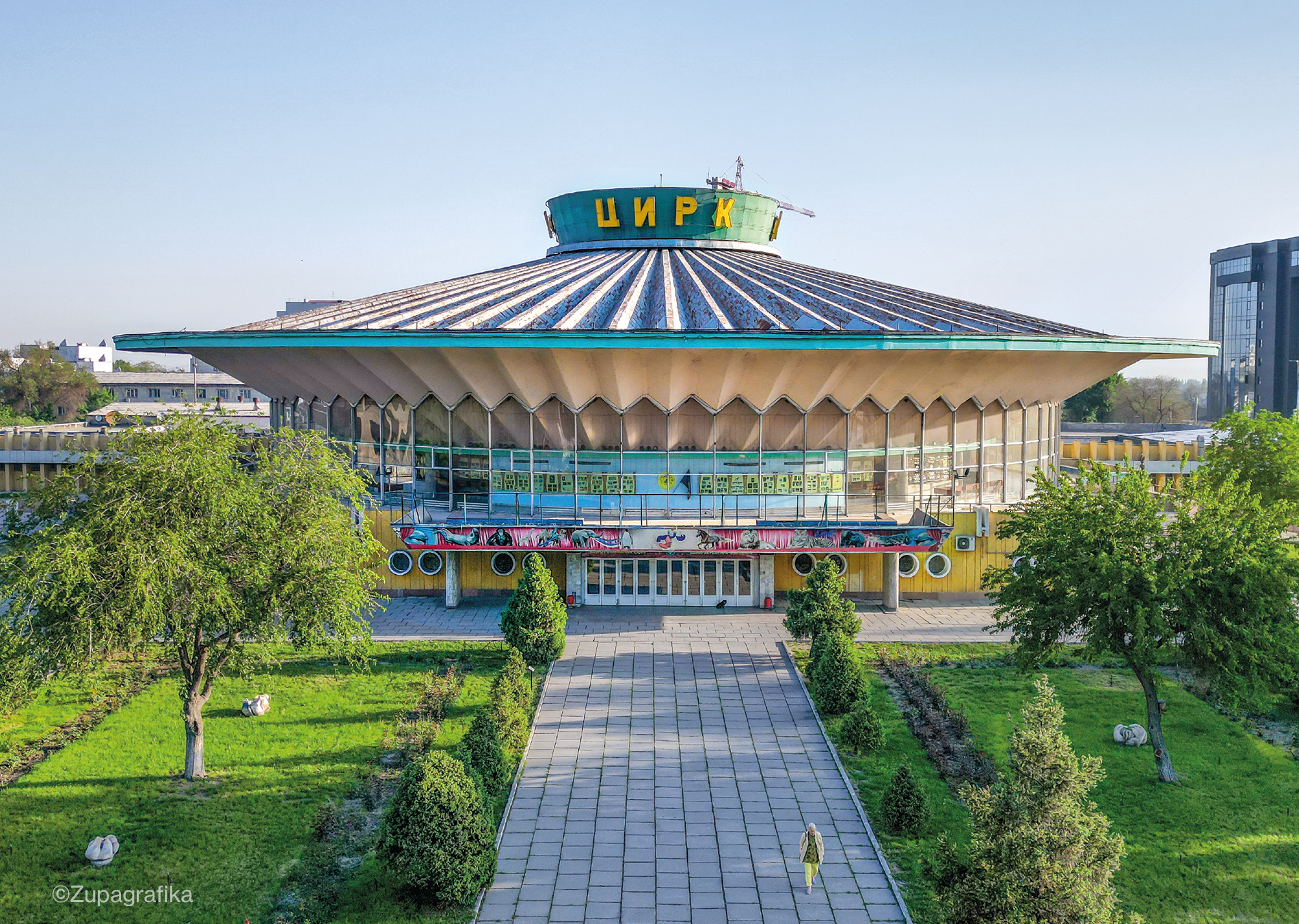
Kyrgyz State Circus in Bishkek
(Image credit: Zupagrafika)
Explore the typology of the ‘modernist circus’
These permanent circus buildings typically took the form of a concrete interpretation of the classic Big Top, often with abstract decoration in the form of panels or elaborate roof structure. Capable of seating several thousand people, they served as permanent homes for the numerous state circuses that provided officially sanctioned mass entertainment.

Kazan State Circus, 1965-1967
(Image credit: Zupagrafika)
As the book notes, ‘the circus occupied a prominent place in the performing arts throughout the former USSR and other socialist countries. Combining elements of both art and sport, it was an egalitarian form of entertainment: simple and direct, easy to understand yet complex to perform and equally attractive to children, students, workers and intellectuals.’

(Image credit: Zupagrafika)
Russia has a long history of purpose-built circus buildings – the Saint Petersburg Ciniselli Circus dates back to 1877. Following the revolution, circuses, like ballets and orchestras, were nationalised, overseen by Gos-Tsirk and later the Soyuzgostsirk (the Union of State Circuses). There was even a state-administered system of professional circus training and the Moscow State Circus in particular toured the West.

(Image credit: Zupagrafika)
Written by Zupagrafika’s David Navarro and Martyna Sobecka with a foreword by architect and researcher Jelena Prokopljević, the book contains seventeen such structures, each surviving as a remnant of past political priorities and the importance of a strong architectural presence. As well as classic circus iconography, there’s a science fiction element to many of these buildings, resembling giant UFOs set down in the cityscape.

(Image credit: Zupagrafika)
Designed explicitly for a singular purpose, interiors often included elaborate mechanisms for trapeze and high-wire acts, as well as spaces for animals in addition to the performers. Some have survived into the post-Soviet era as performance spaces, while others have been more neglected. Taken together, the structures in Cirk showcase an important but often overlooked aspect of socialist architecture, the provision of communal entertainment spaces.
Image 1 of 4


The five models that can be made include the Kyrgyz State Circus in Bishkek, the Chișinău State Circus, Dnipro State Circus, Tashkent State Circus and the Great Moscow State Circus.
Cirk: Build Your Own Socialist Modernist Circus, €32, Zupagrafika.com
‘ The preceding article may include information circulated by third parties ’
‘ Some details of this article were extracted from the following source www.wallpaper.com ’