As a longtime student of African American music history, John Davis came to New Orleans in search of the sound that came before jazz.
He had virtually no knowledge of south Louisiana other than of composer and pianist Louis Moreau Gottschalk.
“I remember going to the Hogan Jazz Archive, and this guy Lynn Abbott — who’s a very well-known guy in the world of jazz scholarship and the early history of Black American music — comes out and he said, ‘So what do you want to see?’ And I said, ‘Well, how about box No. 1? Let’s start there.’”
After his second choice was box No. 2, Abbott started to get the picture.
“I could see the consternation on his face because he knew I was going to want to see everything, probably.”
Three decades later — after examining more than 30,000 pieces of music archived at the now-Hogan Archive of New Orleans Music and New Orleans Jazz, as well as the New Orleans Jazz Museum, The Historic New Orleans Collection and other repositories — the exhibition “The First Piano Professors and Lost Music of Early New Orleans” is now on view at the jazz museum.
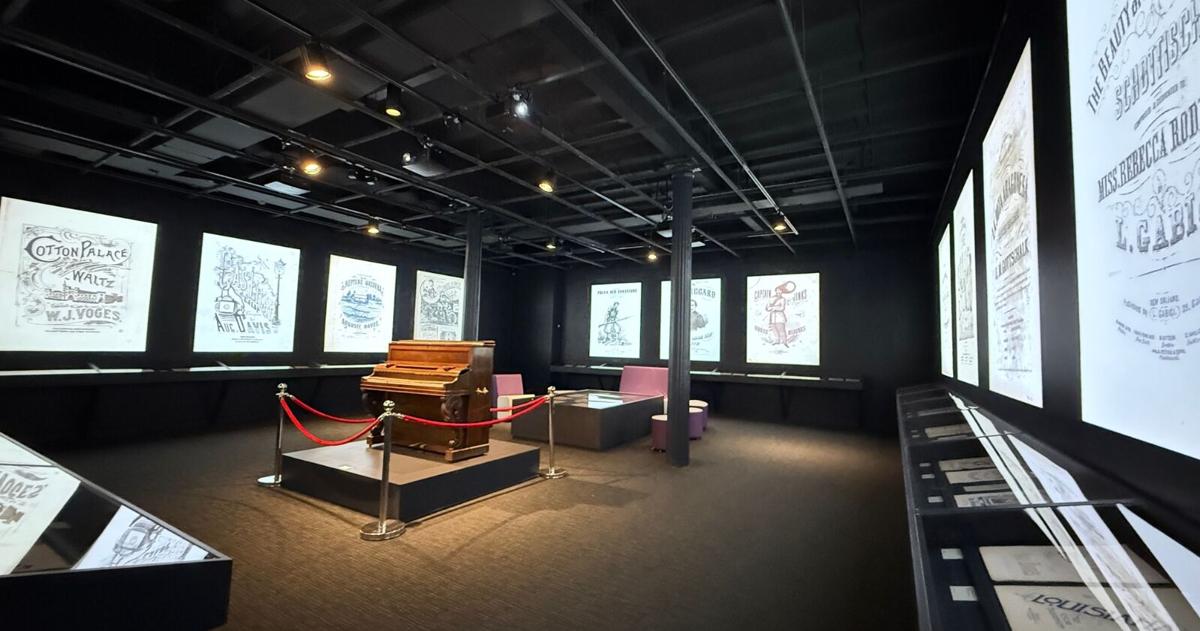
Sheet music by 19th century New Orleans composers are projected on the walls of the exhibit “The First Piano Professors and Lost Music of Early New Orleans” at the New Orleans Jazz Museum.
Pre-jazz compositions
New Orleans music of the 19th century was performed in opera houses, concert halls, churches, clubhouses of mutual aid societies and in private homes. Some of its creators were émigrés from Europe, while some were Louisiana-born Creoles. They combined European influences with pieces informed by African, Afro-Caribbean and Latin cultures.
Sheet music was the delivery medium for popular music, most often performed on pianos in private homes. Canal Street-based music publishers brought the music to market.
Built of first-edition sheet music unearthed by Davis, “The First Piano Professors” resurrects pre-jazz compositions that have been seldom heard since their creation.
“The music has been kind of out there in plain sight,” said David Kunian, jazz museum music curator and co-curator of the exhibit. “Because the other forms of music in New Orleans overwhelm everything else, maybe people haven’t quite looked to this yet.
There’s a longstanding prejudice against American classical music compared to European pieces, he pointed out.
“I also think that the fact that some of the composers were Black probably figured into that in terms of the way people think about it,” Kunian said.
A world before recorded sound
Through two large rooms, the exhibit walks visitors through a world before recorded sound and into music drawn from cultural influences that infused New Orleans music in the 20th century.
Through advertisements, photos and illustrations, the first room introduces the musicians and venues where they performed. In the second room, publishers, engravers and lithographers who illustrated the covers of the sheet music are introduced.
The printed music is arrayed in cases around the outside of the room, organized by topic (“Creoles of Culture,” “Women and Love,” “Mardi Gras,” “Afro-Caribbean and Voodoo Culture,” “The Confederacy”).
Super-sized versions of the sheet music covers are projected, which is credited to the principals of 2×4 Design, whom Davis met by chance in Rome. They worked with the museum’s curatorial and archival teams to complete the exhibit’s stellar look.

Canal Street’s bustling community of music publishers distributed the compositions of 19th century New Orleans composers.
Performed by Davis, piano pieces featured on the walls play in the gallery as a musical soundtrack, which can be comfortably enjoyed in a seating area.
“I had to look through all that music to find 25 or so pieces that I thought were really high-level stuff, or something that I thought was thematically interesting to begin with, and maybe bore some connection to the music that came later in New Orleans — 20th-century jazz and rhythm and blues,” Davis said. “But it also had to be good music, right?”
‘ The preceding article may include information circulated by third parties ’
‘ Some details of this article were extracted from the following source www.nola.com ’