Madeline Johnson risked everything last year when she quit her stable job as a speech therapist at a local hospital to focus on her sensory-based haircare business, Miss Madeline’s LLC, which caters to children and adults with sensory needs.
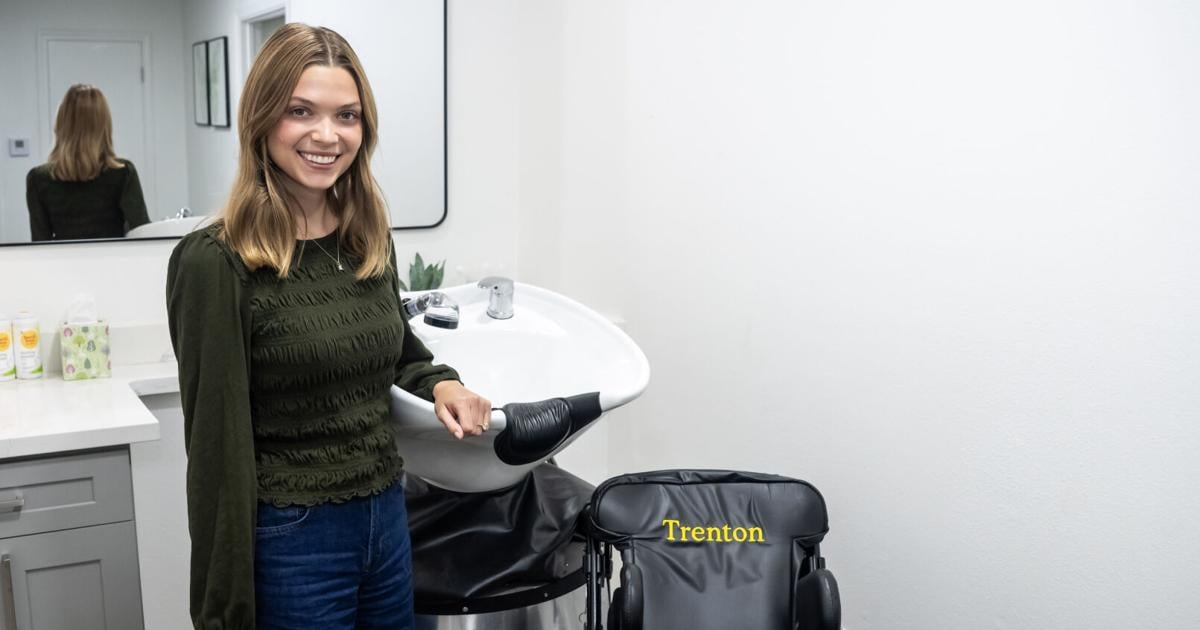
Since then, she has come up with an innovative idea — an adapted shampoo bowl that moves according to wheelchair capabilities. Johnson has also joined speech language pathologist Rachel Guidry at Connections Speech, Language & Reading Specialists, both as a speech therapist and as a sensory-friendly hairstylist.
After hearing about a person who fell at a hair salon during a transfer from a wheelchair to a salon chair, Johnson had an idea for a wheelchair-accessible shampoo bowl. She had not even begun her own hair business, but she saw a need that wasn’t being met.
She pitched the idea to the LSU School of Engineering Capstone Design Program, which is a senior design project for engineering students in which they work on a deliverable project for a real company.
“I had the idea for the bowl forever,” Johnson said. “I submitted it two years ago before I even had started Miss Madeline’s. I did a terrible job writing it up. No students chose it then, which, thank God.”
After a year of working consistently in sensory-based haircare, Johnson modified her design and pitched it again in August 2025.
This time, she was prepared. Four students chose her design challenge — Claire Dolan, Jaden James, Tucker Poret and Cheyenne White.
A new design
Johnson made an indelible first impression at the LSU Capstone Design Fair. Poret said she walked in from “the pouring rain” right into her presentation. She got their attention.
“She walked up there and gave her presentation while soaking wet,” Poret said. “It really showed me that this person really cares a lot about this project and what they do.”
After learning a little more, Poret saw an opportunity to learn and do some real good.
He said that a lot of the ideas pitched are for bigger corporations, and those are projects that typically get a lot of funding and support.
“But this was someone in Baton Rouge that wanted to do something cool and just needed some resources to do it. That was part of my decision, and my teammates would echo similar thoughts,” Poret said.
Johnson said her original concept for the shampoo bowl was very different. She was thinking just of mobility and movement so the bowl can move to accommodate the chair. She said that the engineering students went beyond her ideas to meet their requirements for the project.
The team used paper design and computer programs like AutoCAD and SolidWorks the first semester to finalize the design.
Poret said the engineers had lots of challenges during the manufacturing process.
“We started building things, and we realized that a lot of it needed more work to actually be put together,” Poret said. “For example, the different adjustments had to be redesigned on the fly the second semester after we realized that the first idea wouldn’t really work during testing.”
He said they had to redesign the vertical, forward and back adjustment parts as well as the tilting system — a large amount of work in a short time frame.
“At the end, I think we created a really great prototype. Ours does function, and with the constraints that Madeline gave us at the beginning of the previous semester, our project met all of those,” Poret said.
Johnson and the team agreed that she should bring the project back up for Capstone consideration in 2026 to create “a second generation,” Poret said.
Since every part of the design had to be made by the students and also replicable, initially, White 3D printed the shampoo bowl. However, it didn’t drain well enough, so after the students’ project was graded, Johnson purchased a bowl for it that the students retrofitted.
Poret said that Johnson’s passion drove the students to work hard on it.
“I hope it expands access to people, and it inspires work to continue because there’s so little in that space, as it’s kind of a niche area. It needs people like Madeline and other engineers paying attention to it so they can solve problems for people that need it,” Poret said.
A new salon
Now that she had an adaptive shampoo bowl for wheelchairs, Johnson needed another salon space that had room for it. The lease of her small suite ended in May.
Guidry discovered Johnson when she was on the local news about her sensory-friendly haircuts. She clocked that Johnson said she wanted to do speech therapy part-time and cut hair part-time. She got in touch with Johnson and offered her a contract position.
After Johnson worked for Guidry at Connections for several months, Guidry was looking for a new building. The two went together to check out properties, and they found a spot on Jamestown Avenue.
The owner, C.T. Taylor, was redoing the office suites, and Guidry saw a former small kitchen space as Johnson’s potential salon. Taylor renovated the room to function as a salon around the same time the bowl was ready.
Guidry also added an occupational therapy gym to her office and hired an occupational therapist. Both the salon and the OT gym function as sensory-friendly spaces for Johnson’s clients, depending on their needs.
Guidry and Johnson moved into the new clinic on Memorial Day weekend.
Because Johnson wants to transfer her clients only twice — from their car to her wheelchair and back — she needed her own wheelchair. She went to Our Lady of the Lake on Goodwood Outpatient Pediatric Clinic, and they donated the “perfect comfortable wheelchair,” she said.
Johnson works from the clinic and at different schools during the week, doing her speech pathologist contract work. On the weekends, she cuts hair for her clients at Connections.
Collaborating with LSU engineering students and partnering with Guidry has given Johnson new opportunities to reach more children and clients with special needs.
‘ The preceding article may include information circulated by third parties ’
‘ Some details of this article were extracted from the following source www.nola.com ’