If New Orleans has honed one economic forte in the past century, it sits at the intersection of pleasure and business.
Tourism is our largest employment sector; business travel is its most lucrative component; and boosters know to extol the city’s cultural glories in highlighting its economic opportunities.
But it took local ingenuity to turn this co-marketing concept into a branded event. One early effort began a century ago in the neighborhood now known as Bywater — and in a way, it continues today in port cities worldwide.
The idea arose in the early 1920s, when the Port of New Orleans bustled with a revival of river commerce amid the recent openings of the Panama Canal and the Inner Harbor Navigation (Industrial) Canal in the 9th Ward. The question became: How to drum up international traffic at the port while attracting investors to the new industrial space?
The answer: roll out the city’s hospitality and get folks together to talk business in a festive venue. Better yet, hold it right where attendees could see where the Industrial Canal joins the Mississippi River.
International Trade Mart Tower in 1987
In 1924, leaders of the New Orleans Association of Commerce, including Randsell O’Connor, Charles L. Wallace, and Sigmund Odenheimer, envisioned an “international trade mart” where, according to the New Orleans States, “friendly intercourse among the states and … countries that lie beyond the two great oceans and South and Central America” might “stimulate trade and broaden commercial relations.”
Organized as a nonprofit corporation, the public/private partnership would take the form of an elaborate trade show where manufacturers and wholesalers would display their wares to importers, exporters and shipping agents, all to the warm welcome of port and city officials and in the company of everyday New Orleanians.
INTREX
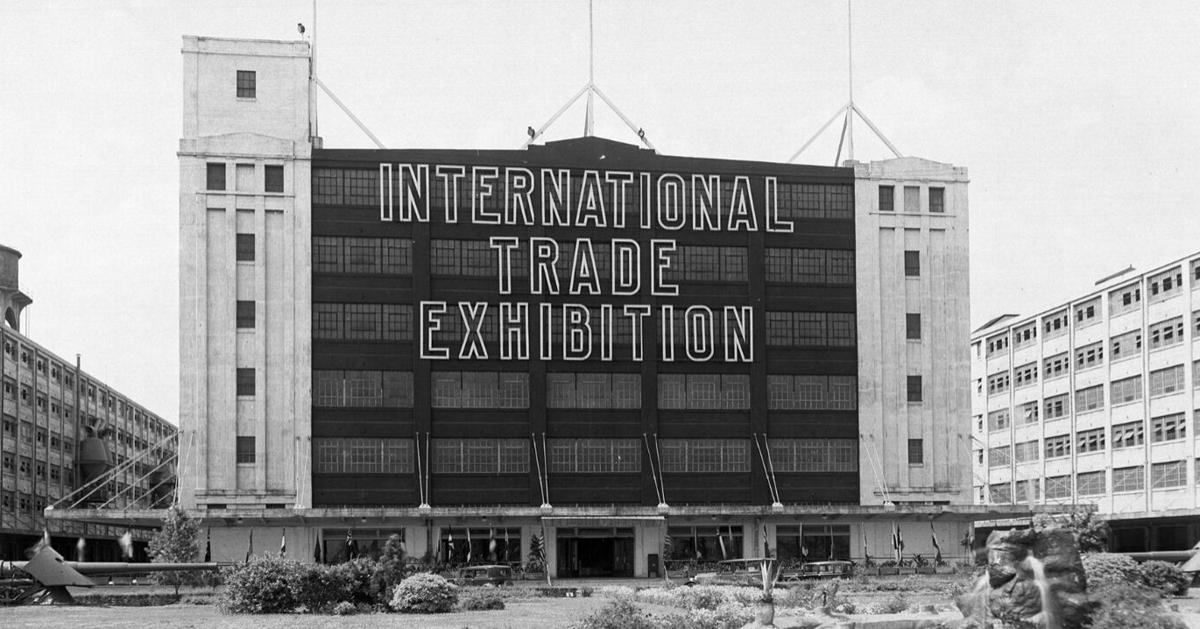
Named the International Trade Exhibition (INTREX), the gigantic floor show would be permanently housed in the middle unit of the Army Quartermaster Supply Depot — those three gigantic warehouses at 4400 Dauphine St. which had been built for World War I but were now largely idle.
INTREX preparations became the talk of the town in 1925 as organizers scrambled to raise funds, secure exhibitors and cajole the federal government for support. The feds delivered by offering, rent-free for two years, some 69,000 square feet of floor space throughout the 600-foot-long warehouse, each of the six floors served by freight elevators.
Invitations went out to 15,000 manufacturers, and commitments arrived from at least 500 exhibitors from 22 countries, including most of Latin America. By July 1925, hundreds of parcels began arriving, those from foreign countries granted exemptions from customs duties.
Locals wanted in on the action. City Hall sponsored a 36-foot-wide mural of life-sized figures titled “New Orleans Welcoming the Nations,” painted by local artist Ella M. Wood.

Mural by Ella Wood at the International Trade Exhibition in New Orleans
Downtown department stores such as Maison Blanche signed up to participate, as did railroad lines, shipping companies, manufacturers and regional growers. Florists and horticulturalists were contracted to adorn displays; stenographers committed to record the deals that would be made; and real estate agents prepared to show houses to moneyed guests who might consider moving to New Orleans.
The Hardwood Manufacturers Institute of Memphis committed to build a “roof city” atop the depot, where, the States reported, “full sized bungalows, paved streets, a perfect water system, [all] well illuminated” would exemplify the “City Beautiful” movement.
Following some delays and a soft opening on Sept. 15, organizers planned a grand unveiling to coincide with the upcoming carnival season. Finally, at 10 a.m. Monday Feb. 1, 1926, President Calvin Coolidge pressed a button in the White House to strike a gong officially opening INTREX.
Amid cheers, a band launched into “The Star-Spangled Banner,” while U.S. marines, police officers and local Boy Scouts marched in procession. After a 21-cannon salute thundered over the Mississippi River, dignitaries gave soaring speeches, including one from exhibition president Sigmund Odenheimer, who explained that he got the INTREX idea from the famous Leipzig Fair in his native Germany.
Doors now open, INTREX went into daily operations, with an ever-changing assemblage of booths and stalls amid music, performances and food — though no libations, this being during Prohibition.
Civic exuberance
Among the most popular displays at INTREX was a scale model of New Orleans, showing all its neighborhoods and infrastructure in dazzling detail. The language with which the States described the $15,000 model reflects the civic exuberance of this era.
“It shows, as no map, photograph, or drawing can show, the greatness of New Orleans, greatest city and seaport of the South, and second greatest port in the nation. … Every New Orleanian … should see this model [and] be proud of his city … its history, its greatness, its beauty.”
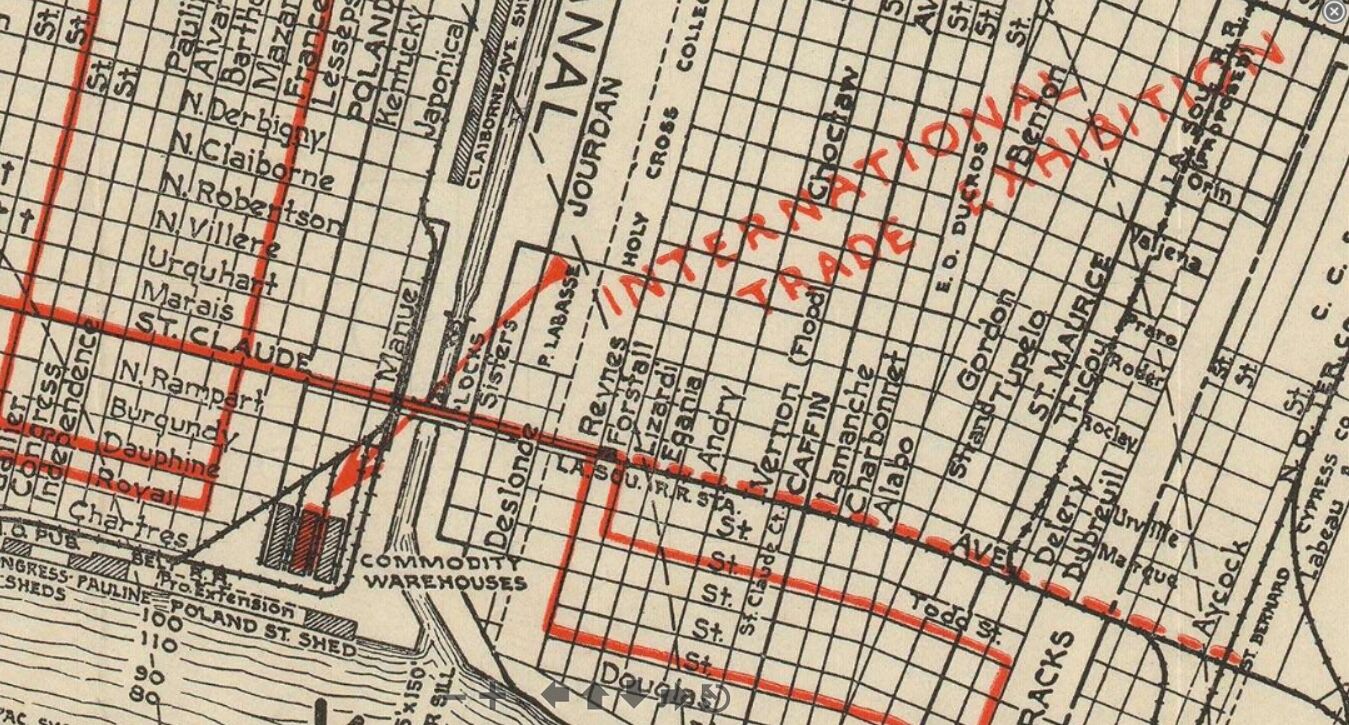
1925 Map of the City of New Orleans showing location of the International Trade Exhibition
A public announcement in the States echoed the alacrity, declaring that “this exhibition will be one of the greatest things for the city that has ever happened.” Proclaimed an editorialist, “New Orleans is the ideal and logical location” for such an event, with “an ideal climate … rich in historical interest” and “cosmopolitan in population,” where “the Latin American finds … racial sympathy, sympathy for his traditions, [and] unrivaled port and financial facilities.”
Over 15,000 visitors attended INTREX in just one week in August 1926, most of them arriving by public transportation. “RIDE THE STREET CARS, Visit the Exhibition,” announced the New Orleans Public Service, Inc. “The Dauphine Car Will Take You to the International Trade Exhibition Building … Open Every Day, Sundays and Holidays Included.”
A fatal flaw
Had organizers planned for a limited-time event, like the Panama–California Exposition held in San Diego in 1915 or the World’s Industrial and Cotton Centennial Exposition held locally in 1885, INTREX probably would have gone down as a success. It did reasonably well in drumming up deals and marketing the city and port, thanks largely to a rigorous economy.
But the decision to make INTREX a permanent fixture — opened 365 days per year, no less — was asking for failure. Visitors conduct their business and go home; exhibitors present and move on; locals sate their curiosity after one or two trips.
And while the Quartermaster Depot was an ideal space, its location was inconvenient, being over 2 miles from the Central Business District. Yet organizers doubled down on the commitment, rebranding INTREX as the Permanent International Trade Exhibition at New Orleans.
The death knell came when the stock market crashed in October 1929. Commerce stilled worldwide, and business junkets all but disappeared. Despite an “impressive beginning,” wrote historian Gary A. Bolding, “the doors of the Permanent International Trade Exhibition closed … on Feb. 27, 1931.” By then, the global economy sunk into the Great Depression, only to be followed by World War II.
Revival of the idea
But the idea of leveraging hospitality to invigorate commerce was too good to die. As Allied troops began to turn the tide in the fighting, the INTREX concept came back to life in a new form.
In 1943, commercial leaders rolled out the red carpet at an elegant Victorian high-rise they called the International House. There, well-appointed offices and meeting rooms awaited foreign colleagues as a sort of home away from home, where “good neighbors” could become “good trading partners.”
In this manner, “with its French and Spanish overtones,” wrote one local leader in Ports and Harbors Magazine, “its Mardi Gras customs, excellent cuisine, and innate graciousness,” New Orleans could capitalize on its charm.
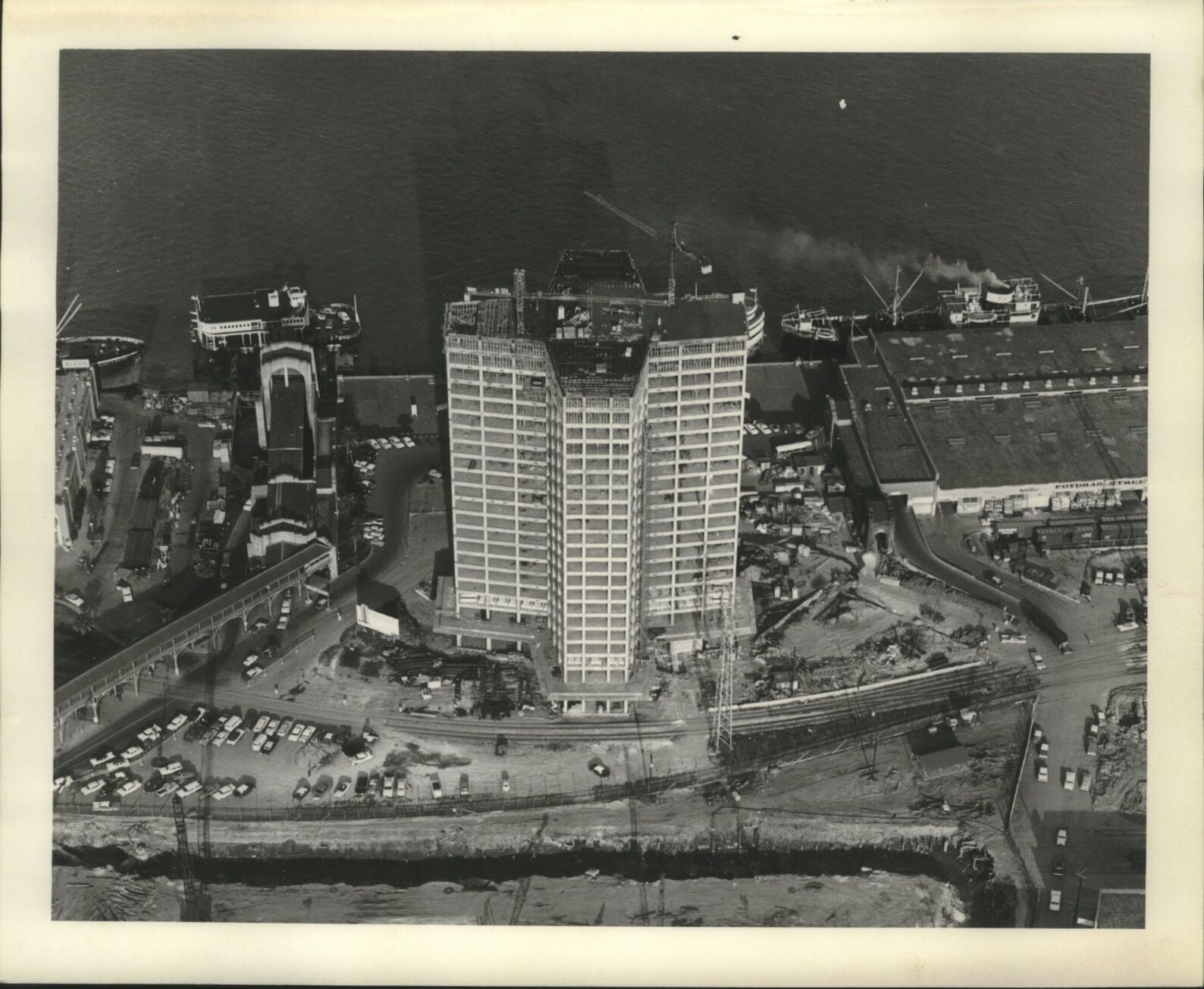
Aerial view of the International Trade Mart Complex tower in 1965.
Five years later, the same cohort of business boosters launched the International Trade Mart, where manufacturers could meet, exhibit and make deals in a purpose-built five-story showroom. It was no coincidence that this new effort had the same original name as INTREX, along with the same exposition-style programming — only this time on Camp Street in the heart of downtown, steps from the International House.
In 1947, the Port of New Orleans opened its first modern Foreign Trade Zone, which aimed to do for cargo what the International House and ITM did for colleagues. That is, it offered “a wharf away from home” where international shippers could store freight at minimum cost and hassle, thus maximizing logistical flexibility and inviting investments in value-added industries. Now the rest of the world had another reason to do business at New Orleans.
In 1965, the Port of New Orleans erected a skyscraper at the foot of Canal Street to house a bold new International Trade Mart, as well as its own headquarters. Three years later, it opened the visually stunning Rivergate Exhibition Hall adjacently, taking the INTREX concept to the next level with multi-use space designed to handle rotating tenants, trade shows and even Mardi Gras parades — all overlooking one of the world’s busiest shipping arteries.
The locally born idea of leveraging hospitality and commerce was now poised to spread globally in the form of “world trade centers.” In 1969, the Port Authority of New York and New Jersey began work in lower Manhattan on two identical skyscrapers designed to the tallest in the world. In 1973, the twin towers officially became New York’s World Trade Center.
Back in New Orleans, the International House and International Trade Mart in 1985 merged to become World Trade Center New Orleans, described by a later president, F. E. Lauricella, as the “first of what are now 322 World Trade Centers in 95 countries.”

Although the buildings are a few blocks apart, the International House on Gravier Street and the International Trade Mart (in the distance) joined hands to form the New Orleans International Center for the promotion of world trade, travel and education in 1976.
By then, circumstances had changed. Great ports were radically changing, thanks to mechanization and relocation, while New Orleans endured an oil bust and ongoing population loss.
GNO Inc.
Venerable business groups, among them the New Orleans Board of Trade, Association of Commerce, and Chamber of Commerce, either folded or merged, passing their mission on to today’s Greater New Orleans Inc. In 2022, GNO Inc. partnered with World Trade Center New Orleans, thus conflating the legacies of the organizations that had conceived INTREX a century prior, or descended from the idea behind it.
Today, that idea lives on in the form of our convention trade, whereby any given week might bring multiple trade shows and exhibitions to the Ernest N. Morial Convention Center and other venues.
Relatedly, both the International House and former International Trade Mart are now hotels, while the original site of the INTREX is slated to become the NSA East Bank Apartments, featuring an innovation hub, residences, and retail overlooking the Mississippi River.
‘ The preceding article may include information circulated by third parties ’
‘ Some details of this article were extracted from the following source www.nola.com ’