In “Rheology,” Shayok Misha Chowdhury, an experimental theater artist, and his mother, Bulbul Chakraborty, a theoretical physicist, bridge the language of their different disciplines to explore a subject dear to both of them: loss.
Chowdhury, author of the play “Public Obscenities,” a 2024 finalist for the Pulitzer Prize, and the director of the sensational off-Broadway production of Jordan Tannahill’s “Prince Faggot,” is as tenderly devoted to his mother as the young Marcel was to his own in Proust’s “In Search of Lost Time.” The idea of his mother dying is insupportable to Chowdhury, but given that she’s in her 70s and he’s in his 40s, certain terrifying realities must be faced.
“Rheology,” which is receiving its West Coast premiere at REDCAT (in a brief run ending Saturday), is the piece they’ve created to prepare Chowdhury for that fateful day. This strikingly staged Bushwick Starr, HERE Arts Center and Ma-Yi Theater Company production is an interdisciplinary experiment that is as playful in its methodology as it is serious in its research aims.
Chakraborty, a professor at Brandeis University, starts off with a physics lesson. Her subject is sand, and she poses a simple question: Is the sand pouring through the hourglass sitting on the counter before her a liquid or a solid?
A charismatic teacher, she knows how to Socratically engage a room. Her welcoming manner draws out from the audience the different ways sand behaves both like a solid and like a liquid.
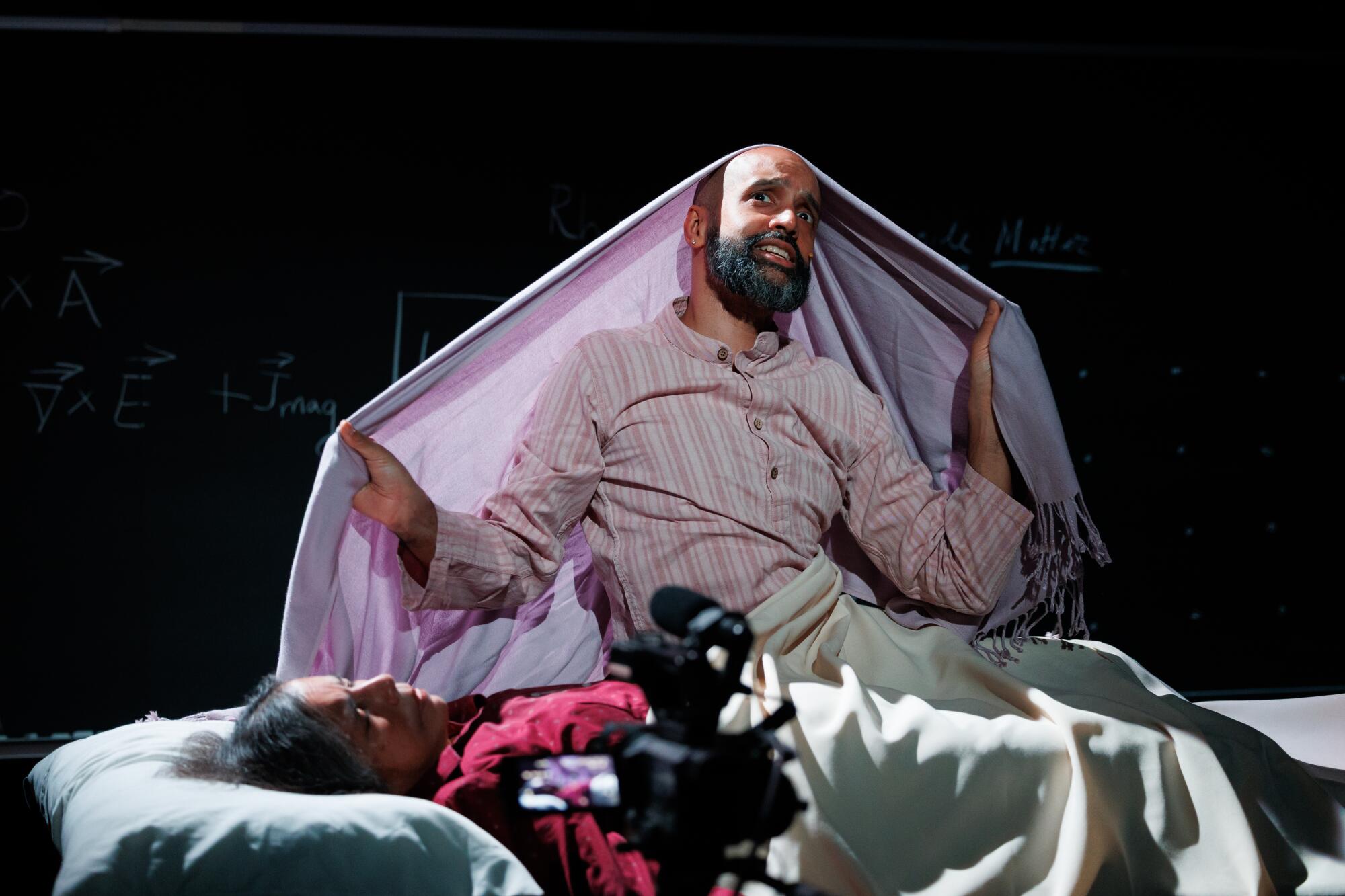
Shayok Misha Chowdhury, in rear, and Bulbul Chakraborty in “Rheology” at REDCAT.
(Roy and Edna Disney CalArts Theater [REDCAT])
Rheology, or the science of how a substance responds to external stress, is her chief interest. Her research, focused on soft condensed matter, has been seeking a comprehensive theory to explain the curious elasticity of such material. A photo of a sand dune, in which she’s seated alongside Chowdhury as a toddler, helps illustrate her point that sand can flow like a liquid yet retain its shape like a solid.
An onstage sandbox is more than just another visual accompaniment to her talk. It’s a source of both elemental mystery and childlike wonder. But elucidation is her motive. She enters the box with her bare feet, noting the way the sand flows around her toes yet supports her weight in observation of the rule that “every grain has to be in force balance.”
She writes equations on the board to explain these findings, equations that begin to glow as the production moves from the realm of pure science to the more slippery domain of art. The transition, like all aspects of this piece, is frolicsomely conducted.
While pouring sand from one container to another, Chakraborty appears to be overcome with dust. For a moment, it’s not clear if this is part of the show or a medical incident until Chowdhury, discreetly occupying a seat in the audience, asserts himself as the director. He asks his mother to run through the death scene with a different sequence of movements and introduces the accompaniment of George Crotty on cello to liberate her performance.
They are rehearsing not so much Chakraborty’s end but Chowdhury’s reaction. He assumes he will fall apart and vows to die himself out of heartbreak. Chakraborty wants him to carry on his work, just as she carried on her research as a mother with a young son who would wail uncontrollably when she would drop him off at daycare.
She recounts that his emotional outbursts were so extreme that it was painful leaving him behind. But she was assured that he was handling the separation. For proof, she was taken into a private teacher’s room, where through a one-way mirror she saw him compose himself shortly after her departure and start to play with the other children.
Mother and son enact a similar situation where, after a more permanent leave-taking, she can catch a glimpse of her son recovering himself sufficiently to survive her loss. Chowdhury, a queer artist who enjoys sampling performance modes, adopts the figure of the grieving Bollywood widow. The effect isn’t to lampoon but to confront his raw emotion and to test his capacity for resilience.
The experiment might sound sentimental, but Chakraborty, the production’s secret weapon, maintains a scientific restraint, albeit one suffused with maternal anguish. The way she listens to her son, takes in his feelings, gently suggests other possibilities of response and treats his experimental theater piece with the same dignity as her own research is incredibly moving to witness. Her performance won an Obie Award, and though she insists that she’s not an actor, she demonstrates a sincerity and collaborative grace that many veteran performers would envy.
As it unfolds, “Rheology” can seem piecemeal, even haphazard. There’s an informality built into the production, but it’s somewhat deceptive because the mercurial staging is extremely precise. Chowdhury’s direction has visual panache. Kameron Neal’s video design transforms Krit Robinson’s part lab, part lecture hall set into something kaleidoscopic.
When mother and son sing songs from the famous cycle by Bengali writer-composer and Nobel laureate Rabindranath Tagore or hold a deathbed conversation in Bangla, the piece spins further across time and space. Empiricism gives way to surrealism. But the world, as any scientist probing into the atomic level can attest, contains more secrets than meets the eye.
Fragile matter is Chakraborty’s specialty, and her expertise is put to novel use in shoring up her son’s tender heart.
‘Rheology’
Where: REDCAT, 631 W. 2nd St., downtown L.A.
When: 8 p.m. Friday, Saturday. Ends Saturdays. Tickets: $27
Contact: redcat.org
Running time: 1 hour, 15 minutes
‘ The preceding article may include information circulated by third parties ’
‘ Some details of this article were extracted from the following source www.latimes.com ’