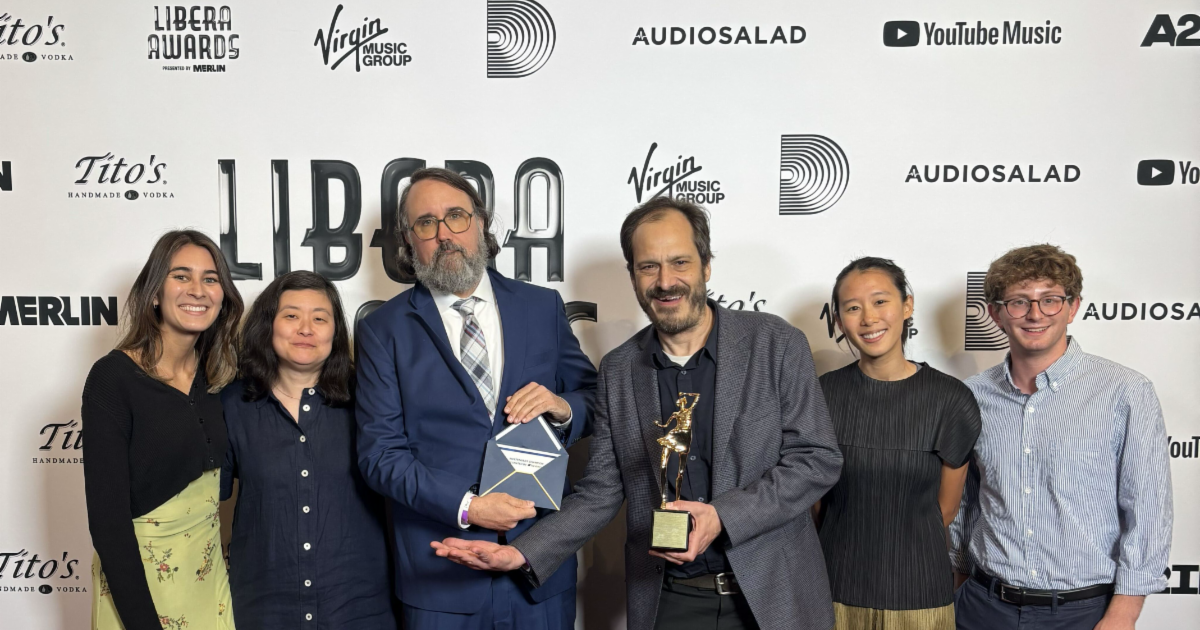
Last week, the French streaming service Qobuz won for Independent Champion at the Libera Awards in New York. It’s kind of a mini-Grammys strictly for independent artists and the infrastructure supporting them (other winners included Geese and Hayley Williams).
“It was a nice validation of our strategy to be the music service that we as music freaks would like to see,” said Dan Mackta, Qobuz’s managing director for North America. “Indie labels have started to see more revenue coming through from Qobuz. We’re actually on the board now.”
In an era when streamers are deluged with AI slop, and artists cut ties over corporate titans’ investments, Qobuz found a sweet spot for an emerging streamer. It’s big enough to drive real revenue (its per stream payout averaged US$0.01873 as of 2025, well above Spotify and Apple). But it’s still built like a tasteful record store with hi-res audio and downloads, no ad tier, and a glossy music magazine championing outsider acts.
The company, founded in 2007, saw striking growth last year — a 45.7% revenue increase in 2025. It could break out as the Spotify alternative for serious music fans reconsidering their culture dollars. The Times spoke to Mackta about competing with the streaming giants, how to deal with AI slop and the best ways to get cash in artists’ hands.
Last year’s growth was pretty remarkable, given that everyone that wants a streaming service probably has one. Where is that growth coming from?
I think the growth over the last year has been people who are switching. Until recently, people who were doing music streaming had a service and were sticking with it. No one was really thinking about changing. Digital Media Association released their new report that 95% of people who subscribe to streaming were happy with their service. But the idea that you can switch, you may want to switch, there may be reasons to switch, really took hold in 2025. As an alternative, we’ve been a beneficiary. We didn’t do anything to drive folks to check us out. It’s because we thought that was the right way to do it, with human curation and a focus on albums, and keeping it interesting and eclectic. There’s even more people than we anticipated finding us quickly.
Last year, some high-profile artists that said they’re leaving Spotify. That’s not going to end the company, but it was cause to revisit what streaming service fans are using. Is that a meaningful market — music fans that want their culture dollars better reflecting their values?
In independent and underground music, people are a little bit more conscious of the world, and how things work and what they can do about it. I think there’s a big intersection in music fans who are digging deeper, and people who are more plugged into what’s going on in the world. The phenomenon of artists saying we don’t want to work with this or that company resonates with fans and listeners. When that fan base is predisposed to wanting to stick it to the man, it’s not a tough sell. By just keeping what we do very simple and just focused on music, we’ve managed to be a worthy alternative.
For fans concerned about how streaming has changed artists’ income, you’re also paying out just about the most per stream of any of the big services. Is this model closer to what might sustain independent and smaller acts?
The reality of streaming economics is that, if we were as big as Spotify, our average per stream rate would go down. There are lots of different reasons why there’s such a disparity. But in a broader sense, think back to the pre-digital era where there were mainly CDs. If you buy CDs at Walmart, you were probably a very mainstream music fan who buys one CD a year. Underground and independent artists played almost no role in that that economy. I worked at labels in those years, and we were fighting for distribution and shelf space.
Our motivation is to be all about music for people that are really into music, and we’re big enough where we matter, but small enough that we don’t have to worry about being all things to all people. When Drake puts out three albums in one week, we only featured one, and we’re gonna give the other two spots to some lesser-known artists.
We’re trying to generate revenue that can add value and flow back to the labels, artists and songwriters. Our financial model is not that different — we’re still a streaming service. But we do have the download store that is still growing, where everyone said that model was dead. We’re finding more and more people want to actually own the music, and people know that if they buy a digital album for 10 or 15 bucks, that that’s a better deal for the artist than streaming it 100 times.
The vinyl boom of the last decade just crossed a billion in annual revenue last year, but records are now like $40. Downloading an album in-service for $10 might be an underrated way to support artists directly, and own the music.
Yeah. It’s also algorithm fatigue. I saw an ad campaign in the New York subway for Back Market, a company that sells refurbished electronics, with an iPod Nano, the little thing that was a clip with no display, just a button. It said, “No algorithm. You pick 100 songs, that’s it.” They’re trying to sell refurbished iPod Nanos, because kids are into iPods again. I’ll take it, but it is funny that what’s old is new again. Music is such a special human thing that I think there is this weariness of how techie it’s all gotten in terms of how you interact with music. We’re fitting in nicely just by being music people and music-focused.
I appreciate the editorial on Qobuz. It feels more like a smart magazine than a “You Might Like…” engine. Does that music-critic writing really make the service stickier?
Definitely. The magazine content is great; I’m hoping to double down on it this year. The new releases that we feature on the front page every week, we know for a fact that’s influential. We see the streaming numbers, and some very unlikely artists that are not famous get some real engagement.
Our weekly newsletter is written by the same folks that do all the curation, and I guess it’s a little bit of a rarity now, but it seems to work. When we feature something that’s pretty unknown, it’ll get as many streams or more streams than a famous artist who put out an album the same week.
Let’s talk AI. There’s a huge conversation in streaming about how to police slop, and you’re developing an in-house system for identifying this stuff. How can you deal with the deluge coming in through distributors?
It’s a nightmare. It’s the ultimate manifestation of a weakness in the streaming business model. It’s fraud, 100%. There’s no other reason why these aggregators would be delivering so much music to us. It’s literally like if every man, woman, child and dog on the planet released a couple of albums this year. It is crazy, and it’s costly. It’s bad for everybody, except for the fraudster that’s running some kind of scam and sucking money out of streaming that legitimately should be going to real artists.
The team developed our own AI detection model that is able to identify tracks that are created with any of the major generative AI platforms. It will be be flagged on our side, and we will continue to upgrade and update that model, but it’s already running. It takes a long time, and we don’t have unlimited server power, so they’re not going back to the beginning of time, they’re analyzing the catalog back to 2020 something, when this actually started to be possible.
What I understand is that it’ll basically be, at the release level, some kind of flag that this release has used generative AI. This stuff is already excluded from any of our recommendations and editorial — you’re not going to get recommended AI slop.
But the big problem is AI slop with the names of real artists that you know. We’re putting in lots of other checks and balances and protections to try to keep it from polluting the system. It drives me absolutely bonkers that the industry hasn’t clamped down on it. It’s so much music that we have to ingest and store that it’s a cost, and there’s very little we can do about it other than start to police it. We’re going to take stuff down that is clearly fraud, we’re going to tag everything, and if there are any kind of streaming anomalies or other signals that it’s fraud, it’s coming down.
Spotify, a competitor of yours, recently struck a deal with UMG to allow people to do AI-aided remixes of certain catalog tracks. That seems like it would be off–brand for you, but would you ever explore that?
We’re definitely going to steer clear of that. We haven’t even talked about anything like that, but I’ve got thoughts. I think some people want to remix and play around with music, but I don’t know how much they really want to do that. That seems to me like a totally different business. We’re a record store and a fanzine. I guess I could see, for us, trying to partner with some of the DJ software so people could use Qobuz there, although that would require us to get some different licenses. For the most part, Qobuz is the ultimate record store where everything is in stock and it’s all in mint condition, and the other stuff to me is external to our core business. We can get better and bigger just doing what we’re doing.
The company is expected to be profitable next year. You’ve said there’s no corporate debt, and the firm is private and family–owned in France. Do you intend to stay that way?
There’s no immediate plan otherwise. The guy I report to in France seems pretty happy with the way things are going. Once we hit profitability and prove the model, the value of the company will only increase. But he’s got kids in France who are involved, and I think he views it as a family business right now, which is a relief for me. I consider myself an adopted son as an employee.
I’ve spoken to some independent music managers who said they’d like to see a user-centric payment model in streaming, where, out of a $10 subscription, the $7 worth of royalties will get paid out depending on what the user listens to, rather than going into one massive bucket. Is that something you would ever consider?
We’ve looked at it. We’ve done our own study, and it was determined that there wasn’t much actual difference in the amount at the end of the day that the big artist versus the smaller artist made. The big objection in streaming is that the lion’s share of the money goes to the bigger artists who need it the least. So if you put it on a user-centric basis, like if I only listened to the August Brown Band, then all $7 would go to the August Brown Band.
God help you, if that’s all you listened to.
That’s such an edge case, though. The actual difference in payments to major labels versus smaller artists is not that earth-shattering, and we couldn’t do it anyway unless the major labels said we could. We more or less exist at their pleasure with our full-catalog model.
Others have looked at it, but it doesn’t make sense unless the entire thing is working that way, because we are not able to dictate the model to a major label who’s so much more powerful than we are. If UMG came to us and said, “Here’s how we think it should work now,” we probably have to go along with it, unless we didn’t want to have all their music anymore. We’ve thought about a lot of different models to try to optimize the earnings for our artists in general, but we don’t have much leeway in the model. We feel like pushing the download store and keeping that robust and growing is the best way within our toolkit to drive more revenue for artists.
‘ The preceding article may include information circulated by third parties ’
‘ Some details of this article were extracted from the following source www.latimes.com ’