I’m at my desk in Las Vegas waiting for Perez Hilton to enter the Zoom, and I’m thinking about the last time I threw up from drinking. It was Sept. 9, 2023, at the Palms Casino Resort. Technically, I threw up after I left the Palms, after I lost my phone and then found it again, after I sent one text that said “lovvve you” and another that said “p b at hmm,” after I got in the pool with my clothes on, after I insisted my friends drive me to a strip club, after I announced when we were almost there that actually I was going to be sick and needed to go home. And as I threw up and cried for the first time since living in a dorm, it occurred to me how fitting it was that I’d just been at a party co-hosted by one of the central figures from my millennial college years: Perez Hilton.
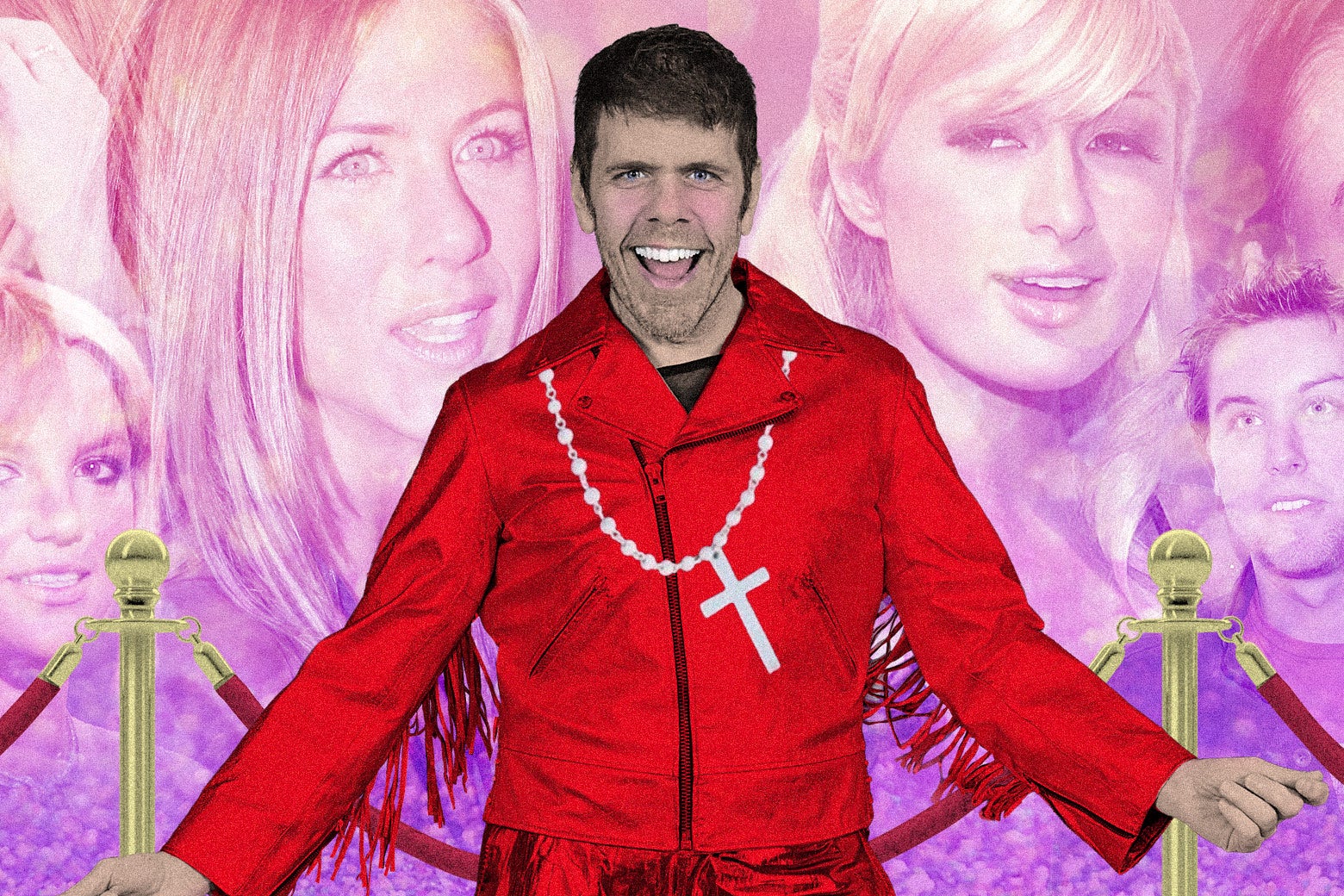
From what I remember of the event, a benefit supporting Aid for AIDS of Nevada, I was in a booth at a nightclub and Hilton was onstage. He wore a red suit, like a character in a movie playing a stylish version of the devil. The crowd cheered as if he was as famous as he’d been in the early aughts, and I wondered if I’d time-traveled back there. I was, after all, at the same hotel that had hosted the 2002 season of MTV’s The Real World where Trishelle, Steven, and Brynn hooked up in a hot tub in the first episode, and I was about to go to a VIP afterparty at early-2000s nightlife destination Ghostbar. But no, I was not in a time warp; I was just in Vegas, where I live, and where Perez Hilton does, too. He’d become a Vegas local earlier that year, making the move with his three children and his mother after 20 years in Los Angeles. He cited the warm reception he received in 2018 during a two-month guest-hosting gig for Chippendales as a motivating factor. In a YouTube video filmed shortly after his move, Hilton spoke from the kind of sand-colored living room that is ubiquitous in Las Vegas tract homes. He talked about familiar Vegas topics—adjusting to the Southern Nevada Water Authority’s irrigation restrictions, the appointment-based DMV system—and praised the “sense of community here that Los Angeles doesn’t have.”
I’ve never heard anyone say that about our transient city, but I can see why he felt that way. His arrival was met with a fawning article from the Las Vegas Review-Journal, a video of the showgirl cast of VEGAS! THE SHOW welcoming him to town, the cover of local LGBTQ+ magazine QVegas, and a flood of followers to his new Instagram account, @lasvegasperez, where he documented meals at local restaurants and weighed in on a feud between two Las Vegas influencers.
Before he was a local Las Vegas celebrity—a curious group that includes Carrot Top, Pauly Shore, Floyd Mayweather, and, for the last years of his life, O.J. Simpson—Hilton was one of the most powerful people in celebrity media. Born in Miami to Cuban immigrants, Mario Armando Lavandeira Jr. created his Perez Hilton identity shortly after moving to Los Angeles. In his memoir TMI: My Life in Scandal, which is one of four books he’s written (there are two other nonfiction books and a children’s book), he explains how he chose the name: “The ‘Perez’ in me was the outsider, the Latino guy, the homosexual, the person who stuck out, and the ‘Hilton’ referred to Hollywood, the mainstream.”
His eponymous website, which launched in 2004, was originally called “PageSixSixSix” until the celebrity.land—home of Page Six—filed a lawsuit. PerezHilton.com quickly became synonymous with the cruel style of celebrity gossip that dominated the pop-culture landscape in those days. This was the era when a stolen recording of an inebriated 19-year-old Paris Hilton having sex with her 31-year-old boyfriend became a bestselling adult video. This was the era when you couldn’t go to the grocery store without a magazine cover demanding that you look at the 72 best and worst beach bodies.
Hilton was relentless during these years. He scrutinized famous women’s bodies, attempted to out closeted men, mocked child stars with drug addictions, and drew crude doodles on paparazzi photos. If you are a millennial, you already know this, but if you didn’t or you blocked it out, here’s a non-exhaustive list of some of the worst things Hilton posted in the early aughts: a topless image of Jennifer Aniston (who he called “Maniston“), an upskirt photo of a then-underage Miley Cyrus, an upskirt photo of a then-underage Taylor Momsen showing her tampon string, a link to Colin Farrell’s sex tape, a photo of Vanessa Hudgens that he’d drawn ejaculate on accompanied by mocking coverage of her leaked nude photos, numerous photos of Lindsay Lohan with crude drawings and jokes about her addiction struggles, photos of Mariah Carey with the nickname “Mooriah,” a photo of Elizabeth Hurley’s wedding with the headline “Even Whores Wear White,” countless attacks on Britney Spears calling her things like “a trailer trash ghetto princess” and an “unfit mother,” bullying of not-yet-publicly-gay men like Lance Bass, Matt Bomer, and other male celebrities … and somehow also a false report that Fidel Castro was dead.
When I talk to millennial women about 2004 to 2010 PerezHilton.com, everyone seems to have a specific photo, doodle, or nickname that they remember. For me, it’s a 2008 post about Mischa Barton, who was on a downswing from her time as teen royalty following her controversial exit from The O.C. and a drunk-driving arrest. Hilton wrote: “Somehow, Mushy Fartone got an invite to the Costume Institute Gala at The Metropolitan Museum of Art in NYC on Monday night. She must have gone as someone’s +1! Thankfully, the former TV actress kept her cottage cheese thighs covered.”
That same year, a man I was dating had used those same words—cottage cheese thighs—to describe my body. We were in the car having an argument that had nothing to do with my appearance and he spit it out so suddenly, so angrily, that I could tell he’d been thinking it for a long time. I should have dumped him or at least demanded an apology, but instead I just sat there in silence, staring at the blur of darkening forest from the highway. I realized then that I was not alone in the disgust I felt when I looked at myself.
I’d spent most of high school on a low-carb diet, becoming so thin I lost my period, so obsessive I had a breakdown after consuming a single Reese’s cup. I bought diet pills that gave me heart palpitations and read magazines that suggested that the worst thing you can do when you’re hungry is eat. I watched a reality show where women got plastic surgery and then competed in a beauty pageant. In college, I became editor in chief of our university magazine and a photo of our editorial team sparked an anonymous debate about whether or not I was hot. On weekends, my friends and I lined up at frat parties awaiting the judgment of the men who got to decide if we were attractive enough to enter. If one of us didn’t make the cut, we abandoned her and went inside, down to the basement where on the ceiling in large letters it read “bring your daughter to the slaughter.” We read what Perez Hilton wrote about Britney Spears and learned to hate her, but not as much as we hated ourselves.
If you’re a millennial woman, you already know some version of this. It was the world that raised you too. Now, I was going to come face to face with someone who could possibly be held accountable for at least some of it. He wasn’t the architect, but he did help lead the construction.
I wanted to talk to Perez Hilton about his apologies. His latest had come after a life-threatening incident in April, which led to yet another reinvention here in Vegas—this time one straight from God.
Hilton’s modern apology tour began with the one he made in 2009 after he called Will.i.am of the Black Eyed Peas a homophobic slur during an altercation. (GLAAD was displeased.) Then, there was the 2010 YouTube video “I’m Going to Be Doing Things Differently” and the apology on The Ellen DeGeneres Show following accusations of hypocrisy when he was contributing to the It Gets Better campaign, which was created to support LGBTQ+ youth. In nearly every interview I could find from the years that followed, he was asked about these apologies and forced—or perhaps given a platform, depending on how you look at it—to repeat them.
More than a decade later, there was this, his most recent apology, from April 2026, which didn’t seem connected to any controversy, but functioned as a sort of blanket statement of regret and remorse. In a video titled “I’m Sorry! AND…,” Hilton spoke from his bed. He wore a T-shirt with a close-up of Britney Spears’ face, her mascaraed eyes looking up at him. He held a Bible. Through tears, he talked about a newfound faith in God and, referencing his past, said, “I’m sorry. I will continue to apologize.”
Even though he’s softened his tone over the years, Hilton has kept up a frenetic pace of posting about celebrities. His namesake website is still very active; a recent headline alleges that “Jennifer Lopez DID Have A Fling With Brett Goldstein While Filming Office Romance!” He hosts a weekly pop-culture podcast, The Perez Hilton Podcast, with radio personality Chris Booker. He posts daily videos on YouTube and maintains multiple social media accounts. He is also on Cameo, where he creates personalized videos within 24 hours of purchase starting at $44 for personal use and $500 for businesses. In one recent Cameo, he congratulates someone named Patrick on launching an app, with the caveat, “I’m not going to mention the name of your app because if you want a business Cameo, that’s a separate booking.”
I’d been following his three Instagram accounts—one personal, one for the website, and one for Las Vegas content—and found myself surprisingly endeared to his enthusiastic posts about our shared city. We were both fans of Majestic Repertory Theatre, a small immersive theater company in the Arts District. We liked the same restaurants—not just on the Strip but in neighborhoods, and I was hoping we could have lunch at one of them.
I emailed his sister, Barbara, who has worked with him since he launched his website. She said he wasn’t currently doing in-person interviews—he’d just gotten out of the hospital—but we could set something up virtually. In a YouTube video from March 23, “My Stupidity Got Me In The Hospital For 21 Days! This Is The Most Important Video I’ve Ever Shared,” he explained he’d developed an ulcer which led to sepsis. What followed was a nearly monthlong hospital stay. He couldn’t walk, eat, or control his bodily functions. Through the experience, he said in the video, he’d found God. Like me, he’d grown up Catholic, but he hadn’t believed until nearly dying. The Instagram version of the video got reactions from television psychic Tyler Henry and right-wing pop singer Joy Villa, but also comments from people I knew in Las Vegas. It felt, in some way, like the universe wanted us to come face-to-face, wanted me to hear him out.
Still, I was skeptical of Hilton. I had a feeling that, like the previous apologies, which seemed to coincide with a shift in the media away from open cruelty, the “I’m Sorry! AND…” video that followed was an attempt to adapt, to latch onto a trend or new audience. Maybe it had something to do with the recent spike in conversions to Catholicism. I suspected that this was also why he’d moved to Las Vegas in 2023; it has been ranked as one of the best cities for a fresh start. It’s a place that’s open to reinvention. And those of us who live here know how people on the outside see Las Vegas: a drunken mistake, so artificial it’s impossible to imagine real people calling it home. As a result, sometimes it seems to me like the city is desperate to be taken seriously. Even when Perez Hilton is the one validating us, we’ll take it.
Las Vegas is also a strange mirror of Los Angeles. I thought about that often when writing my debut novel, Close Relationships with Strangers, which is about a Las Vegas wildlife photographer who moves to Los Angeles and becomes a paparazzi photographer. The narrator is frustrated with Las Vegas’s reputation and limitations; he sees Los Angeles as a land of possibility. And if L.A. is where you go to pursue your dreams, Vegas is where you go to retire or rebrand. I did the latter when I moved here. I’d been working in the national parks and I wanted to live in a city and be a writer. For other people, Las Vegas is where you go when you’ve been priced out of or exiled from California. Our celebrities typically fall into at least one of those categories. Music artists who no longer have the energy to tour find residencies. Actors who are too red for blue California find a fanbase in purple Nevada. Could this be where the man who started the most hated website in Hollywood finds forgiveness? A flood of believers commenting on his latest apology seemed to think so, leaving messages about grace and prayer. A REAL Christian won’t be against Perez, one person wrote, and I felt my Catholic guilt kick in.
A week before the interview, I had breakfast with a friend at a diner. I ordered eggs and fresh fruit. I kept an eye on the time so I wouldn’t be late to Pilates. Sixteen years after Perez Hilton’s “I’m Going to Be Doing Things Differently” video, and on the brink of my novel being published—a huge dream, coming true—I’m still trying to be smaller and prettier. I have mostly accepted that I will always be trying. Of course, I don’t blame Perez Hilton for that, but I do think his website, which had as many as 14 million views in a single day at its peak, had some influence. And I know that a lot of women feel the same way. I’m planning on asking him what he might say to them. I also plan to bring up the Barton “cottage cheese thighs” post, to tell him about the effect his words had on me. It seems so embarrassing, though, to ask for an apology from someone who didn’t even know I existed when he was hurting my feelings.
“I don’t want to be mean,” I told my friend—somewhat ridiculously, given who I was about to talk to.
The name in the Zoom waiting room is Mario. When I click admit, his face materializes and the name changes to Perez. He’s wearing a silver crucifix necklace. I tell him I hope he’s feeling better. “Six weeks ago, I was broken totally,” he says. He’s closer to normal now, and he has this focused, intense energy. He has straight teeth and a big smile. He raises his eyebrows often, widens his eyes, and talks with his hands. His first dream was to be an actor—he once had two lines on an episode of The Sopranos—and I can see how he comes alive when there’s an audience, even if today that audience is just me. He asks me if he should get a ring light or change the angle of his camera, but I assure him I’m not going to be posting a video recording anywhere.
When I ask him about his relationship with Las Vegas, he cuts me off, but not in a rude way—it’s more like he’s so excited to talk about it that he can’t help but start.
“For the longest time, the Mob ruled Vegas, and that Mafia mentality is still in place in many ways,” he says. “It took me a while to learn that the powers that be here do not appreciate honesty. They just want you to be a cheerleader, and if you’re not, you’ll be blacklisted so quickly. And Vegas is such a small town. In Los Angeles, I didn’t care about access to celebrities, but here I care about access to this new restaurant, that new experience, whatever it might be. So I had to adapt. It’s very rare that I’ll have a negative experience somewhere, and if I do, I just won’t talk about it.”
“I had to adapt.” I ask, “Do you think Vegas treats celebrities differently than L.A. does?”
“Oh, absolutely. If you’re in L.A., you’ll only get comped if you’re the top tier in whatever you do,” he says. “But in Vegas, if you’re a C-list actor, or even a D-list actor, or a C-list creator, or a D-list creator, you’ll still get the royal treatment.” I don’t ask him what category he’d put himself in, and I also don’t volunteer which one I think it is. In the early aughts, he was a household name. Now when you Google him, one of the first related searches is “What happened to Perez Hilton?”
“They really roll out the red carpet for anybody with any following,” he says. I think of a pool party I went to hosted by a cast member of a short-lived reality show. “I get stopped a lot in Vegas, but not so much in L.A. And people here are always so nice.”
I mention the “I’m Sorry! AND…” video he posted after getting out of the hospital in which he said, “I’m not used to being supported. I’m used to getting hate.” I’d seen so many clips of him in the past where people regarded him with suspicion or disdain, and in every one he just took it. In a 2009 episode of Keeping Up With the Kardashians, Hilton approached a booth where several members of the family were sitting at a party and a wide-eyed Kris Jenner looked up at him and said, “I don’t know whether to hug you or kill you.” He hung around long after that, appearing unfazed.
“It kind of seems like you’re surprised by kindness,” I say.
“I feel like I have impostor syndrome. Like, why are people being kind? I think everybody deserves kindness, but not everybody gives kindness.”
This seems like a good time to ask him about his own pivot to being nicer. I tell him about a paparazzi photographer I spent time with while doing research for my novel who told me about the golden age of his industry, which was also when PerezHilton.com was at its height. That was over now, the photographer said, because the public no longer had an appetite for cruelty. “I disagree totally,” Hilton says, and cites what most people cite when explaining the downfall of the paparazzi industry—less print media and more social media. His own empire, which was born on the internet, is still monetized through online ads, though he also has a Patreon now. “I don’t think the masses even care or spent much time contemplating the ethics of paparazzi.”
I look at his crucifix necklace, the silhouette of Jesus at the center like a missing piece. I know he found it while spring cleaning because I saw him talking about it on Instagram. “The more you are in tune with God, the more he speaks to you,” he said to the internet. “It was no coincidence that I found this.”
Weeks after our conversation, his video “Christians vs Catholics – what the differences are” will start a debate in the comments. The subject matter will be different, but the people will be just as opinionated as the ones who respond to celebrity news items on PerezHilton.com. He’ll start selling T-shirts and mugs with religious figures on them. “Wear something holy, praise Him, and support your boy if you want,” he’ll say in an Instagram reel. He will explain that he is selling Jesus mugs because he is in “hustle mode” to pay off his hospital bills—a deeply American combination of words.
But we spoke before the religion merch push, so I am genuinely curious when I ask him if his newfound faith has influenced what he does. He stops to choose his words, as he often does during our conversation. “You know, people recently have asked, ‘Now that you have found God, are you going to stop doing what you do? God doesn’t like gossip.’ And I respond, ‘Well, I don’t do gossip. I do celebrity journalism.’ ” (Hilton uses this term pointedly—when Blake Lively’s lawyers accused him of participating in a smear campaign against her, calling her things like “Blake Lies-ly,” the American Civil Liberties Union of Nevada defended his free-speech rights as a journalist and later gave him a Civil Rights Leadership Award.)
“Not everybody believes in letting people evolve and grow, and I think it’s a cautionary tale,” Hilton tells me. “That’s why I’m happy to keep apologizing.” A few seconds later, he adds, “But I’m also done with my apology tour. I’ll still apologize, but it felt like for many years it was just nonstop apology tour, and that was appropriate. It should have been that. But recently—and some people might roll their eyes—but you know, I had this really powerful and real experience in the hospital with God. And I know that God forgives me. And just as importantly, I forgive myself.”
“OK,” I say, shifting in my seat and looking at my own face on the screen.
I am part of the “some people might roll their eyes.” I am smiling nervously when I say, “On that note, I want to ask you about something specific. So, in 2008, um …” I stop myself and say, with the tone of an apology, “I was looking back on like, very old posts from the website, and thinking about things that, like, I saw when I was young.” Later I will rewatch the Zoom and wince at how often I say like when I’m uncomfortable.
“One thing that always stuck in my memory was the way you talked about Mischa Barton. There was this post where you were talking about her cottage cheese thighs at the Met Gala, and I’m curious, like, especially now that we’re kind of in this era of—”
Hilton interrupts me. “In 2008, I was still very unhealthy—I don’t like to use the word fat—not that that’s a bad word. Actually, let’s use it for this conversation. I am still a fat person, even if I’m not fat right now. A fat person has a fat person’s mentality and way of thinking, and isn’t that always the case that a fat person is going to be jealous and project and throw darts at somebody else? And this is not deflecting. What I said and did was wrong, but with the posts on women, more often than not the negative comments about women are from women, or, you know, Us Weekly. And all of these tabloids, they were run by women.”
I feel my face go hot. Surely, he’s not implying that women are the real misogynists?
“What would you say to women who feel that your language really hurt them and influenced how they feel about their bodies?”
“I would say I understand why many people aren’t open to forgiving me, and that’s OK. Everybody, I believe, can be better and do better, and that’s all that I’m doing now.”
He smiles. I can tell he probably knew that I was working up to that question the whole time. He seems to always know what other people are not saying. He has a habit of vocalizing the words of imagined haters. When we’re talking about his faith, he mimics the voice of someone who doesn’t believe him: “Perez’s latest grift.” Nearly every time he does this, he says exactly what I’m thinking.
Later, I watched more of Hilton’s YouTube videos, social media stories, and interviews, and I heard the same words from our conversation, sometimes almost verbatim. He is good at giving sound bites, constructing his sentences so that each can stand on its own. For example, when I mentioned TMZ’s new Washington coverage and asked if he’d be doing more political content as well, he said no, and compared what he does to McDonald’s: “Nobody wants to get a salad at McDonald’s.” But, interestingly, he actually has been more overtly political since our interview. His celebrity news stories are interspersed with rumors about Tulsi Gabbard’s resignation from the Trump administration and updates on ex-Prince Andrew’s ties to Jeffrey Epstein. He appeared on right-wing political commentator Tomi Lahren’s show and praised Republican and former reality-show villain Spencer Pratt’s Los Angeles mayoral campaign.
It all comes back to what he said when he started selling religious merch to pay down his medical debt: He is in hustle mode. He has been his whole life. In his memoir, he writes that he was riding his bicycle around L.A. when he couldn’t afford a car, illegally subletting his apartment in New York, reselling books that were sent to a magazine he worked at, starting his website with the free Wi-Fi outside of a Coffee Bean & Tea Leaf, making friends with celebrities but never getting too drunk around them because sloppiness interferes with the work. He has always had a natural instinct for what’s about to be popular. He heard “Just Dance” by Lady Gaga before it was released to the public and shared it to his website because he knew she was going to be a star. He launched PerezHilton.com a year before TMZ was created. I am sure that the switch to kindness, the move to Las Vegas, and the sudden faith in God are more examples of him being first to identify a trend, which is not the same thing as an actual cultural shift. Yet deep down, I want to believe him when he says that people can evolve—because I want to believe that about myself.
I keep thinking about the moment his name switched from Mario to Perez on my screen. I know it was just a function of the software—an account name versus a display name—but it also pointed to something more unsettling.
One of the last things we talked about was the difference between Mario and Perez. Mario, the outsider who was bullied as a child, who was banned from the Chateau Marmont as an adult. Perez, the insider, who has appeared in a Rihanna music video and on a stage with Oprah.
“When I go to a red carpet,” he told me. “I’m showing up as Perez. I’m not showing up as Mario.”
“Have you thought about what it would look like if you did show up as Mario?” I asked.
He laughed. “Oh, God. I mean, if I showed up as myself, I’d probably wear just, like, all black. I’d be more worried about looking good.”
In the memoir, Hilton describes getting ready to host MTV’s 2008 New Year’s Eve show in Times Square. 2007 was the most successful year of his life. It seemed like every day, his website broke a new traffic record. He was rich and famous, but he was deeply lonely. Looking in the mirror, he saw a “faded clown” with “a shimmering mask of makeup around his sad eyes.” But when he approached the red carpet, he pretended to be happy. Soon enough, he began to believe it, and he was Perez. But after midnight, he went back to his hotel room and was Mario again. He took off his velvet jacket, sat on the bed, and drank a glass of Champagne alone in the dark.
I think about that white text on the black screen again. Mario. The display name Perez when he actually appeared and started talking. And then I know what the feeling is, because it’s one I’ve had before—many times, in fact, because I live in Las Vegas. It’s what I feel when I walk down Las Vegas Boulevard and a costumed character approaches me. Mickey Mouse or Elmo hoping for tips in exchange for a photo, frozen cartoon smile and cartoon eyes. I know there’s a person in there—someone inside the artifice making choices, feeling emotions, and controlling the performance. I’m just never going to meet them.
‘ The preceding article may include information circulated by third parties ’
‘ Some details of this article were extracted from the following source slate.com ’