The Cap Times is an independent newsroom serving Madison and Wisconsin. Sign up for the Food & Culture newsletter for exclusive weekly insight.
“Where were your clothes grown?”
That’s the question Jessica Becker and Leslie Schroeder like to ask people who haven’t given much thought to the textile industry before.
Becker and Schroeder are the co-organizers behind Field to Frock, a Madison-based festival put on by Schroeder’s nonprofit Midwest Linen Revival. This summer marks Field to Frock’s second year running, with pre-festival events set to kick off on Tuesday, June 23 and end with an expert panel discussion and linen fashion show on Sunday, June 28.
Midwest Linen Revival is a nonprofit aiming to promote sustainably grown flax and the processing of flax fiber products, like linen, within the region. “Field to Frock” is like their take on “farm to table.”
Around 2022, Schroeder found herself inspired by the emergence of various fibershed organizations, like Fibershed Heartland, which encompasses parts of Wisconsin and Illinois. These organizations were looking to develop sustainable networks to process local products like wool, leather and flax.
“I found myself asking, ‘What can I do as one person to promote local clothes?’” Schroeder said.
From that thought, Midwest Linen Revival was born.
Jessica Becker works with thrifted linen to create clothing for the upcoming Field to Frock event.
Flax-linen in the Midwest
Linen, a breathable, naturally biodegradable textile, is made from the fibers of the flax plant.

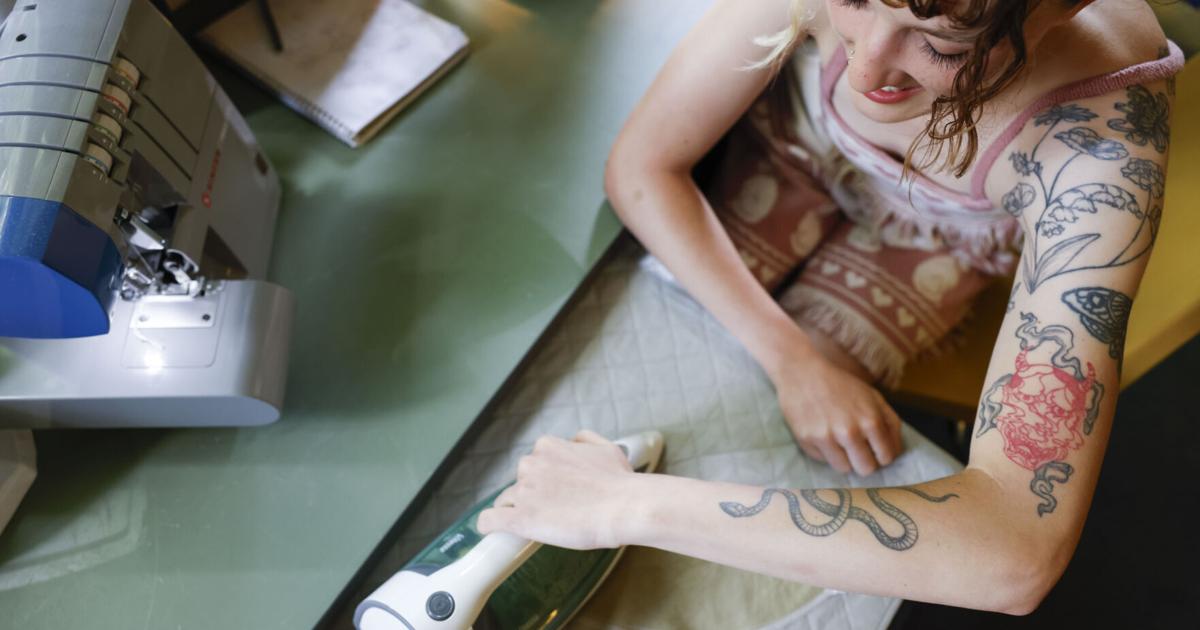
Jessica Becker works with thrifted linen to create clothing for the upcoming Field to Frock event. Using the linocut process, Becker carves stamps to create printed patterns on the fabric.
“I’m really, really interested in flax because I’m interested in bast fibers and the ancient relationship people have with them,” Schroeder said.
Bast fibers are fibers that come from a plant’s stem (like flax, hemp and nettle) as opposed to a fiber like cotton that comes from the flowering part of the plant.
“People have been using this for literally tens of thousands of years,” Schroeder said. “So then, it all came together, and I was like, ‘Oh, flax. You can grow it here, so why are we not growing it here?’”
Wisconsin’s climate is well-suited for growing flax, but Schroeder said historically, other factors have hindered a modern flax-linen industry in the Midwest.
“(Flax) couldn’t compete with cheap cotton, so we didn’t get the infrastructure set up, and then everything lost to synthetics,” she said.
Synthetics are materials like polyester and nylon, which are not biodegradable and shed microplastics as they break down. In 2024, the United Nations estimated that roughly 60% of all clothing was made from synthetics.

Dresses and other clothing featured in Field to Frock celebrate flax-linen. “Throughout all of human history we grew and made our clothing locally,” said Veronica Mingle, artistic director of the June 28 fashion show.
However, even if more Midwest farmers were growing flax for fiber, and Schroeder says the interest is there, there still wouldn’t be enough regional infrastructure to process it into linen.
“I discourage anybody from growing (flax fiber) at any kind of scale or even considering it, because there’s no destination for it right now,” she said.
These supply chain issues are what Schroeder helps to shift the conversation towards with Field to Frock.
Fashion as an entry point
Jessica Becker is the co-organizer of Field to Frock and Schroeder’s longtime friend; she also has an extensive background in public programming and event planning.
“We just started to imagine some of the fun things that we could do last year, and it actually went phenomenally, we couldn’t believe how much interest there was,” Becker said

Veronica Mingle works with thrifted linen to create clothing for Field to Frock, an upcoming fashion show. Mingle spent countless hours sourcing secondhand linens like bedsheets and tea towels to repurpose and sew into garments.
Now back for year two, she and Schroeder have built a festival lineup with a wide range of flax-linen events, from a papermaking workshop to a historic textiles tour, a flax hand-processing demo, and more.
Linen is also having a fashion moment right now. A simple google search of “fashion” plus “linen” will bring up countless recent articles raving about how the fabric is breathable, sustainable and trendy.
In Becker’s eyes this popularity can be an excellent starting point for conversations around textiles, the industry, and what it means to be human.
“We all wear clothes in the same way we all eat food, and yet we kind of fail to think through those complexities and the beauty of it,” she said. “Humans have always decorated themselves and so I find it refreshing to be connected in it.”
That’s one of the reasons why leading up to Field to Frock, both Schroeder and Becker have been participating in a 100-day linen dress challenge, where they have each worn one article of linen clothing every single day.

Veronica Mingle has a sewing studio at Neighborhood House in Madison.
“It gives us a reason to talk about it with people,” Schroeder said. “These kinds of things challenge you to think about things in a different way. Jessica and I have been doing our own personal contemplating about our wardrobes. One (question) is definitely, ‘How many pieces do you even need?’”
The last day of Schroeder and Becker’s linen dress challenge will be June 28, the same day as the festival’s linen fashion show.
This final event will kick off with a panel discussion moderated by PBS Wisconsin’s Ami Eckard-Lee and feature local farmers and experts in the flax-linen field. After the panel, a fashion show will showcase linen designs by students from the University of Wisconsin-Madison School of Human Ecology alongside other local artists.
The show’s artistic director Veronica Mingle spent countless hours sourcing secondhand linens like bedsheets and tea towels to repurpose and sew into garments for the event.
“A lot of it is stuff we’re keeping out of the landfill, which is really fun for me,” Mingle said.
She hopes the event will help people see what their clothing is made out of truly matters.
“Throughout all of human history we grew and made our clothing locally. It’s brand new that it’s become a globalized phenomenon,” Mingle said. “If we can make it locally, we will cut out unspeakable land and labor exploitation, it’s going to be higher quality, and it’s going to feel better to have a better relationship with your clothing.”
‘ The preceding article may include information circulated by third parties ’
‘ Some details of this article were extracted from the following source captimes.com ’