Ivy Wolk is aware of what you say about her: the good, the bad, and the wildly speculative. If you’ve thought it, she’s already read it on a forum weeks ago.
“I definitely stay abreast of the conversation surrounding me,” the actor and comedian says matter-of-factly. “It’s important to be clued into the cultural conversation.”
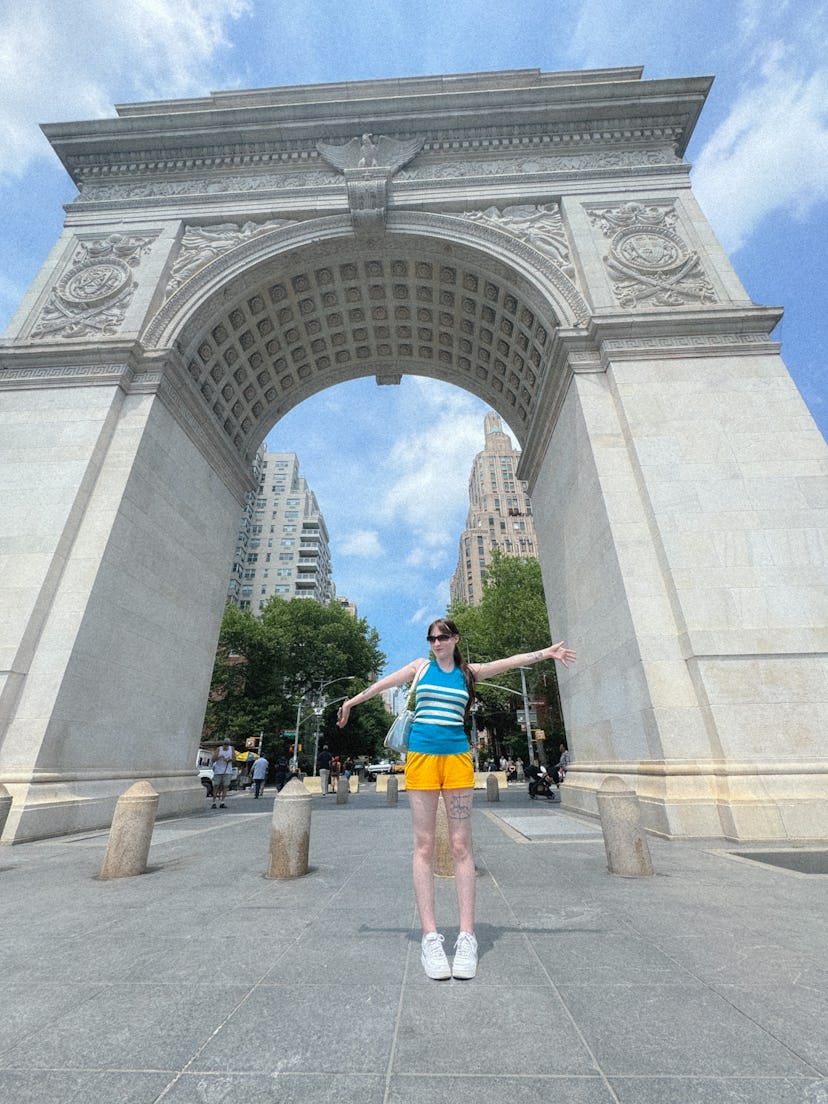
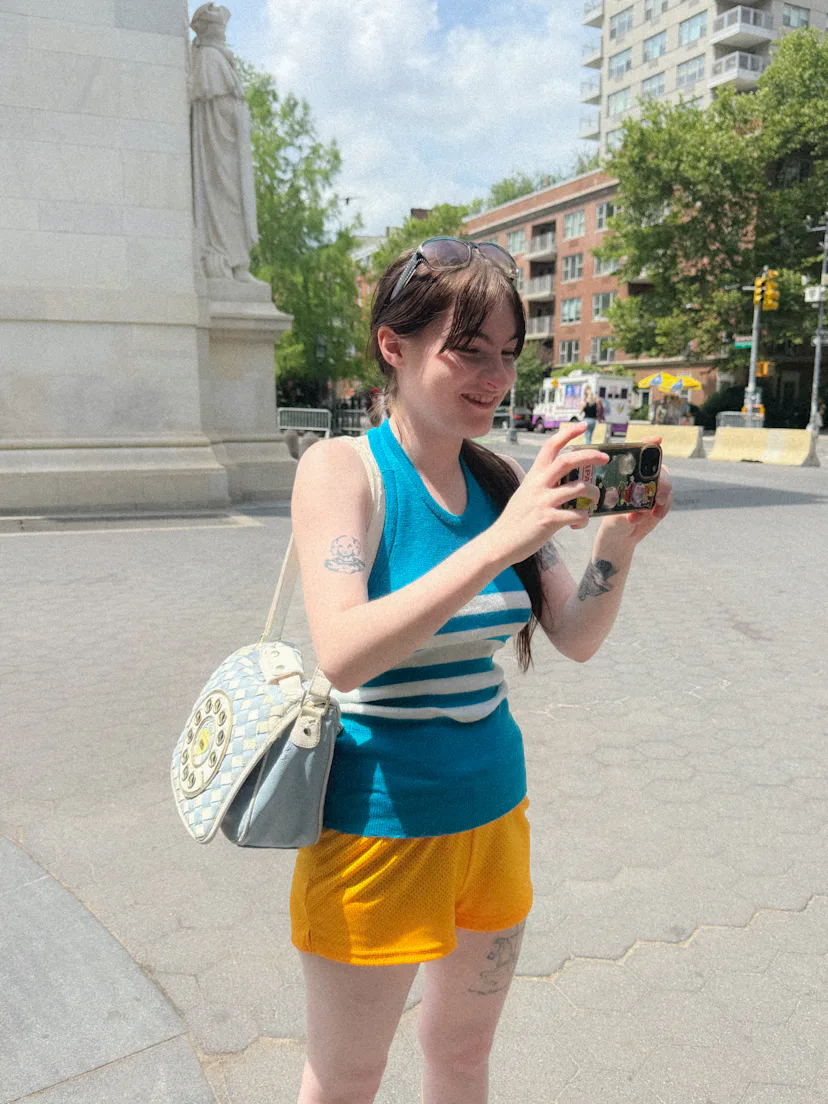
When we meet at a Union Square coffee shop on one of the hottest afternoons of the summer so far, the city is suspended between a heat advisory and Knicks-induced delirium. She arrives in a knit sky-blue halter top and yellow gym shorts, popping off her bedazzled oversize sunglasses into a thrifted Betsey Johnson messenger bag. Her halter’s open back reveals her “Hollywood Forever” tattoo, a suggestion of inevitability in the making.
She’s lightly flushed and apologetic after train delays. I assure her it’s no worries — the entire city is running late on everything today — and she eases into the conversation. Iced tea in hand, we began to walk downtown toward Washington Square Park. Wolk talks a mile a minute, her topics ping-ponging between Lena Dunham, Trisha Paytas, and JonBenét Ramsey. “In all of female celebrity history, if you find the right squad of gays, you will never die,” she says at one point. “When gay guys see a famous woman falling over herself drunk and throwing up on her shoes, and then hitting the stage anyway, they’re like, ‘That’s how it felt for me in the middle school PE locker room.’ Gay guys are obsessed with female pain and female triumph in equal measure. I am lucky that I am somebody who has scores of both in equal measure, so I will always be held by gay men.”
If there’s a common thread among her idols, it’s that they tend to inspire discourse. The messier, more polarizing, and more endlessly discussed, the better. “Diva worship,” as she calls it, isn’t about being liked. It’s about being unforgettable.
Hate her or love her, Wolk understands the power of keeping people interested.
“People know me. They think of my name and think that’s somebody that a lot of people have a lot of sh*t to say about. I’ve got to know what that sh*t is and why it happens.”
Long before she appeared in Anora, If I Had Legs I’d Kick You, Outcome, or Netflix’s Roommates, Wolk was already an Internet folk hero — or villain, depending on whom you asked. While still a teenager, her dry, deadpan, and often intentionally uncomfortable sense of humor made her a fixture of Twitter discourse, earning her the kind of attention most people spend years trying to avoid.
“People know me. They think of my name and think that’s somebody that a lot of people have a lot of sh*t to say about,” Wolk, now 21, explains. “I’ve got to know what that sh*t is and why it happens.” Growing up in Los Angeles, Wolk spent her childhood studying women the public couldn’t stop talking about (read: Courtney Love and Sandra Bernhard, among others). Then she became one herself.
Wolk was an actor from the start, growing up bouncing between auditions and a children’s musical theater conservatory, before she became @fathoodbitch: a darkly comedic presence posting snarky jokes on Twitter and deadpan TikToks. But while many child actors spend adulthood attempting to distance themselves from their Internet footprint, Wolk embraced hers. When she landed Everything’s Gonna Be Okay, network executives initially required her to delete her social media, but she quietly returned under a new handle, where her audience only continued to grow. (She was not asked back for the second season.)
She continued building an audience through her satirical tweets and sharpening her voice (and her baby bangs) until a role in Sean Baker’s Anora changed the trajectory of her career. Wolk booked the film while attending Emerson College; shortly after, she dropped out and made the leap to New York, relocating with what remained of her childhood acting earnings and a growing conviction that the city was where she needed to be. “I felt really held by the city,” she says.
“I’m not trying to provoke people ever. I just do by nature of who I am.”
These days, she’s become a familiar face in Gen Z cultural mainstays like Subway Takes and Interior Motives, where she appeared alongside her supreme diva, Courtney Love. The admiration, it seems, is mutual: Wolk has a tattoo of Love’s face on her arm, while Love told her she’d been “on my mind ever since I rejoined Instagram.” Offline, she’s a staple in New York’s downtown comedy scene, performing regularly at spots like Sesh Comedy, where her one-hour show Age of Consent takes on themes of female sexuality and female subjugation.
“I see the world often through uncomfortable and violent lenses, and how I survive is by articulating it,” Wolk explains, arguing that much of the backlash to the show, which some viewers interpret as making light of sexual violence, comes from audiences mistaking observation for endorsement. “The violence that I feel we are all constantly under the threat of, I articulate online and people are upset to be confronted by it. They think it’s belittling or I’m making light of it, but it’s all grave to me.”
Age of Consent traces Wolk’s relationship to sex and womanhood before zooming out into something much larger: an examination of female pain, fetishization, and the ways women are often most celebrated when they’re at their most vulnerable. “A woman is never more beautiful than when she’s at her lowest,” she says. “Look at Anne Frank’s bob.”
It’s the kind of observation that sounds designed to provoke. Wolk insists that’s never the point.
“Oftentimes the things that I say that I think are the most benign are the ones that get me into the most trouble,” she says. “I’m not trying to provoke people ever. I just do by nature of who I am and the fact that I’m constantly sharing everything.”
Wolk is surprisingly guarded about what’s next. I ask about the Los Angeles-set television series she’s currently developing, and for perhaps the first time all afternoon, she becomes slightly elusive. The details remain largely under wraps, though she describes it as deeply personal and informed by her experiences growing up in the city. For someone who has spent years turning her life into material, it feels notable that this is the one thing she’s keeping close to the chest.
Still, the project represents a natural next step; Wolk has never been particularly interested in confining herself to a single medium. “Stand-up, acting, prose writing, screenwriting, and the Internet — all of those things are equally important mediums to my expression,” she says. “The Internet is another canvas on which I can paint.”
As our walk in the park winds down and we near the Washington Square Arch, Wolk has already drifted from a brief geopolitical tangent about Israel to the difficulty of finding good gluten-free food, stitching together cultural fragments in a way that somehow makes perfect sense. Keeping up is nearly impossible — but then again, that’s part of the appeal.
‘ The preceding article may include information circulated by third parties ’
‘ Some details of this article were extracted from the following source www.nylon.com ’