There is an industry that profits every time you come to hate your neighbor a little more. Steven Olikara calls it the “division industrial complex” — “a collection of algorithms, polarized media, and hyper-partisan political operatives that make money on making us hate each other all the time.” It is a multibillion-dollar machine, he argues, mirroring the military-industrial complex it rhymes with, and it has convinced most of us that the people on the other side want to destroy everything we hold dear. The strangest part, he says, is that it’s mostly a lie. “We end up having a lot more in common than we realize. Just our discourse doesn’t reflect that.”
Olikara’s response was to go where the lie is manufactured. He runs Bridge Entertainment Labs, what he describes as the first Hollywood office built to combat toxic polarization and grow a culture of pluralism in America. It advises filmmakers and studios from Disney to Paramount on how to tell stories that make Americans see each other as human again. He came to it the long way: a decade in politics, and before that, a kid at a piano in a segregated city, learning that the people who aren’t supposed to share a room can still build something together.
A Lesson From the Bandstand
That kid grew up in Milwaukee, one of the most racially and socioeconomically segregated metros in the country, a place where, as he puts it, “not a lot of people looked like me or shared my background.” Music was his way across. What he loved most was when his bands would draw and infuse different influences across genres and cultures — the collision that made the art, in his words, “so much more dynamic, exciting, and creative.” Jazz in particular taught him how. “You have to listen before you can play,” his instructor used to say — a discipline of presence and call-and-response he came to see as a model for how a fractured country might talk to itself. In the right kind of creative, open and dignified spaces, he says, people “can add up to something that’s larger than the sum of our parts” — not a least common denominator, but “something totally new and evolutionary together.”
From Politics to the Cultural Zeitgeist
Olikara spent that decade chasing the idea into politics, founding Future Caucus, now the largest movement of young elected officials working across partisan lines on issues from gun violence prevention to criminal justice reform. The wins were real. But he kept circling a harder problem. Passing reforms in statehouses was one thing; convincing the friends he grew up with that a better discourse was even possible was another. “That’s hard to believe if you’re not seeing it in our media, you’re not seeing it in the stories we tell,” he says. The question that followed reframed his whole mission: for the people with media platforms, “which stories do we choose to tell and which ones do you choose to ignore?” That question launched the Bridge Entertainment Labs chapter. As the country approaches its 250th year, he frames the stakes in one line: “Can we create a new American story of us?”
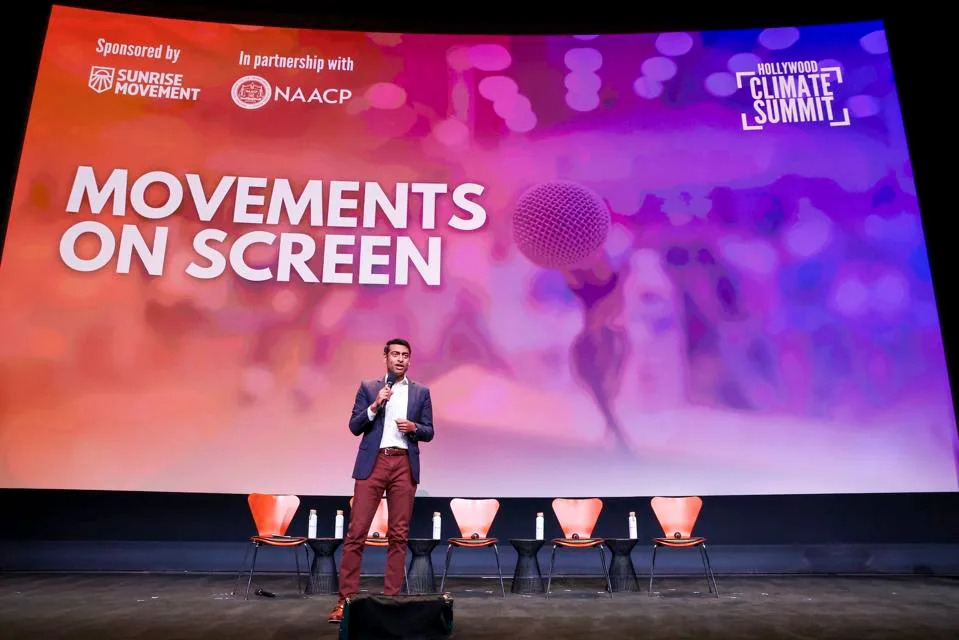
Steven Olikara
Chelsea Lauren / Shutterstock for Hollywood Climate Summit
Storytelling as a Counterweapon
If the division-industrial complex is the disease, Olikara believes storytelling is the cure — the oldest one humans have. Storytelling, and what researchers call narrative transportation, is “one of the only mediums that we have as a human race to truly connect with the lived experience and open our hearts to a human journey that’s different than our own.” Fear, he points out, is taught — the assumption that people unlike us want to destroy what we hold dear. A nuanced portrayal dispels it. You may still disagree with a character, but you can no longer pretend not to understand them.
Stories That Change Minds
The proof is on the screen. Bridge’s first project was a romantic comedy, “The Elephant in the Room,” from director Eric Bork, who realized that political difference had quietly become a real barrier to people falling in love. The film follows two people who connect, then discover they voted differently — and choose to go deeper instead of running.
Olikara points to a sharper, larger example in “Ted Lasso,” whose “be curious, not judgmental” became something close to a national catchphrase. It works the way an earlier campaign did when shows like “Cheers” slipped “designated driver” into the cultural lexicon and helped curb drunk driving. When the dystopian film “Civil War” was released in 2024, Bridge advised on the rollout, helping the cast point audiences toward real solutions; Olikara captured those conversations in a Variety piece, and watched actor Wagner Moura speak on CBS Sunday Morning about wanting to listen to people he disagrees with.
Underpinning the work are four research-backed principles Bridge unveiled at the 2026 Sundance Film Festival: curiosity, contact, complexity and good conflict. The last one matters most to Olikara, because his work is often mistaken for an aversion to tension. The opposite is true. “There is a difference between dead-end conflict and good conflict,” he says — the difference between characters locked in irreconcilable contempt and characters whose clash opens a door to understanding. He sees it in this summer’s “Spider-Man,” where Peter Parker keeps trying to find the humanity in his villain rather than write him off.
That principle extends to who gets portrayed, and how. Olikara, who grew up around Wisconsin’s farmland, bristles at how routinely rural America is flattened into caricature. His partnership with Land O’Lakes — the farmer-owned dairy cooperative, one of the country’s largest, best known for its butter — is built to fix that. “It’s personal for me to make sure that those stories are told with the care and humanity that they deserve,” he says — a standard he argues brands can meet too, both in the films they fund and the everyday Americans their advertising chooses to render with complexity instead of cliché. The industry is starting to notice. In the week before this year’s Oscars, Olikara was honored with the Common Ground Award at the Lumen Awards, which recognizes filmmakers and advocates using entertainment for impact.
What the Work Teaches
Olikara is clear-eyed about the difficulty. He likes to quote his mentor Eboo Patel of Interfaith America: “Bridge building is not rocket science. It’s much harder than that.” But the payoff, he insists, is visceral. When people who’ve been taught to hate each other find a genuine connection, “it’s like a real energetic release,” he says. “Wow, okay, this is different than what I’ve been told. It feels good.” The mistake, the one his jazz teacher warned against, is walking into the encounter trying to win it. Going in to convert the other person, he notes, “doesn’t work out very well.” You listen first.
His larger diagnosis is that the division machine has made every disagreement existential — and that once a political difference becomes sacred, people will rationalize almost anything to defeat the other side. The antidote is to keep reminding Americans, story by story, that the people across the divide are human. “We’re trying to figure out how to build the most diverse society in human history together, how to be self-governed as one people,” he says. “That’s going to take some real bridge-building skills.” He has seen the hope already, in person, across the country. The work now is to make the rest of us believe it — and the way to scale belief, he is certain, is through the stories we choose to tell.
This article was originally published on Forbes.com
‘ The preceding article may include information circulated by third parties ’
‘ Some details of this article were extracted from the following source www.yahoo.com ’